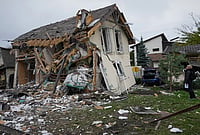
A magnitude-7 earthquake struck China’s Tibet region late Thursday, killing at least 16 people and injuring 54, according to official reports
The epicentre was near Maru township in Baqen county, about 190 kilometres east-northeast of Nagqu, the USGS said
The Nagqu media office said 339 homes and 20 livestock sheds collapsed, with search and rescue operations continuing through the night
At least 16 people were killed and 54 were injured after a magnitude-7 quake hit China’s Tibet region late Thursday, with hundreds of homes collapsing in Nagqu. The U.S. Geological Survey said the tremor struck at 10:33 p.m. local time.
USGS said the epicentre was 191 kilometres east-northeast of Nagqu in a sparsely populated, high-altitude area of northern Tibet, and it put the depth at 18 kilometres. Nagqu is more than 300 kilometres north of Tibet’s capital, Lhasa.
The National Centre for Seismology (NCS) on X said the quake occurred at 20:03:43 IST at a depth of 173 km, with its epicentre at latitude 32.368 N and longitude 93.853 E. Xinhua earlier said a level-II earthquake disaster emergency response had been activated in the area.
Xinhua also described broader damage across the area. Houses collapsed, rescue teams worked through the night, transport links were disrupted and emergency supplies were moved into the region.
Rescue Response
The Nagqu media office said 339 homes, along with 20 livestock sheds, collapsed in the quake, citing city government officials. Search and rescue operations are under way. A rescue team has been sent to the area, and authorities are still assessing the full scale of the damage. The local county has sent more than 1,600 people to assist with rescue work.


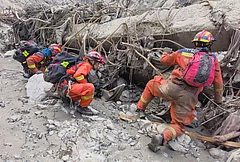
Xinhua reported that more than 300 police officers were dispatched for relief work, while the regional fire and rescue corps mobilised 347 personnel to the affected areas.
CCTV footage showed workers rushing out of restaurants and items falling from supermarket shelves as the quake hit. The broadcaster also showed rescue workers moving through damaged buildings with collapsed roofs, carrying one person and shining flashlights on other damaged structures, while soldiers lined up for deployment.
Supplies including 1,000 prefabricated housing units, about 3,000 tents and folding beds, plus flashlights and winter clothing have reached the region. Xinhua said communication has been cut in part of the area. Local railway authorities halted trains through the region as an emergency step. Rockfalls from the quake led officials to close a stretch of National Highway 317, leaving it open only to emergency, rescue and official support vehicles while crews cleared debris, Xinhua reported. Intermittent snow is expected over the next three days in the quake zone, Xinhua reported. CCTV said it was the biggest earthquake in the region in five years, and the broadcaster said a level-III earthquake disaster emergency response was also activated.
Damage And Injuries
Casualty figures vary across official reports.
Xinhua reported that 16 people were killed and 32 injured after the 7.0-magnitude earthquake hit Tibet late Thursday, October 22, 2026. Livemint earlier put the injury count at 54.
Of those injured, 11 were in serious condition and 21 had minor injuries, the Nagqu media office said, citing city government officials. Search and rescue continued after at least 339 homes collapsed.
USGS put the epicentre in a mountainous area about 190 km east-northeast of Nagqu and 390 km northeast of the regional capital, Lhasa. It said the quake struck at 10:33 p.m. local time, or 1433 GMT. A later update in the brief also said the tremor was shallow, at a depth of 10 km.
The epicentre was in Maru township in Baqen county. Township deputy head Lhawang Dagpo said the quake was clearly felt at the township office, which developed cracks in its walls, according to Xinhua. Xinhua said the county seat also saw disruptions to power and telecoms services.
Regional Earthquake Context
Strong earthquakes are common in China.
In January 2025, at least 126 people were killed in an earthquake in Tibet’s rural Tingri county. In December 2023, a quake in remote Gansu province in northwest China killed at least 127 people, according to state media.
That Gansu quake was China’s deadliest since 2014, when more than 600 people died in the southwestern province of Yunnan. A huge tremor in Sichuan in 2008 left some 90,000 people dead or missing, including around 5,000 schoolchildren.
CCTV said Thursday’s quake was the biggest in the region in the last five years.