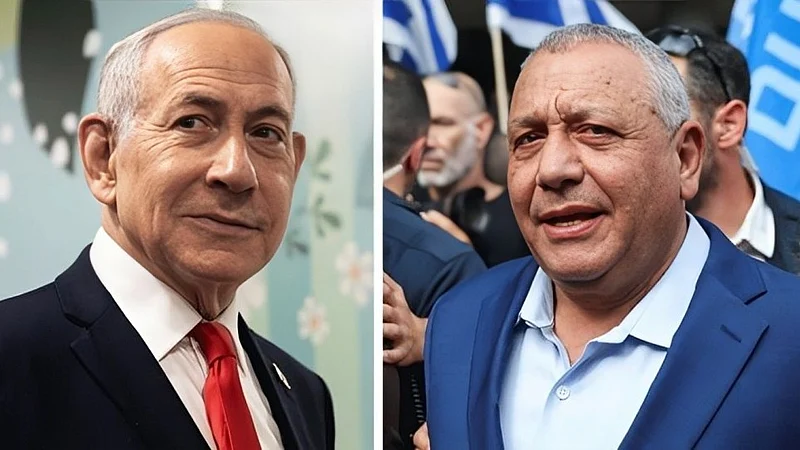
Netanyahu offers Eisenkot the first term as Israel's prime minister.
He proposes a rotation arrangement in a unity government.
Neither political bloc secured the 61 seats needed for a majority.
Israel’s Prime Minister Benjamin Netanyahu has confirmed that he is willing to allow Yashar party chairman Gadi Eisenkot to serve first as prime minister in a unity government. He has offered this as a rotation arrangement in which he will become PM after Eisenkot.
Netanyahu said he believed he should lead a unity government as the head of the largest party. However, he was willing to give up that position because of the security threat facing Israel.
He also said he was ready to let Eisenkot serve as prime minister first, while he would take the role of alternate prime minister at the start of the government's term.
In a post on X, he wrote, “Given the magnitude of the existential threat and the possibility that a government could be formed that lacks the ability to confront it, my responsibility as a leader requires me to set everything aside, including the principle that the largest party should lead, and agree that Gadi Eisenkot will serve first as prime minister, while I serve as alternate prime minister at the beginning of the term.”


Yair Golan Slams Netanyahu
Netanyahu's announcement came after speculation in recent days that he would agree to take the second turn as prime minister of Israel under a rotation arrangement.
However, Yisrael Beytenu leader Avigdor Liberman had dismissed the possibility, calling such an announcement “nothing more than a political maneuver”.
Democrats chairman Yair Golan was the first to react on Saturday evening. He said, “Enough with the tricks and games. Netanyahu lost. It is our duty to respect the will of the voters and establish a government of change and recovery.”
Netanyahu’s Likud-led alliance won 53 seats in the 120-member Knesset, falling short of a majority. The bloc backing Eisenkot secured 48 seats, while Arab-led parties won 19. Neither side has enough support to form a government on its own, as 61 seats are needed for a majority.