Padatik explores the life of one of Indian cinema’s most influential filmmakers.
Chanchal Chowdhury anchors Srijit Mukherji’s ambitious take on Mrinal Sen.
The film brings Sen’s personal life and cinema into fascinating conversation.
It is almost funny that a film about Mrinal Sen begins with nostalgia. Here was a filmmaker who had little patience for looking backward, yet Padatik finds him in old age, struggling with memory and slowly returning to pieces of the life he had spent years moving away from. Srijit Mukherji's fictionalised biography understands that contradiction and builds much of its charm around it. Sen may not have liked nostalgia, but his films carried memories of freedom, poverty, politics and a city that was constantly changing around him.
The film does not attempt to present his entire life in a neat chronological line. Instead, it moves between different periods, using fragments of his personal and professional life to build a picture of the man. We see the struggling filmmaker, the medical representative trying to survive, the husband dealing with poverty and the obsessive artist who simply cannot stop thinking about cinema. It is less interested in ticking off achievements than in understanding what drove him to keep making films when there were very few reasons to believe he would succeed.
That struggle is perhaps the most interesting part of Padatik. Mrinal Sen's problems feel surprisingly contemporary. The idea of a filmmaker trying to make the kind of cinema he believes in while worrying about money, survival and whether anyone will watch it has not disappeared. The technology has changed, but the anxiety has not. There is something almost painful about watching a young Sen fight for every film, every idea and every shot he believes needs to exist.


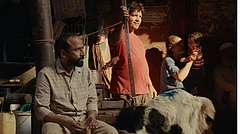
Korak Samanta is excellent as the younger Sen. His performance captures the internal storm of a young man who is simultaneously convinced he has something important to say and terrified that he may never get the opportunity to say it. One of the film's most striking moments shows Sen confronting his own failures in front of a mirror. It is uncomfortable to watch because the desperation is so exposed, but Samanta never turns it into melodrama.


The fourth-wall breaking works particularly well because it acknowledges the artificiality of the exercise. Sen looks at us and effectively reminds us that we are watching someone else's interpretation of his life. That self-awareness fits the portrayed filmmaker. It is Srijit Mukherji engaging with one of his cinematic heroes and finding his own way of approaching him.
The most impressive device in the film, however, is the constant conversation between Sen's life and his cinema. Scenes from Bhuvan Shome, Baishe Shravan, Neel Akasher Neeche, Mrigayaa and other films are brought into the narrative without feeling like obligatory references for cinephiles. They become extensions of the man's experiences. The cuts between recreated moments from Sen's life and images from his films are often beautiful because they suggest that the two could never really be separated.
This becomes especially powerful when the film explores poverty. Sen and Geeta struggle financially, yet cinema remains an almost unreasonable priority for him. He can be selfish and absent as a husband and father while remaining completely consumed by the work. Monami Ghosh brings warmth to Geeta, giving us a sense of the woman who had to live with the consequences of her husband's obsession. Their marriage is not presented as a perfect partnership. There is affection, frustration and sacrifice in equal measure.

Chanchal Chowdhury's older Sen is the film's biggest triumph. He does not merely imitate the filmmaker's appearance. The posture, glasses, clothes, gestures and manner of speaking all contribute to the performance, but it is the attitude that makes the transformation convincing. Chowdhury makes Sen feel like the grandfather you have grown up watching in every Bengali household, rather than a figure recreated for a biopic. He is argumentative, funny, stubborn and occasionally difficult. Most importantly, he feels like a man who has spent his entire life refusing to behave according to expectations.

The supporting cast strengthens that illusion. (Jeetu Kamal's) Satyajit Ray brings an interesting tension to their relationship while other appearances from people in Sen's artistic circle add texture to the world around him. The Ray-Sen equation becomes increasingly important as the film progresses, and at times Padatik appears to drift towards Ray when its real subject should remain Sen. The friendship and intellectual rivalry are fascinating, but the film spends more time on them than perhaps it needs to.

Ritwik Ghatak's presence and eventual death also carry emotional weight, particularly because the film places these towering figures within the same fragile world. They were celebrated artists, but they were also people dealing with insecurity, disagreement, money, and mortality.
Indranath Marik's cinematography makes the past particularly striking through its black-and-white imagery. The visual shift between monochrome and colour gives each period its own identity without making the film look like a museum piece. The editing is similarly energetic. Srijit keeps the film moving through jump cuts, archival material, film excerpts and recreated scenes. At times it feels almost too fast, as if several years of Sen's life are being compressed into a handful of moments, but the pace also reflects the restless nature of its subject.
The documentary-style inserts are another smart touch. They bring a sense of uncertainty to the filmmaking process and remind us that cinema is built on anxiety as much as inspiration. Sen's journey is not romanticised into the story of a genius who always knew where he was headed. He spent years struggling to find his voice.
That is ultimately what makes Padatik work. It understands that Mrinal Sen's greatest achievement was refusing to stop fighting for the cinema he believed in. There are places where the film becomes too eager to cover ground, and the later focus on Ray slightly unsettles its center. Yet the affection behind the project is unmistakable.


Srijit Mukherji has made a film about a filmmaker who hated standing still. Perhaps that is why Padatik itself refuses to sit comfortably inside the conventional biopic. It is messy, restless and occasionally contradictory, much like the man it tries to remember. And for a filmmaker who spent his life asking audiences to look at the world differently, that feels like an appropriate tribute.