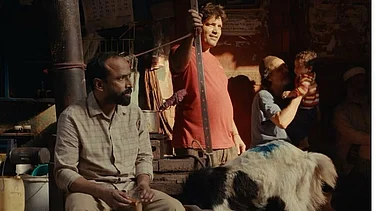
Lav Diaz's latest, Let Us Through, Dear Ancestors, premiered at the Venice Film Festival.
It screened Out of Competition at the 83rd edition.
The black-and-white period drama revisits the origins of the Spanish colonisation of the Philippines.
Savagery was often the operative word tossed by colonisers across the breadth of history to justify their takeovers. The coloniser is orchestrating a civilising mission, to bring light, wisdom and opportunity to the indigenous. What ends up happening instead is extraction, occupation and just shameless land grab. Premiering at the Venice Film Festival in an Out-of-Competition slot, Filipino slow-cinema giant, Lav Diaz’s latest, Let Us Through, Dear Ancestors, is one of his trimmest outings yet. It carries forward the enquiries of his previous, Magellan, couched in a similarly clipped duration. Diaz’s gaze, however, is as probing as ever. This film is more pare-down though the visuals embed a deceptive evocation of scale.
Religious conversion, taking forth the coloniser’s expansion, is once again at the skewering end of this 17th century window into the setting up of the Spanish dominion in the Philippines. Diaz shifts among a vast panoply of characters, refraining from too-specific characterisation but anchoring just enough motivation to weave the ensemble into a matrix of loaded power dynamics. A hierarchy is being built and those challenging it won’t be tolerated. Perhaps the character here that instantly and most vividly gets drawn is Padre Enciso (Bart Guingona), who’s very eager about doing the bidding of his Spanish masters. He’s assembling delegations of local men to lay the groundwork for a grand Catholic church, whose consecration will officially cement the Spanish conquest. Padre’s ambition, desperate and thrusting, is ready to wipe out all opponents, hurdles and antagonism.




Unfolding Let Us Through, Dear Ancestors never shies from calling out the massive rot, the duplicity, the avarice, the brazen exploitation of the Filipinos, their entrapment within the coloniser’s undertaking that’s powered by a proselytising mission. The friar has zero qualms about his reprehensible behaviour. He’s determined, greedy, nasty, throwing his weight around and acting like the inveterate owner of the land. He will have his way, come hell or high water. For that, even if it requires razing through the inhabitants, he isn’t going to soften or retreat. Once you see power coming in your clutches, the intoxication wreaks havoc and misery, ringing across divisions. Enciso swoops into play several simultaneous assignments. Chief among them is also the capture of a well-known local healer, Babayeng (Isabel Sandoval). She represents the older, ancient, rooted philosophy of the island. The community believes in her. Naturally, she’s a source of consternation for Padre. He has her imprisoned, cut off from the locals. She’s key to the animistic rites and beliefs of the islanders. The priest warns the women against these paganistic ritual, establishing the particular order that’ll be permitted.
Enciso goads the architect, Alejo Smith (Daniel Palisa), to pursue illicit relationships and force his way with the local women, as he is infamous for. Elsewhere, the women tittle-tattle and snigger about Enciso’s penis, his unslakable sexual appetite. There’s no shame, just a bitter recognition of how Enciso has seized on taking unfair advantage of the situation. Most of the men in the villages are dying and disappearing. Padre has no compunctions. He’d like to be more busy organising forced labour of the Filipinos to ferry raw material for the church’s foundations than allow any tenderness for his brood of children with the local women, none of whom excite the slightest empathy in him. The friar just blithely exhorts Smith to take women. Enciso has long waived off his morality, ditching it in the quest for power. The total indifference he has for his illegitimate kids is echoed by the disgust they hold for him. Enciso coerces one of his unacknowledged sons, Dungwen (Christian Bables), to steer the latest marble delivery expedition. Dungwen spites him but Enciso has his wife and kids at severe stake.

In Let Us Through, Dear Ancestors, invocation of ancient spirits, beseeching cries for redemption contend with all the rampant pillaging, several vested parties clashing to snatch greater profits. A notorious bandit, Bari Bari (Yul Servo), also portends to be a menace. His skirmishes trigger a lot of narrative spiralling, though Diaz always draws the thread back to an elemental greed that leaves no one unscathed.

Diaz doesn’t spare detail of the colonial machinery, how it trickles down to the grassroots and absorbs all in a cesspool of utter barbarity. The interface is sharply put into focus as deeply linked to the Catholic imposition. The filmmaker is attentive to how empires carry out their vast projects with foot-soldiers who deploy their brains and brawn across religious lines. Religion is the great fodder upon which wars and violence are fed. In vast monochromatic compositions lensed by Diaz himself, the film locates the churn of plundering missions, its spilling chaos and confusion and devastation. Relationships are cast into abeyance in its wake.
Let Us Through, Dear Ancestors also culls drama and intrigue aplenty from ambushes, though Diaz’s cutting is hyper-wary of the slightest elevated register. The film unfolds as an elegiac, sighing observation of entire landscapes and cultures under siege. Violence erupts, a long trail of loss and sorrow washing over doomed journeys. With sombre gravity, this film from one of our great masters captures in pitiless terms the reach and debris of colonialism.