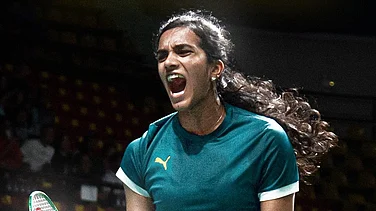
France created history by winning two World Championships gold medals in a single day
Thom Gicquel-Delphine Delrue and Alex Lanier delivered the country's first-ever world titles
A 45-year investment in infrastructure and player development has finally paid off
Twice on Sunday, the French anthem played inside the Indira Gandhi Indoor Stadium. Twice, a Chinese or Japanese flag hung a step below the tricolour. By the time the second podium ceremony ended, the French team had stopped pretending the champagne bottles they had packed for Delhi were merely for luck. They finally had a reason to pop them.
France had never won a badminton world title before this week. It left New Delhi with two, won an hour apart, on the same afternoon.
Thom Gicquel, 27, and Delphine Delrue, 27, struck first, outlasting China's top seeds Feng Yanzhe and Huang Dongping 22-20, 19-21, 21-15 in a three-game battle that swung deep into a decider. Alex Lanier, 21, followed, beating Japan's Kodai Naraoka 21-11, 21-11 in straight games.
Together, they turned a line that would once have sounded like a joke into Sunday's biggest badminton story – two golds, in a single day, at the expense of Asia's badminton powerhouses.
Not since 1983, when Denmark and a Sweden-England pairing combined for two golds between them, had Europe walked away from a World Championships with two titles. France had just matched that feat on its own.



How Did The French Do It
France's badminton story did not begin this week, or even this decade. The French Open dates back to 1908, one of the sport's earliest competitive fixtures anywhere in the world. France was one of nine founding nations of the International Badminton Federation in 1934. For most of the century after that, the sport stayed a fringe pursuit run out of local clubs.
The real shift came in 1980.
"Well, the process started a long time ago. In 1980, we started the process to produce the performance centre in France. It was the first national centre. Before that, it was just the club. Later, we built two other national centers for the young players, and later on, we got nine regional centers for the youngest. And also, we started working with 60 clubs, approximately, around the country," said Cyrille Gombrowicz, the French federation's technical director.
That structure has since scaled into something bigger. Somewhere between 100 and 120 coaches now work at the high-performance level, backed by data tracking and training-load management that simply did not exist in French badminton a generation ago.
Sports science sits at the centre of that shift, and it is used less for recovery than for planning. "It doesn't help to recover, but it's helping to plan and to be smart during the year. It's not something that helps you for just the day, but to think about what we did for the last year or the year before and to anticipate what is going to happen in the future," Gicquel said.
Gombrowicz coached through the leaner years himself. He remembers Erwin Kehlhoffner losing to China's Chen Jin at the 2008 Olympics, back when the national team had almost none of this infrastructure behind it. Even he did not see Sunday coming quite like this.
"Two titles the same day, it's incredible," he said.
"We had thought we were going to win medals but maybe a bronze. Because at this moment we are competitive only in two events, men's singles and mixed doubles. We worked hard step by step and now we have arrived for the first world title."
The signs had been building before Delhi. Christo Popov won the World Tour Finals last year. Lanier took the European singles crown. The men's team took Thomas Cup silver earlier this season. Two golds did not come from nowhere.
India, as it turns out, has a habit of showing up in this story. France's first World Championships medal was also won on Indian soil, when Pi Hongyan claimed bronze in women's singles at the 2009 edition in Hyderabad, the first time the tournament was hosted in the country. Sixteen years later, Gicquel and Delrue added a second medal with bronze in Paris.
Then, in Delhi, India delivered again, only this time, it was two golds in a single day.
Gombrowicz is still not calling France a finished product.
"China, Japan, Korea, Indonesia and Malaysia have players capable of competing across multiple events. France does not yet have that depth. For the French system, we need to put more players in the top 30, and a lot of different events. If we want to be a strong, strong country in badminton, it's a first step. But we have the ambition to go higher," he said.
The Making Of Alex Lanier
Lanier does not talk about Sunday like a player who peaked out of nowhere. He talks about it like a phase of his career finally paying off.
There is a certain nonchalance to him, the kind that seems to come easily to French athletes in sports that don't make front pages back home. He does not chase recognition, and he seems entirely at ease with the idea of staying underrated, even now, even as a world champion.

"It's never easy in men's singles to win the title. It's also extremely tough mentally and physically. Especially for that tournament we prepared extremely well. We trusted that I had the tools and I needed to use the tools," he said.
"Definitely Singapore was important for me to win earlier in the year. I got a lot of experience with the win conditions and how to manage all these tough moments, and I used all that experience for this tournament also."
It was not always this serious. At three, he says, he was not thinking about titles at all, just enjoying the game with friends and family. That changed when he met coach Kestutis Navickas, who has now guided him for almost five years.
"He's very strong. He is stronger than other kids of the same age. It's easy to identify this. After, it's harder to propose a good environment, a good team around him," Navickas said of spotting him early.
A club in Normandy gave way to the regional centre in Caen, then to INSEP, the national institute in Paris where France trains its best. The partnership with Navickas has not been a straight line since.
"There are a lot of good days, bad days. What makes the most important is the trust and the belief in the process," Navickas said.
Lanier, for his part, was not playing purely for himself on Sunday. He had watched Gicquel and Delrue win France's first-ever world gold hours earlier, and it changed something in him.
"I saw the mixed doubles team winning. Everyone was happy, and I was like, I need to win also," he said.
"Today, it was the day for France. And when the mix won, everyone was happy, and I just thought that I needed to give them a double smile, a double moment. And I needed to make history again."
His build has become part of the story too, and he does not shy away from why.
"My parents were sailors. I have also good genetics, my father is also very strong. But I think we are working quite a lot on that. It's my strength, so I need also to break the limits of my physicality. I would say I'm a hard worker in general. I like to push myself during the practice, and I like that since I'm a child," Lanier said.
The Golden Doubles Pair
If Lanier is the system's prodigy, Gicquel and Delrue are its proof of concept. A year ago, they won bronze at the World Championships, the first medal France had produced entirely through its own pathway, no imports, no players developed abroad. On Sunday, that bronze turned gold, and they got there first, with an hour to spare before Lanier's own final.

There wasn't a single Indian player left in either final by the time Sunday came around. It didn't matter. The stands stayed full and loud through both matches, the crowd cheering on whoever was on court regardless of the flag.
"We are really, really happy, really proud. It's amazing. Like 10 years ago, no French player can think about that. We are really proud, and also really a bit stressed, because Alex maybe can win the first one in one hour, so we had to win this one," Gicquel said, laughing.
The federation paired them as teenagers, and the results kept them together.
"We started to play together when we entered the National Center at 17. The federation wanted a young pair that plays a long time together, so they said, 'Okay, you will play with Thom.' We made good results at the beginning, so we keep playing together," Delrue said.
Belief did not arrive all at once. It built one result at a time, backed by a federation that started putting real money behind the sport.
"We had a good group when we were young. We won a lot in Europe, and that mentality helps a lot when you come into the world stage. The federation put more money, more involved, for us to be better. That helped us to grow. Now the sport is very professional in France," Delrue said.
"When we won our first Super 100 at 19, we believed that we can do something and earn some money also, because when you start there is no money," Gicquel added.
"And then the first time you beat a top five pair, I think it was Yuta Watanabe and Higashino, it's quite slowly, you just make steps and steps and you're closer and closer, and at the end, you believe."
There was no time for a big celebration in Delhi. A flight to Hong Kong was waiting that night, with a proper meal saved for the next day.
Asked what the best and worst thing about each other is, Gicquel didn't need to think long.
"The best thing of Delphine is that she hates to lose. And the worst thing is that she hates to lose," he said.
Badminton’s Popularity In France
The win reached further than the badminton world by nightfall. French President Emmanuel Macron posted his own reaction online, "Thom Gicquel and Delphine Delrue are world champions in mixed doubles badminton: a first for France! Bravo to our two champions!"
A presidential shoutout is rare territory for a sport that has spent decades in the shadow of football and rugby back home. The players themselves are under no illusions about what it will actually change.
"We will be welcomed like nobody knows us. There will be nobody waiting for us, I think. We are really good in so many sports that I think a lot of people will start to follow us and follow badminton, so that's amazing. But it's not like football or basketball or anything, so we hope that thousands of people will wait for us, but it's not going to happen," Gicquel said.
Lanier expects the same anonymity, and he is at peace with it.
"Probably I'm going to walk in the road and nobody cares. I'm also fine to be in France and not to be known that much, and to enjoy a little bit my life. But badminton is getting stronger and more famous in France, so I believe more people are going to watch and know badminton. I think it's going to be a little bit of a storm in France for a few weeks. And I think it's also our role to make badminton bigger in France," he said.
That storm has already started building. France now counts roughly 250,000 licensed badminton players, a number that keeps climbing every time the national team delivers a result worth talking about. Navickas sees the two feeding off each other.
"The popularity is growing because the results are getting better. Those results, they are just giving the belief to the whole badminton community also that helps to attract the talents and then the system hopefully can make the talents better and better," he said.
No one may be waiting at the airport when the French team lands. But there is a national federation that has spent forty-five years building toward exactly this, a badminton scene that is only getting bigger back home, and two new world champions who now have to decide how to follow this up.
Badminton in France, for the first time, has a result loud enough to be heard over football and rugby anyway.