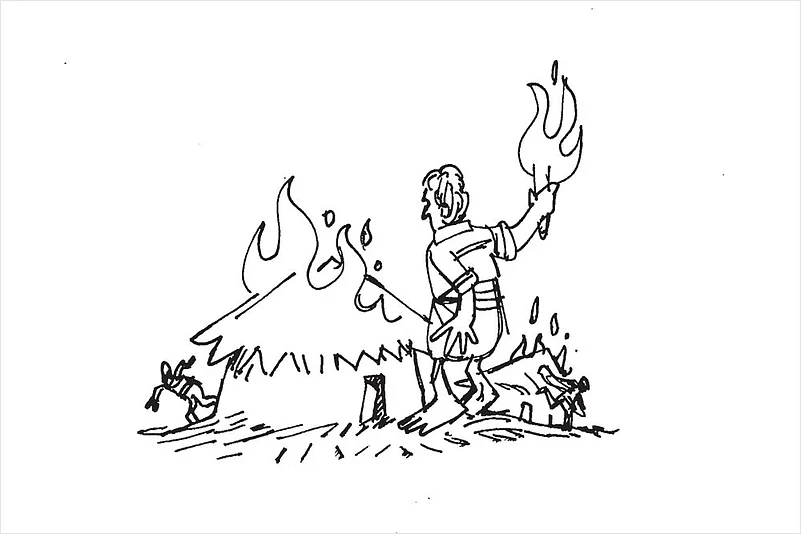
Whenever a strife takes place in Tamil Nadu—religious or caste-related—a cry usually rends the air: ‘What is happening to our Garden of Peace’? That the Tamil land is a garden of peace is well-engrained in the minds of most of its people who look upon the communal and caste-related violence that bedevils north India with barely concealed contempt. But every one of them, barring a hopeless minority, have in them an inalienable religious or caste identity, or both, which they will defend with a surprising vehemence. I have seen docile Iyengars going red in the face and gnashing their teeth whenever they feel that their Iyengar-hood is being insulted. Similarly, it will be impossible for anyone, when Thevars are around, to say a word against Muthuramalinga Thevar, a formidable caste icon, and get away with all limbs intact. Aggressive posturing by Hindu, Christian and Muslim ideologues on TV channels is a routine, daily occurrence. The disdain most non-Dalits have for the just struggles of the Dalits is monstrously and demonstrably callous. A keen observer visiting Tamil Nadu will discern without much difficulty that a core of sectarian fire burns inside almost every Tamil, notwithstanding his or her sanctimonious protestations and that its heat is present in even routine discussions on religion and caste.
The fire, seemingly undiminishable and eternal, has a long history.
Sangam age, immediate years
The Sangam poems, especially the Puram poems, resound with violence, but it is of a tribal variety rather than a religious or caste one. In the years immediately following Sangam age too, religious strife appears to be absent. The lovely epic, Silappadikaram, written by a Jain monk, has many passages in praise of Vishnu and other Hindu gods. Its sister epic, Manimekalai, a Buddhist classic, depicts a world where scholars discuss weighty philosophical issues with their swords firmly in the scabbards. Later, when Pallavas ruled Tamil Nadu, the rivalries appear to be non-violent. The bawdy Sanskrit classic Mattavilasa Prahasanam makes ample fun of the Kapalika and Pasupata sects of Shaivism, as also Buddhism and Jainism. The other work, Bhagavatajjukam, is a farce on Buddhism from the Brahmanical point of view. Violence is absent in both of them.



Bhakti movement and heretical religions
While the Tamil land is littered with remnants of the Jainism of earlier years of the common era, there is no significant epigraphic or archaeological record of Buddhist presence during that period. The earliest Buddhist structure that has been unearthed in Tamil Nadu is from the 4th or 5th century AD. There is currently a revisionist attempt to establish that Buddhism was a thriving religion in the Tamil country before the Bhakti movement systematically annihilated it, but it is based more on wishful thinking than on solid historical evidence. The Bhakti poems do rile against Buddhism, but their main target is undoubtedly Jainism.
The Kanchipuram temple panel
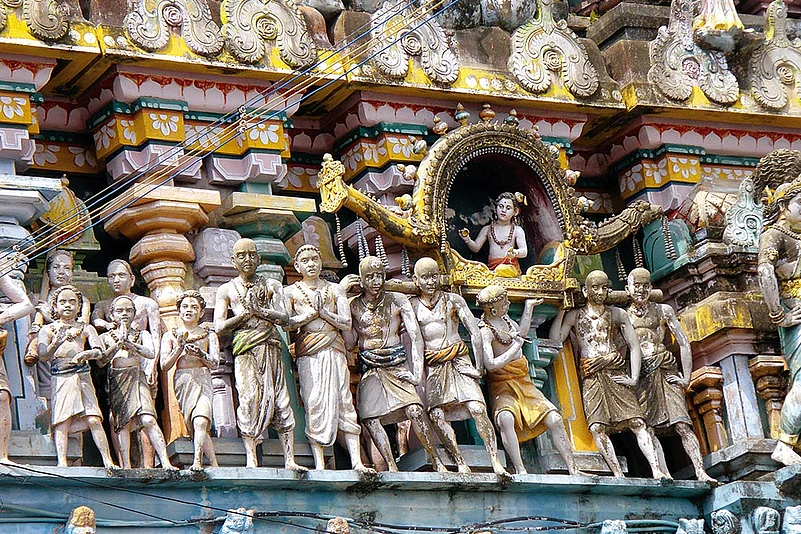
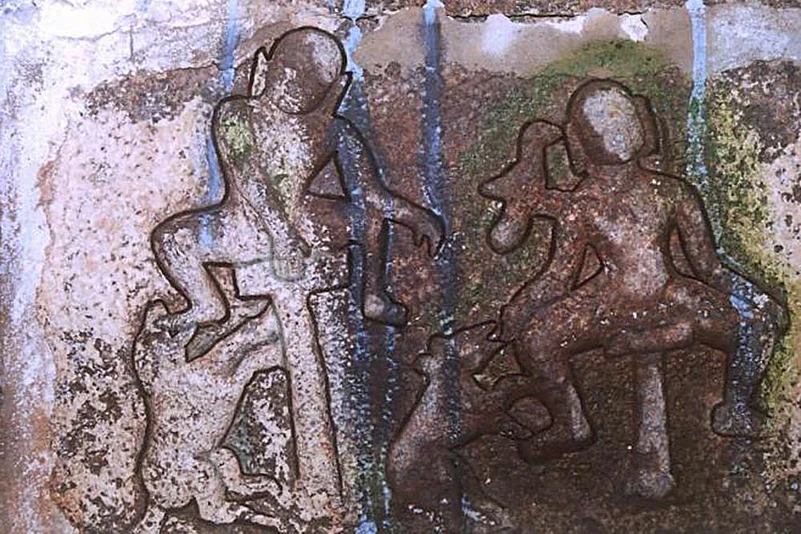
There is a panel in the Vaikuntha Perumal Temple in Kanchipuram built in the 8th century AD that depicts two persons impaled, one upside down, in the presence of the king, probably Nandivarman Pallavamalla. Though this signifies the stern rule (danda) of the king, it brings to the viewer’s mind a persistent myth about the impalement of Jain monks and in fact is being cited in some quarters as proof of the terrifying penalty that awaited the followers of heretical religions of Buddhism and Jainism. According to this myth, which originated in the 11th century, the Shaiva boy saint, Sambandar, who prospered in the 7th Century AD, defeated 8,000 Jain monks in debate and caused them to be impaled in the city of Madurai. Most historians reject this event as ahistorical. But a few Tamils insist that the genocidal story is true. That even the Jain sources do not speak about the event or that the Jains were thriving long after the supposed mass impalements do not seem to deter them. It was quite possible that incidents of violence against the Jains did take place, but there is no credible evidence that there were systematic pogroms to eliminate them. Jainism disappeared from Tamil Nadu primarily because the kings and the rich merchants switched over to Shaivism and Vaishnavism. The wars between the Jains and the savants of Bhakti continued mainly on the intellectual plane.
Killing of Vaishnavas
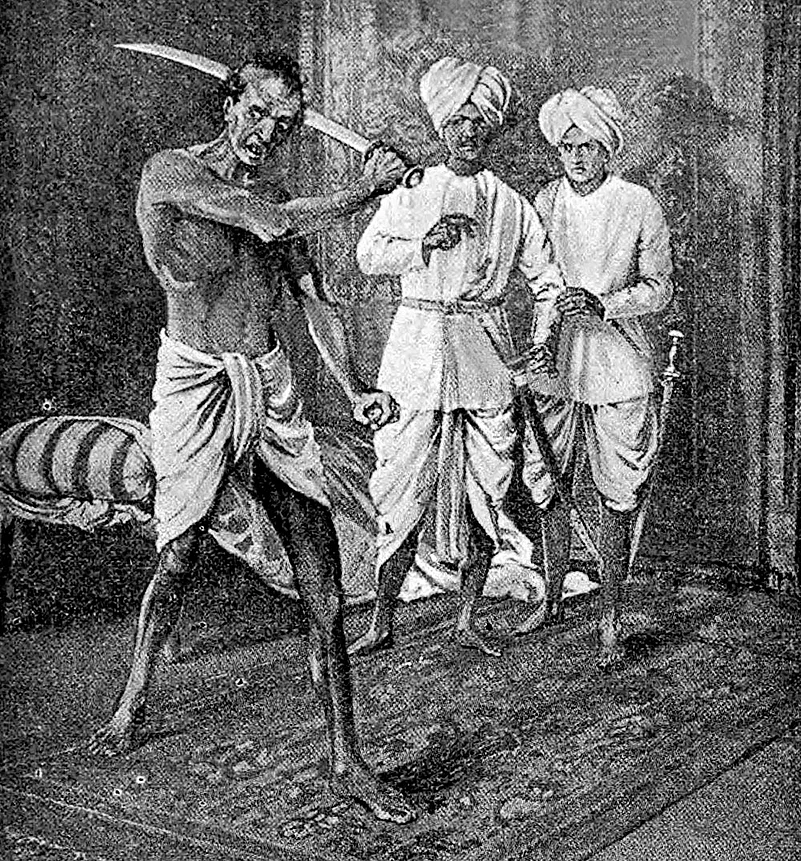
The Islamic invasions in the Tamil country took place in the first half of the 14th century. The first invasion by Malik Kafur weakened the Pandyan rule. The second one by Ulugh Khan resulted in Muslim rule in a large part of Tamil Nadu that lasted for about 50 years. There were widespread killings during this time. Even Islamic historians and travellers attest to them. Kovilozhugu, the temple chronicle of Sri Rangam in Tiruchirappalli, records that some 12,000 Vaishnavas were beheaded by the invaders. The later Vaishnava hagiographies of their acharyas also speak about the prevailing violence and the removal of the idol of the Lord Ranganatha from the temple to safeguard it against the invaders. Though the number of 12,000 appears to be an exaggeration, there is a distinct possibility that mass killings had taken place.