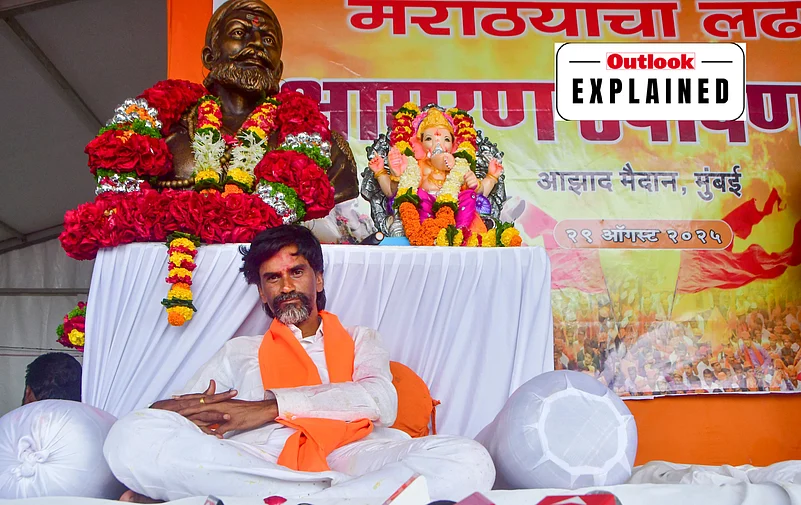
Jarange called off his 20-day hunger strike on Thursday after talks with a Maharashtra government delegation, giving the government three months to act on his demands.
His central demand is for eligible Marathas with historical Kunbi links to receive Kunbi certificates and access OBC reservation benefits.
Jarange rose to prominence during the 2023 Maratha quota agitation and has since led multiple hunger strikes and mobilisations over reservation-related demands.
Maratha quota activist Manoj Jarange-Patil on Thursday, September 17, called off his 20-day indefinite hunger strike after the Maharashtra government sought three months to address his demands. The decision came after a government delegation met him at Patoda in Beed district early in the morning.
Jarange said the fast was being suspended, not the agitation. He gave the government 90 days to issue the required government resolutions and implement measures related to historical records. He also sought a written assurance that none of the nearly 58 lakh records identified in the process of establishing Maratha-Kunbi links would be deleted. He warned that he would take the agitation to Mumbai if the government failed to act.
The latest protest was Jarange’s 11th agitation in three years, underlining how central he has become to Maharashtra’s long-running Maratha reservation movement.
Who Is Manoj Jarange?
Jarange comes from Matori village in Maharashtra’s Beed district and grew up in a farming family. He completed his schooling in the village but left before finishing Class 12, according to The Indian Express. He later moved to Shahgad in neighbouring Jalna district, where he worked at a hotel and a sugar factory and also cultivated land.


His activism around Maratha issues predates his emergence as the movement’s most recognisable face. Jarange was associated with the Congress at the local level before leaving politics. In 2011, he founded the Shivba Sanghatana, an organisation focused on Maratha community issues.
He became a major figure in the reservation movement in 2023, when his hunger strike at Antarwali Sarati in Jalna district drew statewide attention. A police-protester confrontation at the site on September 1 that year further intensified the agitation and brought Jarange into the political spotlight.
Since then, hunger strikes, marches and negotiations with successive Maharashtra governments have become the principal methods through which he has pursued the reservation demand.
What Is The Maratha Quota Movement About?
The Maratha community has traditionally had a significant presence in Maharashtra’s agriculture, politics and public life. Sections of the community, however, have argued that economic distress, unemployment and limited opportunities in education and government employment have increased the need for reservation.
Maharashtra introduced a separate Maratha quota in 2018. The law was challenged, and in 2021 the Supreme Court struck it down, holding that the circumstances did not justify exceeding the 50 per cent reservation ceiling.
This legal history is central to Jarange’s present strategy.
Why Does Jarange Demand Kunbi Certificates?
Jarange’s principal demand is that Marathas who can establish historical documentary links with the Kunbi community should be issued Kunbi certificates.
Kunbis fall under Maharashtra’s Other Backward Classes (OBC) category. Eligible Marathas recognised as Kunbis can therefore access benefits available under the OBC quota.
The movement has focused on historical records, including the Hyderabad Gazetteer and records connected to the former Satara and other princely states. Jarange has also sought implementation of the government's decisions concerning Sage Soyare, which concerns eligible blood relatives of people recognised as Kunbis.
His demands have additionally included action on cases filed against Maratha protesters and assistance or jobs for families of people who died during earlier agitations.
Why Does Jarange Matter?
Jarange’s influence comes largely from his ability to mobilise Maratha supporters through prolonged hunger strikes and mass demonstrations rather than from holding elected office.
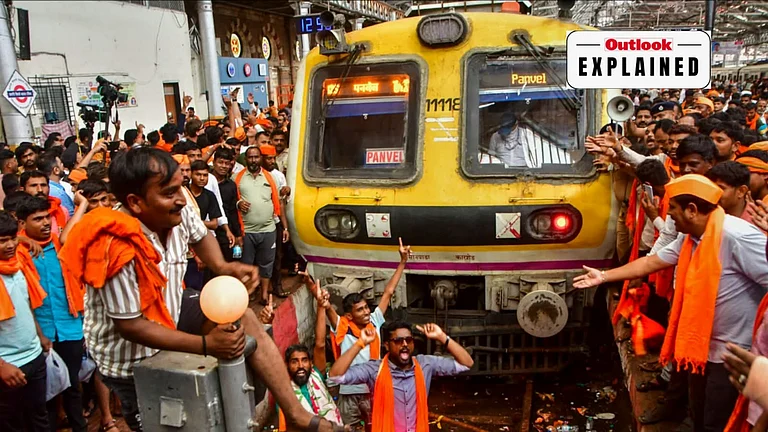
Jarange went to Mumbai in August 2025, leading thousands of Maratha supporters to Azad Maidan for another indefinite hunger strike. Beginning on August 29, the protest centred on demands for Kunbi certificates and reservation benefits for eligible Marathas. The mobilisation came amid new rules limiting protests at Azad Maidan to 5,000 people, while Mumbai Police estimated that nearly 40,000 people could participate. The Bombay High Court subsequently directed that the agitation be confined to the designated protest site, amid concerns over disruption in the city. Jarange continued his fast for five days before reaching an understanding with the Maharashtra government on key demands and calling off the protest on September 2.
In his latest agitation he had planned a march towards Mumbai and an indefinite fast at Azad Maidan, but the plan changed after the early-morning talks at Patoda. The government delegation — including ministers Radhakrishna Vikhe Patil and Dada Bhuse, BJP MLA Suresh Dhas and BJP MLC Prasad Lad — sought three months to address his demands.
Jarange has now returned the issue to the government’s court. He has said that if the promised measures are not implemented within 90 days, the agitation could move to Mumbai again.
After ending his fast, he left Patoda for a private hospital in Chhatrapati Sambhajinagar, where he has received treatment periodically during his years of activism.
The three-month window could therefore become another important chapter in Jarange’s continuing campaign — one that has transformed a grassroots activist from Beed into the most prominent face of Maharashtra’s Maratha quota movement.