India’s semiconductor programme entered its second phase with a $13.5-billion target.
Modi said India was moving towards commercial production and value-chain integration.
SEMICON India brings together 600 companies and representatives from 52 countries
Prime Minister Narendra Modi on Thursday said India’s semiconductor programme had entered its second phase, with a target of $13.5 billion, as the country shifts towards commercial chip production and deeper integration across the value chain.
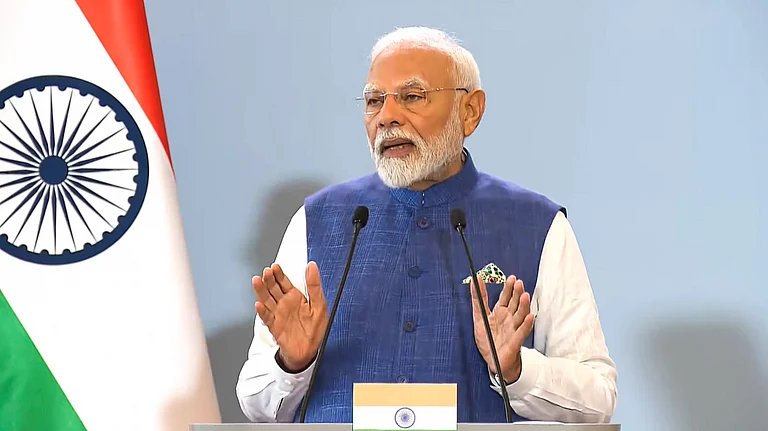
Addressing SEMICON India 2026 at Yashobhoomi in New Delhi, Modi outlined the government’s plans for semiconductor manufacturing, chip design, advanced technologies and workforce development. He said India had achieved in four years what generally takes countries a decade.
“India has launched the second phase of its semiconductor mission. While the first phase was valued at approximately $8 billion, we have set a target of $13.5 billion for the second phase,” Modi said.
He described semiconductor development as a “never-ending journey” and said global participation at the event reflected increasing confidence in India’s chip ecosystem.
SEMICON India 2026 is being held from September 17 to 19 under the theme “Silicon to Systems: Building the Ecosystem”. The event has brought together more than 600 companies and representatives from 52 countries.
'Reform Express'
Modi said the government had introduced further reforms to encourage collaboration between international companies, Indian start-ups, domestic design firms and entities owned by Overseas Citizens of India.



“Whether it concerns policy, funding, or the regulatory framework, the Government of India is taking every necessary step to ensure the success of your projects,” he said.
The prime minister said these measures were part of the government’s “Reform Express” and aimed at developing a semiconductor ecosystem covering design, equipment, components and manufacturing.

AI Infrastructure And Advanced Chips In Focus
Modi called for investment in compound semiconductors and silicon photonics, describing both as important components of AI-related infrastructure.
“From the manufacturing of various compound semiconductors to integrating silicon photonics into the ecosystem—all of this is essential for AI-enabling infrastructure, and we must move forward together in this direction,” he said.
He said India had begun establishing the required foundation and was working to strengthen semiconductor supply chains. Modi also urged equipment manufacturers attending the event to explore opportunities in the country.
Over 70,000 Engineering Students Trained
Modi said the government had trained more than 70,000 engineering students for the semiconductor industry against its target of 100,000.
“Our government has set a target to train 1 lakh engineering students for the semiconductor industry, and we have already trained over 70,000 of them,” he said.
The prime minister called upon young researchers working in India and abroad to contribute to the development of advanced technologies in the country. He said students were receiving training in chip design and opportunities to design chips themselves.
Modi Pitches India As Reliable Production Base
Referring to disruptions and uncertainty across global supply chains, Modi said countries and companies were searching for dependable manufacturing locations.
“The semiconductor industry is facing numerous challenges. Amidst these challenges, the world is in dire need of new and reliable manufacturing hubs—and I say this with full responsibility. I assure you that India is continuously preparing itself for this role,” he said.
Modi said India’s development of a critical industry such as semiconductors would also support the resilience of global supply chains.
“When a country like ours succeeds in a critical industry, it strengthens the global supply chain—a fact that has become even more significant at a time when supply chains are being weaponized,” he said.
Modi Hails BRICS Declaration
The prime minister also referred to the recently concluded BRICS Summit in New Delhi, saying the consensus adoption of the New Delhi Declaration demonstrated India’s standing on global platforms.
“India successfully concluded the BRICS Summit. The adoption of the New Delhi Declaration with everyone’s support is one more piece of evidence of India’s global credibility. And SEMICON India being held amid such major achievements is another significant milestone,” Modi said.
India hosted the 18th BRICS Summit on September 12 and 13 under the theme “Building for Resilience, Innovation, Cooperation and Sustainability”.