



Congress defends singing the first two stanzas, citing the 1937 Congress Working Committee resolution and the historical practice of freedom-era leaders.
The BJP has accused Congress of disrespecting the National Song and linked the shorter rendition to the party's historical approach to communal politics.
The dispute has revived a nearly century-old debate over Vande Mataram's religious imagery, its association with Anandamath and its evolution into a symbol of nationalism.
The Congress-BJP dispute over Vande Mataram has returned to the political centre after Congress leaders sang only the first two stanzas of the national song at party events, prompting the BJP to accuse the opposition party of disrespecting the song. Congress president Mallikarjun Kharge has defended the shorter rendition, arguing that it was the version historically sung by leaders including Mahatma Gandhi, Jawaharlal Nehru and Sardar Vallabhbhai Patel.
The controversy, however, goes back nearly nine decades to a debate over the song's religious imagery, national identity and the accommodation of India's diverse communities.
The current dispute has been sharpened by the Centre's 2026 protocol around the full six-stanza version and the year-long commemoration of 150 years of Vande Mataram.
Why Is Congress Singing Only Two Stanzas?
The Congress relies on a 1937 CWC resolution to defend its stance. The party points out that leaders of the freedom movement, including Mahatma Gandhi and Rabindranath Tagore, backed limiting public rendition to the first two stanzas. This decision was made to avoid verses containing specific religious imagery.


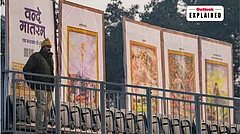


Congress president Mallikarjun Kharge defended the practice on Tuesday. He said that the party is continuing a 90-year tradition. "I sang the same Vande Mataram that Mahatma Gandhi and Jawaharlal Nehru sang... If this is a crime, then file a case against Gandhiji, Nehruji and Vallabhbhai Patel," Kharge told ANI.

He added that the Congress had passed a resolution determining national songs long before current leaders were born. He argued that national standards should not change merely because a new government assumes power.
The current dispute follows recent legislative action. Parliament passed the Prevention of Insults to National Honour (Amendment) Act, 2026, during the recently concluded Monsoon Session. The legislation criminalises attempts to stop or prevent the singing of Vande Mataram.
The present controversy centres on the distinction between the complete composition of Vande Mataram and the version traditionally used by the Congress at public and national gatherings.

What Is The History Of The Vande Mataram Debate?
Vande Mataram was written by Bankim Chandra Chattopadhyay and first appeared as part of his novel Anandamath. The song became one of the most powerful symbols of India's freedom movement. The government has been marking its 150th anniversary through a year-long commemoration that began in November 2025 and includes public renditions of the full version.
Historian Sabyasachi Bhattacharya noted that the first two stanzas were originally composed as a hymn to the motherland, while the poem was later expanded in the context of Bankim Chandra Chattopadhyay's novel Anandamath. The later verses introduced explicitly Hindu religious imagery, including references associated with deity worship. Human Resources Development minister, Arjun Singh said that the recitation was aimed at paying tribute to freedom fighters and martyrs: "The song should not be viewed otherwise." A day earlier, in Mirzapur, he had said that he did not think Muslims should have any objection to reciting the song -- the first two stanzas, that is.
The BJP charged the HRD minister with "appeasement" of Muslims because of his "clarification".
What Is The BJP Objecting To?
Prime Minister Narendra Modi has repeatedly criticised the 1937 decision. During the special discussion in Parliament marking 150 years of Vande Mataram, Modi argued that the Congress had "fragmented" the song under pressure from the Muslim League. He linked the controversy to the wider political debate over Congress' approach to communal harmony before Independence.
BJP MP Anurag Thakur on Saturday accused the Congress leadership of showing "deep discomfort" with the full rendition of Vande Mataram at the party headquarters on Independence Day and demanded that the Congress apologise to the nation, alleging that its leaders insulted the National Song, as per ANI. "Today, the Congress leadership has once again demonstrated its deep discomfort with the full rendition of 'Vande Mataram'. This is not merely a matter of protocol; it is a question of the nation's honour," Thakur said.
The fight is therefore no longer simply about how a song should be sung. It has become a contest over who gets to define patriotism, nationalism and the legacy of India's freedom struggle.
How Did Vande Mataram Become A Symbol Of Indian Nationalism?
Vande Mataram was set to music by Rabindranath Tagore in 1896. The song and the words "Bande Mataram" were considered seditious by the British Government and were sought to be suppressed by violence and intimidation. At a famous session of the Bengal Provincial Conference held in Barisal in April 1906, under the presidentship of Shri A. Rasul, a brutal lathi charge was made by the police on the delegates and volunteers and the "Bande Mataram" badges worn by them were violently torn off.
Some delegates were beaten so severely as they cried "Bande Mataram" that they fell down senseless. Since then, during the past thirty years, innumerable instances of sacrifice and suffering all over the country have been associated with "Bande Mataram" and men and women have not hesitated to face death even with that cry on their lips. The song and the words thus became symbols of national resistance to British Imperialism in Bengal especially, and generally in other parts of India.















