



More than 100 Israeli settlers attacked Jalud as Israeli forces tried to escort a displaced Palestinian family back to its homes, with roads blocked, tyres set alight and three Israeli soldiers injured.
The Tubasi family was evacuated after settlers surrounded the area, while their homes were found damaged, with Israeli authorities arresting two settlers and opening an investigation.
The incident comes amid rising settler violence and Palestinian displacement in the West Bank, with UN figures showing thousands of Palestinians affected by attacks, property damage and access restrictions.
More than 100 Israeli settlers attacked the Palestinian village of Jalud in the occupied West Bank as Israeli forces attempted to escort a displaced family back to its homes, setting fire to buildings, blocking roads and throwing stones at security personnel, according to witnesses and the Israeli military. Three security personnel were injured and the operation to return the family was abandoned as the violence escalated.
The incident has drawn attention to the growing pressure on Palestinian communities in the West Bank, where the United Nations has recorded a rise in settler attacks, property damage and displacement. It also comes amid continuing expansion of Israeli settlements and outposts, which the UN and International Committee of the Red Cross consider contrary to international law.
What Happened To The Palestinian Family In Jalud?
The family at the centre of the incident is the Tubasi family, whose two houses in Jalud, near Nablus, had been seized by settlers weeks earlier. The family had remained elsewhere in the village after leaving their homes following repeated harassment and violence. The Israeli military subsequently agreed to escort them back and provide protection during the return.

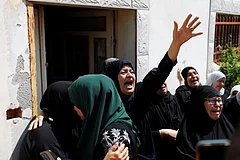


The operation began late on Monday night. About 10 minutes after the family reached its homes, more than 100 settlers arrived, witnesses told Reuters. The settlers blocked access roads, set tyres on fire and threw stones towards Israeli security personnel. The military said three officers were injured.
As the confrontation intensified, the family was taken to the roof of one of the houses before Israeli forces evacuated them, according to witnesses cited by Reuters. The military said the operation to return the family could not be completed because of the violence.

The damage became clearer the following day. Wael Tubasi, who owns one of the houses, told Reuters that doors, windows, tiles, stairs and bathrooms had been damaged. Reuters journalists who visited the property reported seeing blackened walls and residue from tyres that had been set alight inside the building, Reuters reported.
The Israeli military said two settlers had been arrested and that an investigation had been opened. Prime Minister Benjamin Netanyahu condemned the violence and called for those responsible to be prosecuted.
The violence was not confined to Jalud. In nearby Al Mughayyir, settlers reportedly set fire to cars and spray-painted the word “revenge” on an apartment building, according to Reuters.

How Widespread Is Settler Violence In The West Bank?
The Jalud incident is part of a broader pattern that has increasingly involved not only physical attacks but also damage to homes, vehicles and agricultural property, as well as restrictions on Palestinians' access to land.
The UN Office for the Coordination of Humanitarian Affairs (OCHA) recorded more than 1,600 settler attacks resulting in casualties, property damage or both across 275 Palestinian communities between January and mid-September 2026. During the same period, more than 2,600 Palestinians were displaced in the context of settler violence and related access restrictions.
A wider UN report issued on September 24 said more than 1,430 settler incidents involving casualties or property damage had been recorded in 2026, affecting about 260 Palestinian communities. Since January 2023, 127 Palestinian communities have experienced full or partial displacement, affecting more than 6,390 people, according to the report.
OCHA's reporting illustrates how displacement can happen gradually. In some communities, repeated attacks, threats, grazing on Palestinian land, damage to property and restrictions on access to roads or agricultural areas can make it increasingly difficult for families to remain.
In September, OCHA described the case of a household near Umm Safa that had faced recurrent settler harassment and intimidation throughout 2026. Settlers had repeatedly gathered around the family's home and, in August, installed a gate on its only access road. The UN said the restrictions had isolated the household and increased concerns about possible displacement.
The figures vary according to the period and definition used, but the broader trend is consistent: settler violence has become an important driver of Palestinian displacement in the West Bank. OCHA said settler attacks and related access restrictions accounted for about 60 per cent of displacement recorded across the West Bank in 2026 as of September 14.

What Is The Legal Status Of Israeli Settlements And Settler Attacks?
The West Bank, including East Jerusalem, is regarded by the International Committee of the Red Cross as occupied territory under international humanitarian law. The ICRC says Israel's establishment and expansion of civilian settlements in the occupied West Bank is incompatible with Article 49(6) of the Fourth Geneva Convention, which prohibits an occupying power from transferring parts of its own civilian population into occupied territory.
The UN Security Council has also repeatedly taken the position that Israeli settlements in territory occupied since 1967 have no legal validity under international law. Resolution 2334, adopted in 2016, called for an end to settlement activity.
In its 2024 advisory opinion, the International Court of Justice went further, concluding that Israel's continued presence in the Occupied Palestinian Territory was unlawful and that Israel must cease new settlement activity. The court also said Israel must repeal measures maintaining the unlawful situation.
The legal question surrounding individual settler attacks is separate from the status of settlements themselves. Attacks on civilians and destruction of property can violate international humanitarian and human rights law, while the specific legal classification of an individual incident depends on the facts and circumstances. The ICRC says Israel, as the occupying power, has an obligation to protect the Palestinian civilian population against settler violence and to prosecute crimes committed against Palestinians.
Israel disputes the characterisation of its policies and has rejected international findings concerning the legality of its presence and settlements. The Israeli government has also condemned settler violence in individual cases, as Netanyahu did following the Jalud incident. In this case, the military said it arrested two settlers and opened an investigation.
The Tubasi family's experience therefore sits at the intersection of two issues that have increasingly shaped the West Bank: the expansion and legal status of Israeli settlements, and the consequences of settler violence for Palestinians living in and around them.















