



Kiren Rijiju rejected reports claiming China had intruded 60 km into Arunachal Pradesh.
He said differing perceptions persist because parts of the LAC remain undemarcated.
Rijiju acknowledged that concerns raised by residents of border villages were valid.
Parliamentary Affairs Minister Kiren Rijiju on Wednesday rejected reports claiming that China had intruded 60 km into Arunachal Pradesh, saying differing perceptions of the Line of Actual Control (LAC) persist in some areas because the boundary has not been "demarcated".
In an interview with news agency IANS, Rijiju said concerns raised by residents of border villages were valid but denied that Chinese forces had captured an Indian village.
“It is not like they (China) came and captured our village. That is not the case. On certain land, they have cast an eye because there is no demarcation. Our people believe that our land extends further ahead, while the villages situated on the China side, including Tibetan and local people, claim that their land extends deep inside here. So, there is confusion,” he said.
Rijiju Rejects 60-Km Intrusion Claim
Rijiju said the lack of a delineated boundary had resulted in differing perceptions among people living along the frontier.
“Those who say that China has entered 60 kilometres inside (India) and share various videos to defame us are wrong. There is a problem at the border. Some people from villages in Arunachal Pradesh have expressed concern about the border problem, and that concern is valid because the border has not been delineated,” he told IANS.



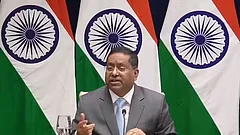
The minister said the situation should not be described as the capture of an Indian village by China.
MEA Says Border Situation Has Wider Impact
The Ministry of External Affairs has also said that developments along the India-China border have implications for the overall bilateral relationship.
On August 11, MEA spokesperson Randhir Jaiswal said India and China had agreed to use existing diplomatic and military mechanisms to “avoid misunderstanding and miscalculation” along the border.
Jaiswal made the remarks while responding to a question on the military situation in the Arunachal Pradesh sector and reports of a possible standoff.
India, China Spar Over Naming Of Arunachal Locations
The border issue has also been accompanied by a fresh exchange between India and China over the naming of places in Arunachal Pradesh.
The Indian government recently formally identified 27 locations and geographical features in the state by their standard names on Survey of India maps.
The locations include mountain passes, settlements, a high-altitude lake and Long Ju along the LAC, an area associated with an India-China border confrontation in 1959.
The government has said the exercise is intended to ensure accurate identification of the places and improve public awareness.
China objected to the move and reiterated its territorial claim over Arunachal Pradesh, which Beijing refers to as “Zangnan”.
Chinese Foreign Ministry spokesperson Guo Jiakun said China does not recognise what it described as the “so-called ‘Arunachal Pradesh’ illegally set up by India”.
“India’s move of attempting to replace names long been used by China with its so-called ‘standard names’ is illegal, null and void,” Guo said, adding that the move would not alter China’s territorial claim.

MEA Rejects Beijing’s Objection
India rejected China’s remarks and reiterated its position that Arunachal Pradesh is part of the country.
“Arunachal is an inalienable and integral part of India. This is a fact which is self-evident and nothing can change this reality,” Jaiswal said.
China has previously issued its own standardised names for locations in Arunachal Pradesh.
In April 2026, Beijing released another list of Chinese names for places in the state. At the time, Guo said the exercise fell within what China considers its “sovereign rights”.
The MEA rejected that move, describing the assignment of Chinese names to locations in Arunachal Pradesh as “mischievous attempts” to create “false claims and manufacturing baseless narratives”.
The ministry said such actions could not change the “undeniable reality” that Arunachal Pradesh “was, is, and will always remain an integral and inalienable part of India”.
It also said such actions could undermine efforts to stabilise India-China relations.















