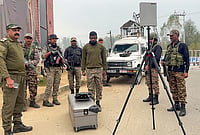
India and the US signed an LOA for Javelin anti-tank missile systems for the Indian Army.
The US had earlier approved a possible sale of 100 Javelin rounds and 25 launch units estimated at $45.7 million.
The deal comes amid expanding India-US defence cooperation, including the recent MQ-9B Sea Guardian lease.
Nine months after the US State Department approved a possible Foreign Military Sale to India of the Javelin Missile System, India and the United States on Friday entered into a government-to-government agreement for its procurement for the Indian Army, the US Mission in India said in a press release.
Although the release from the US Embassy did not disclose the cost of the deal, according to a US State Department readout issued last year, it was estimated that the missile system and related equipment could cost $45.7 million.
"The United States welcomes the Indian Army’s signing of a Letter of Offer and Acceptance (LOA) for the purchase of the Javelin anti-tank guided missile system through the U.S. Foreign Military Sales process," the US Mission said in its press note.
“This agreement reflects a defence partnership that is growing deeper, more capable, and more consequential,” said U.S. Ambassador Sergio Gor.
He further added, “The Javelin agreement demonstrates the depth of U.S. support for the Indian Army and creates new opportunities for our defence industries to work together. We see tremendous potential for future cooperation that strengthens the defence industrial bases of both countries.”



What Is The Javelin Missile System?
The Javelin weapon system is a shoulder-fired anti-armour system that automatically guides itself to the target after launch, allowing the gunner to take cover and avoid counterfire.
Javelin was developed and produced for the U.S. Army and Marine Corps by the Javelin Joint Venture between Lockheed Martin in Orlando, Florida, and Raytheon in Tucson, Arizona.
It came into existence in 1994, and its fire-and-forget capability provides superior survivability by enabling the operator to immediately relocate after firing.
It is a single-man-portable, fire-and-forget, medium-range anti-tank weapon system designed to defeat all known and projected threat armour, including main battle tanks and softer targets. It can also be fired in top or direct attack modes.
The Javelin can engage targets from approximately 65 metres to 4 kilometres under most operational conditions.
The system consists primarily of the missile and a Command Launch Unit (CLU), which provides the operator with target acquisition, surveillance and aiming capabilities.
The CLU has a 4x day sight and 4x or 12x thermal sight, allowing the weapon to be employed in day, night and adverse-weather conditions. The missile weighs about 11.8 kg, while the CLU weighs around 7 kg, with the complete round weighing approximately 15.4 kg, according to the manufacturer’s specifications.
India-US Defence Pact
The announcement from the US Embassy comes almost a year after both countries signed a 10-year Defence Framework, including growing efforts to expand defence-industrial collaboration.
The US Defense Security Cooperation Agency last year announced the sale of the Javelin to India via a notification, stating that the US State Department had approved the sale of 100 FGM-148 Javelin rounds; one Javelin FGM-148 missile, fly-to-buy; and 25 Javelin Lightweight Command Launch Units (LwCLU) or Javelin Block 1 Command Launch Units (CLU), apart from simulation rounds, battery coolant units, interactive electronic technical manuals, Javelin operator manuals, lifecycle support and a few other items.
Although the Indian Army has not yet released any comment on the deal, the defence and strategic partnership between the two countries has witnessed a spike in recent years, despite ongoing geopolitical tensions and the policy of tariffs and sanctions under President Donald Trump.
Notably, earlier this month, the Ministry of Defence inked a contract with American giant General Atomics Aeronautical Systems for the leasing of two MQ-9B Sea Guardian high-altitude, long-endurance (HALE) remotely piloted aircraft systems (RPAS) for the Indian Navy.
Valued at around Rs 1,943 crore, the contract covers a 30-month lease period and was signed in the presence of the Defence Ministry’s Additional Secretary and Director General (Acquisition), A Anbarasu, at Kartavya Bhawan-2 in New Delhi.