Harish Parvathaneni said India will not accept new permanent members without veto powers if the Security Council is reformed
India argued that such a structure would create second-class permanent members and preserve the dominance of the P5
The remarks were made on Monday at the Inter-Governmental plenary on the question of the veto in the UN General Assembly
India has opposed any UN Security Council reform that creates new permanent members without veto powers, arguing that such a move would leave them as “second-class” members while keeping the existing five permanent powers in charge of decision-making. New Delhi has said that if the veto remains, every permanent member of a reformed Council should have the same rights and responsibilities.
The current Security Council has 15 members. China, France, Russia, the UK and the US are its five permanent members and each holds veto power. The remaining 10 sit as non-permanent members for two-year terms.
India’s Permanent Representative to the UN, Ambassador Harish Parvathaneni, made the case on Monday as India pressed its long-running demand for a larger and more representative Council. “India's position on the veto is principled and well known... We reiterate that as long as the veto exists, it must be held by all permanent members of a reformed Council,” he said.
Veto And Equality
Parvathaneni spoke on Monday at the Inter-Governmental (IGN) plenary on “Cluster Debate on the Question of the Veto” in the UN General Assembly. He framed India’s position as a matter of fairness in any future expansion of the Council.


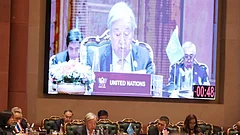
He repeated India’s demand that equal rights must apply to all permanent members. “India's position on the veto is principled and well known... We reiterate that as long as the veto exists, it must be held by all permanent members of a reformed Council,” he said.
He also rejected proposals that would create a weaker class of permanent members. Parvathaneni said a reform that expands the Security Council by “creating another category of long-term members without the veto effectively makes them 'second-class' members and would not change the decision-making dynamic of the P5”.
Push For Expansion
India has repeatedly urged expansion of both the Council's permanent and non-permanent membership. New Delhi has warned that reform focused only on adding elected seats would border on “failure” because it would leave the balance of power unchanged.
The argument is tied to India’s wider campaign for reform. It says a Council built in 1945 no longer fits 21st-century realities or the current geopolitical landscape.
That demand also links to India’s own bid for a permanent seat. New Delhi has consistently said it deserves permanent representation at the horseshoe table as part of a broader restructuring of the Council.
Seat Bid Timeline
India is also seeking one of the non-permanent seats for the 2028-29 term. Elections for that term are scheduled for June next year.
India and Tajikistan are set to compete for the Asia-Pacific Group's lone seat. The contest comes as New Delhi continues to push for wider Council reform.
India last served on the Security Council in 2021-22, which was its eighth term. It previously held seats in 1950-51, 1967-68, 1972-73, 1977-78, 1984-85, 1991-92 and 2011-12.