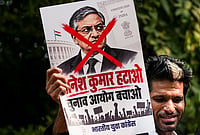
The 2023 law replaced the Chief Justice of India with a Union Cabinet minister on the selection panel.
Justice Dipankar Datta said the existing two-judge Bench could decide whether the law meets constitutional principles.
Justice Satish Chandra Sharma said the challenge raises a new constitutional question requiring a larger bench.
The Election Commission has come under increased scrutiny over its functioning and the way key decisions are taken. The controversy surrounding the nationwide Special Intensive Revision (SIR) of electoral rolls has brought several aspects of the poll body's functioning into focus, including the role of its three Election Commissioners and the process through which they are appointed.
Two of the three Election Commissioners — Sukhbir Singh Sandhu and Vivek Joshi — have formally objected at least 14 times over the past 10 months to decisions and orders taken by the Election Commission, according to an investigation by The Indian Express. The objections came during the nationwide SIR of electoral rolls and included concerns over voter registration, deletion and restoration of names, and access to electoral-roll data.
One of the reported disputes involved changes to Form 6, used by people applying to be registered as voters. According to the report, a new declaration was added asking applicants whether their own name, or that of a parent or grandparent, appeared in the electoral roll from the previous SIR.


Joshi objected to the change in May, arguing that the statutory form could not be altered without amending the relevant electoral-roll rules. Sandhu subsequently backed the objection and described the change as “unauthorised” and “illegal”.
Against this backdrop, a separate case concerning how Election Commissioners are appointed is before the Supreme Court. On September 23, a two-judge Bench differed over whether petitions challenging the 2023 appointment law could be decided by the existing Bench or required consideration by a Constitution Bench. The matter was ultimately placed before the Chief Justice of India for consideration of an appropriate larger bench.

What Is The Separate Supreme Court Case About?
The developments within the Election Commission come as the Supreme Court is examining a separate challenge to the law governing the appointment of the Chief Election Commissioner (CEC) and other Election Commissioners.
The Chief Election Commissioner and Other Election Commissioners (Appointment, Conditions of Service and Term of Office) Act, 2023 excludes the Chief Justice of India (CJI) from the selection process.
On Wednesday, a two-judge Bench referred petitions challenging the law to the CJI for consideration of whether a Constitution Bench should be formed.
Justices Dipankar Datta and Satish Chandra Sharma differed on whether the matter should be heard by a larger bench. They agreed, however, that it should be placed before the CJI. They said sending it first to a three-judge bench would be of “little worth” and could delay a final decision on the constitutional questions involved.
The judges also flagged delays in deciding constitutional references and urged the CJI to consider setting up a permanent five-judge bench for constitutional cases.
What Is The Anoop Baranwal Case?
The challenge to the 2023 law traces its origins to the Supreme Court's March 2023 judgment in Anoop Baranwal v Union of India.
A Constitution Bench had noted that Parliament had not enacted a law governing appointments to the Election Commission, despite Article 324 of the Constitution contemplating one.
Until Parliament enacted such a law, the court laid down an interim mechanism under which appointments would be made by a committee comprising the Prime Minister, the Leader of the Opposition in the Lok Sabha and the CJI.
The Bench had also stressed the importance of an independent Election Commission and said those entrusted with conducting elections must be insulated from executive influence.
Parliament subsequently enacted the 2023 law. It replaced the CJI on the selection committee with a Union Cabinet minister nominated by the Prime Minister. The three-member panel therefore comprises the Prime Minister, the nominated Cabinet minister and the Leader of the Opposition.

What Did Justice Datta Say?
Justice Datta held that the petitions could be decided by the existing two-judge Bench. According to him, the constitutional principle had already been settled in Anoop Baranwal, which held that appointments to the Election Commission could not remain under “exclusive executive control”.
The question, he said, was whether the 2023 law complied with that principle and did not require a Constitution Bench.
Justice Datta also raised concerns about the selection committee. Referring to the Cabinet minister nominated by the Prime Minister, he said a minister bound by collective responsibility “cannot be expected to defy his own nominator”.
He said the presence of the Leader of the Opposition could therefore become “largely ornamental”. He also stressed that the Election Commission must not only be independent but must appear to be independent. These were, however, prima facie observations.
Justice Datta also rejected the government's comparison between the Election Commission's appointment process and the judicial collegium system.

What Did Justice Sharma Say?
Justice Sharma disagreed and held that the challenge should be referred to a Constitution Bench. He said the Supreme Court was examining the constitutional validity of the 2023 Act for the first time and that there was no authoritative decision of the court on its validity.
For Justice Sharma, the key question was whether Parliament was justified in replacing the CJI with a Cabinet minister nominated by the Prime Minister. He said the question of whether Parliament was justified in excluding a neutral selector had not been dealt with in any precedent.
He therefore held that Article 145(3) left no room for the present two-judge Bench to finally decide the issue.

What Is A Constitution Bench?
Under Article 145(3), a Constitution Bench of five or more judges decides a substantial question of law involving the interpretation of the Constitution.
A case does not go to a larger bench merely because it involves the Constitution. The question must be unsettled - meaning it has not been authoritatively answered by the Supreme Court earlier.
The present disagreement is therefore over whether the constitutional questions arising from the 2023 law were already settled by Anoop Baranwal or require consideration by a larger Constitution Bench.