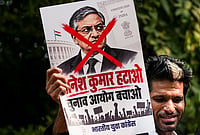
A Supreme Court advocate sought the Attorney General of India’s consent on September 24, 2026, to move criminal contempt proceedings against Chief Election Commissioner Gyanesh Kumar.
The plea relied on reports alleging a complete breakdown of multi-member consensus within the Election Commission of India.
The Indian Express reported that Election Commissioners Sukhbir Singh Sandhu and Vivek Joshi raised written objections at least 14 times over 10 months.
A Supreme Court advocate sought the Attorney General of India’s consent on Thursday, September 24, 2026, to begin criminal contempt proceedings against Chief Election Commissioner Gyanesh Kumar after a report alleged a “complete breakdown of multi-member consensus within the Election Commission of India (EC)”.
The request matters because the Attorney General of India, a constitutional authority, must give prior consent before a criminal contempt petition can be filed in the Supreme Court. Singh’s plea drew on described as alleging “deep structural subversions” within the poll panel and repeated objections from the two other Election Commissioners.
“Bypassing fellow Commissioners to secretly issue public dictates under the banner of ‘full Commission’ constitutes willful defiance of the law declared by the Supreme Court under Article 141,” Singh said in the contempt-consent request. Singh further argued that the alleged conduct was “reducing a constitutionally-mandated multi-member independent panel into a one-man autocracy”; he said the CEC had scandalised and lowered the authority of the institution and directly threatened the free and fair elections doctrine.



Objections And Disputes
The dispute centres on internal dissent. Election Commissioners Sukhbir Singh Sandhu and Vivek Joshi registered written objections at least 14 times over the last 10 months. The newspaper described the issue as not a one-off disagreement but a sustained and documented rupture inside the three-member Election Commission.
The documentary record cited in the report consisted of internal notes and letters from October 2025 to August 2026. It recorded at least 14 formal objections in 10 months, including four on one day, and the objections were copied to Kumar.
The objections covered several decisions. The Indian Express reported that the two Commissioners objected to sweeping alterations to voter registration software, centralisation of electoral-roll software and database control, changes to Form 6 and the addition, deletion and restoration of voter names under the Special Intensive Revision process. They said those steps were taken without their knowledge or approval of the full Commission. They also questioned the filing of large numbers of West Bengal appeals without clarity on who had authorised them.
In one objection, the Commissioners characterised action taken contrary to their written advice as “unauthorised” and “illegal”, The Indian Express reported.
Legal And Institutional Claims
Singh tied the allegations to Supreme Court rulings. He argued the alleged actions and omissions by Kumar violated the Supreme Court’s rulings in T.N. Seshan versus Union of India and Anoop Baranwal versus Union of India. Singh said those judgments required the Election Commission to function through institutional consensus.
He also argued that the Chief Election Commissioner was only primus inter pares, or first among equals. The CEC did not have absolute authority, Singh said in his plea.
The Election Commission of India pushed back against the account. In its September 23-24, 2026 response, The Indian Express reported that the ECI did not dispute the existence, dates or contents of the 14 notes. It said the notes were part of the normal decision-making process and maintained that the Commission’s decisions were unanimous.