A recent Nature study identified 219 hanging glaciers in Uttarakhand's Alaknanda basin, with nearly one-third of the unstable ice mass located in the Upper Alaknanda basin.
If unstable ice breaks away, it can trigger an ice-rock avalanche and potentially cause secondary hazards such as debris flows and glacial lake outburst floods, putting downstream communities and infrastructure at risk.
Scientists say systematic monitoring, early-warning systems, hazard mapping and rapid evacuation can reduce casualties, with the contrasting outcomes of the Chamoli and Blatten disasters highlighting the importance of preparedness.
The devastating floods in Nepal have highlighted a little-known Himalayan hazard that could pose risks to India: “hanging glaciers” — unstable masses of ice perched on steep mountain slopes that can break off and trigger avalanches, floods and other cascading disasters.
A recent study identified 219 such glaciers in the Alaknanda basin of Uttarakhand's Garhwal Himalayas, with nearly one-third of the unstable ice concentrated in the Upper Alaknanda basin.
In the Himalayas, that simple physical setting is central to how they are discussed and monitored. That matters because mountain ice is never just scenery. It is part of a larger system shaped by slope, height and ice conditions.
What Are Hanging Glaciers And How Do They Form?
An ongoing assessment by glaciologists has identified at least 858 hanging glaciers along India’s approximately 2,500-km-long Himalayan stretch, raising concerns over the safety of millions of people living in downhill hamlets, villages and towns across the mountainous region, according to New Indian Express.
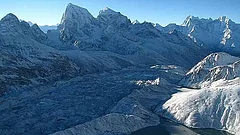
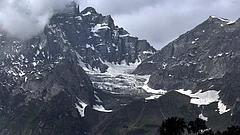


These hanging glaciers are relatively small, steep ice formations located along mountain slopes and near cliff edges. Their unstable nature makes them particularly susceptible to the effects of climate change.
Experts have warned that when such glaciers collapse, the resulting destruction can be severe because of the large quantities of ice and water they contain. Glaciologists have highlighted the possibility of a major catastrophe, particularly during summer, when faster melting can increase the danger and the number of locals and tourists in the region is also higher. Experts have linked the growing threat to increased warming across the Himalayas, according to New Indian Express.
As Himalayan temperatures rise and regional rainfall patterns change, glaciers are becoming less stable, with some potentially developing into “hanging glaciers” — bodies of ice suspended on steep mountain slopes that may break away and unleash powerful avalanches.
What Happens If A Hanging Glacier Breaks Off?
A hanging glacier can break away when a section of ice has gradually weakened over time through repeated freezing and melting, as per BBC report.
The resulting mass of ice and rock can then race down a steep mountain slope under the force of gravity.
When it reaches the valley floor, the rocks, snow and sediment carried with it can accumulate in a relatively narrow mountain stream and obstruct its flow. As water builds up behind the blockage, the barrier can eventually give way, sending a powerful mixture of water and debris downstream and causing extensive flooding. The combined effects of water, gravity and geological conditions can create a devastating chain reaction, resulting in deaths and putting hundreds of people at risk.
Kalachand Sain, Director of the Dehradun-based Wadia Institute of Himalayan Geology, told BBC, "What we have found is actually not very common. The weakening of the 'hanging' glacier must have happened over a long period of time as the ice froze and thawed."
According to him, climate change is the “main factor” behind rapid fluctuations in temperature, which cause ice to repeatedly freeze and thaw and can contribute to fractures developing in glaciers over time. Normally, glaciers gain snow during winter and lose it during summer. However, rising temperatures are causing them to lose ice at a rate faster than they can accumulate new snow, resulting in glacier retreat.
India’s Himalayan region is home to approximately 10,000 glaciers, while Uttarakhand alone has as many as 1,495 glaciers. Many of these glaciers are retreating as the region experiences a warming climate.

The Alaknanda study's simulations found that avalanche flows in the Badrinath-Mana sector could exceed 50 metres in height. Such an event could overwhelm settlements and infrastructure. Break-offs can also generate secondary hazards, including glacial lake outburst floods (GLOFs).
A study published in April 2026 in Nature, has identified 219 hanging glaciers across the Alaknanda basin in the Garhwal Himalayas, with nearly 30 per cent of the unstable ice mass located in the Upper Alaknanda basin.
The research, published in Nature, was conducted by Ashim Sattar of the School of Earth, Ocean and Climate Sciences at IIT Bhubaneswar, Nandu Krishnan of the Divecha Centre for Climate Change at the Indian Institute of Science, Bengaluru, and two other researchers. It warned that rapid warming and climate variability are contributing to increasing “geometric and dynamic instability” among Himalayan glaciers.

How Big Is The Risk To India And What Can Be Done?
The study estimates that the Alaknanda basin will face greater exposure to avalanche hazards in the coming decade. By 2030, the land area occupied by buildings and infrastructure that is vulnerable to such risks is expected to be 120 per cent higher than it was in 2000.
The research also projects a 17 per cent increase in the population living in areas exposed to these hazards during the same period.

The findings highlight the importance of identifying glaciers that pose a high risk and continuously monitoring them, along with incorporating hazard assessments into decisions about land use. Such measures could help limit the dangers posed to communities downstream in mountainous areas. The recent disaster in Nepal serves as a warning of the consequences that such cascading hazards can bring.
Another study published in Nature on March 6 highlighted the importance of disaster preparedness in the warming Himalayan region. Authored by Anshuman Bhardwaj, Rayees Ahmed and two other researchers, the study examined the contrasting outcomes of two major ice-and-rock avalanche events.
In 2021, the Chamoli disaster occurred when a huge mass of ice and rock collapsed into the Rishiganga valley. The incident destroyed hydropower plants, washed away bridges and claimed more than 200 lives. Four years later, an ice–rock avalanche hit Blatten in Switzerland, burying much of the village but resulting in only one death.
According to the researchers, the contrasting outcomes were “not luck, but preparedness, monitoring, and rapid response”. In Blatten, early indications of slope instability prompted authorities and residents to take action, allowing them to evacuate the area in time.