The death toll from the catastrophic Nepal-Tibet border disaster has crossed 700.
Scientists say the disaster was likely triggered by a massive glacial collapse.
Nepal's military has rescued thousands of people.
The death toll from the catastrophic Nepal-Tibet border flooding has crossed 700, with authorities warning the number will likely climb further as search operations continue in hard-to-reach areas. More than 700 people have died in Nepal and at least 16 were killed in China, with Nepali authorities struggling to cope with the mounting number of bodies while Chinese officials say no more survivors have been found.
The Missing
The scale of those unaccounted for remains staggering. Around 3,000 people, including Indians and other foreigners, are still missing. A large share of the missing are workers. Nearly 900 Nepali employees working on hydropower projects are unaccounted for, according to the country's Independent Power Producers' Association, though about 361 workers from the industry have been rescued so far.
Rescue Operations
Nepal's military has led an extensive air-and-ground rescue effort. The Nepal Army says more than 2,500 people have been rescued by aerial evacuation, including 216 foreign nationals, with at least 200 more rescued on the ground, though some remote areas remain difficult to access by helicopter. By Saturday, official figures showed an even broader rescue tally: at least 7,514 people had been rescued, including 227 foreign nationals, according to Nepal's National Disaster Management Authority, with at least 219 injured people treated or discharged.
Officials are also preparing for the grim task of identifying unrecovered victims. According to ABC News, Nepal's Prime Minister Baken Shah said the government would preserve DNA samples and other identifying evidence from bodies that cannot be identified before proceeding with burial, and Nepal is coordinating forensic efforts with India, China, and Israeli experts.



Glacier Collapse At The Root Of It
According to footage verified by The New York Times, a group of hikers witnessed a glacial collapse across the border in Nepal.
Ziha Yitie, a 26-year-old tour guide, was with a group of hikers who had climbed to an observation deck in Tibet, China, offering views of the snow-covered mountains in Nepal.
The footage recorded by the group showed the extent of the change caused from the glacier's collapse.
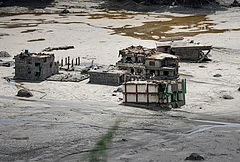
This glacier collapse in turn wreaked havoc downstream in Nepal causing a major surge of water, ice, rock and debris in the Bhotekoshi river.
Ground Impact
Two days after roughly 30-foot waves surged down the river between Tibet and Nepal, wiping out communities for miles downstream, the death toll had already risen past 670, with some morgues running out of space and access to clean water a growing concern. Compounding the crisis, Chinese authorities reported that a massive debris-formed lake behind the disaster site had started to overflow, forcing a halt to relief efforts in border areas.
Experts warn this event fits a worsening pattern across the Himalayas, sometimes called the world's "third pole" for its ice reserves. Studies have identified thousands of glacial lakes across Nepal, India, and Tibet, dozens of them flagged as potentially dangerous — underscoring that no forecast anticipated an avalanche striking this particular location before Wednesday's disaster.
Rescue, identification, and cause investigations remain ongoing; figures are expected to change as authorities reach remaining cut-off areas.