The DRC has confirmed 10,060 Ebola cases, its deadliest outbreak on record.
Attacks on health workers and limited access hinder containment.
Imported cases in Kenya and Nigeria prompted contact tracing and border surveillance.
The Democratic Republic of the Congo (DRC) has recorded more than 10,000 confirmed Ebola infections, according to government data released on Tuesday, October 27, as health authorities struggle to contain an outbreak that has spread beyond the country’s borders and become the deadliest in its history.
The latest situation report from the country’s public health institute put the cumulative number of confirmed cases at 10,060. The outbreak, caused by the Bundibugyo strain of the Ebola virus, has strained health services across several provinces, while violence against health workers and difficulties reaching affected communities have complicated efforts to contain transmission.

Outbreak Spreads As Health Workers Face Attacks
The outbreak, declared in May, has spread across eight provinces in the DRC, with Ituri remaining the epicentre. The WHO reported 9,704 confirmed cases and 4,687 deaths across the DRC as of October 20, highlighting the scale of the public health emergency. The outbreak has also crossed borders, with imported cases reported in Kenya and Nigeria, prompting contact tracing and emergency preparedness measures in both countries.
Efforts to contain the virus have been hampered by attacks on health workers. Last week, youths armed with machetes attacked two community health workers raising awareness about Ebola in eastern Congo, killing one and injuring the other, according to officials and a memo seen by Reuters. The worker who died was an experienced nurse at a hospital in Bafwasende, Tshopo province, who had recently been assigned to raise awareness about the outbreak in his community.


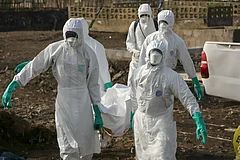
The violence has added to the challenges facing response teams working to identify infections, trace contacts and encourage people to seek medical care. The WHO has warned that sustained transmission across affected areas, delays in detecting cases and difficulties accessing communities are complicating efforts to control the outbreak. Health authorities and international partners continue to coordinate surveillance, laboratory testing, infection prevention and community engagement.

Cross-Border Response Intensifies
The outbreak has prompted neighbouring countries to strengthen surveillance and preparedness. Kenya reported an imported case in early October involving a patient who had travelled from the DRC through Uganda, while Nigeria confirmed an imported case on October 20. Nigeria has activated its incident-management system, with health authorities and international partners working on case investigation, contact tracing and infection prevention.
The Bundibugyo strain is a particular challenge because there is no approved vaccine or specific treatment for it. The WHO recommends supportive care and rapid identification of cases to reduce deaths, alongside sustained surveillance and cross-border cooperation. It has advised against imposing travel or trade restrictions on affected countries, stressing the importance of coordinated public health measures as the outbreak evolves.