



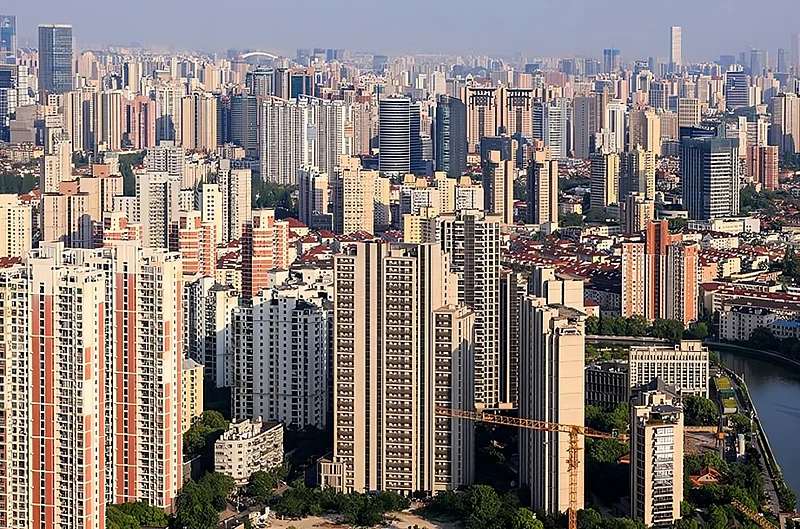
China's industrial output growth slowed to 4.8% in October, missing economists' forecasts.
Retail sales rose just 0.4% as weak consumer demand and the property crisis continued to weigh on spending.
Strong exports and advanced manufacturing are supporting China's economy despite falling investment and subdued domestic demand.
China's economic recovery came under pressure in October as factory output and retail sales grew slower than expected, exposing the weakness of domestic demand even as the country's manufacturing and export sectors continued to support growth. Official data released on Monday, November 16, showed that industrial production grew 4.8 per cent year-on-year, down from 5.5 per cent in September, while retail sales increased by just 0.4 per cent, compared with 1.1 per cent the previous month.
Both indicators fell short of economists' forecasts, highlighting the difficulty of sustaining economic growth through exports while domestic consumption and investment remain subdued. The figures also underline the challenges facing Beijing as it attempts to meet its annual growth target of 4.5-5 per cent without addressing the underlying weakness in domestic demand. An export boom, driven partly by demand for artificial intelligence (AI)-related products, has helped support the economy, but the property market downturn and subdued consumer confidence continue to weigh on spending.
Factory Output Slows As Manufacturing Demand Weakens
According to China's National Bureau of Statistics (NBS), industrial output grew 4.8 per cent year-on-year in October, missing the 5.3 per cent growth forecast by economists surveyed by Reuters. The figure also marked a slowdown from September's 5.5 per cent increase, pointing to weaker momentum in the country's manufacturing sector.


The manufacturing Purchasing Managers' Index (PMI), another indicator of industrial activity, fell to 49.3 in October from 50.1 in September. A reading below 50 indicates contraction compared with the previous month. The decline marked the third contraction in four months, with the production index falling to 49.8 and the new orders index dropping to 49.4. The new export orders index also slipped to 48.7, indicating weaker demand for manufactured goods among overseas buyers.
The PMI measures changes in business activity through surveys of purchasing managers; it does not measure the actual volume of industrial production. This distinction is important as China's industrial output continued to expand year-on-year despite the contractionary reading in the survey.
The slowdown extended beyond manufacturing. China's non-manufacturing business activity index, which covers services and construction, fell to 49.7 in October from 50.2 in September, slipping below the 50-point mark that separates expansion from contraction.
The slowdown has not affected all manufacturing segments equally. The NBS reported that value added in equipment manufacturing increased 10.6 per cent year-on-year in October, while high-tech manufacturing expanded 17.6 per cent. Production of 3D printing equipment, lithium-ion batteries and industrial robots also recorded growth of 85.9 per cent, 30 per cent and 26 per cent respectively.
While advanced manufacturing continues to expand, the contraction in new orders suggests that this strength has yet to translate into broader manufacturing momentum.
Retail Sales Remain Weak Despite Holiday Spending
Retail sales, a key indicator of household consumption, rose just 0.4 per cent year-on-year in October, falling short of the 0.8 per cent growth forecast by economists surveyed by Reuters. The figure was also considerably lower than September's 1.1 per cent increase.
The weak figures are notable because October included China's seven-day National Day holiday and the start of the Singles' Day shopping campaign, which spans October and November. Both periods typically provide opportunities for retailers to attract consumers through travel, shopping and promotional sales.
However, spending remained subdued, reflecting concerns about household finances, employment and the economic outlook. The prolonged property market downturn has also weighed on consumer confidence, with falling home values affecting household wealth and discouraging discretionary spending.
Lynn Song, ING's chief economist for Greater China, described 2026 as "one of the weakest years for domestic demand in recent history". She said the negative impact of trade-in programmes, which had brought forward purchases, could ease in 2027. Song added that policy support for domestic demand could pick up, particularly if external demand weakened.
The NBS also acknowledged the challenges facing consumption. A spokesperson said: "There is huge potential for consumption but people's capacity and willingness to spend need to be enhanced".


The distinction between goods and services spending is also significant. NBS data showed that retail sales of consumer goods increased by 1 per cent in the first ten months of 2026, while retail sales of services grew by 4.9 per cent. Overall retail sales of goods and services rose by 2.5 per cent during the same period.
Property Crisis Continues To Weigh On Investment
Weak consumption has coincided with a prolonged downturn in China's property sector, which continues to affect investment and household confidence.
According to the NBS, property development investment fell 21.6 per cent in the first ten months of 2026 compared with the corresponding period last year. The investment slump has coincided with continued weakness in housing prices and sales. According to Reuters calculations based on NBS data, new home prices fell 0.1 per cent month-on-month and 2.4 per cent year-on-year in October, although the annual decline was the slowest since November 2025.
The weakness extends beyond real estate. Fixed-asset investment, which covers spending on infrastructure, manufacturing and property development, declined 8.1 per cent between January and October. This was a sharper contraction than the 7.2 per cent decline recorded in the first nine months and worse than the 7 per cent fall forecast by economists surveyed by Reuters.
Infrastructure investment declined 5.1 per cent, while manufacturing investment fell 2.9 per cent during the first ten months. Private investment contracted by 11.4 per cent in the first ten months of the year. Excluding property development, the decline stood at 7.8 per cent, indicating that weakness in private investment extended beyond the real estate sector.
The decline in property investment has also reduced demand for construction materials and related services, while falling housing values have affected household confidence. These pressures have made it harder for Beijing to stimulate domestic demand through conventional investment and property-sector support measures.
China's surveyed urban unemployment rate, meanwhile, edged down to 5.1 per cent in October from 5.2 per cent in September. The improvement came alongside continued weakness in retail spending.


Exports Support Growth As Beijing Faces Policy Pressure
While domestic demand remains weak, China's export sector has continued to support economic activity, particularly through overseas demand for AI-related products and advanced manufacturing goods.
NBS data showed that the value of China's goods exports increased by 28.7 per cent year-on-year in October, while imports rose 34.7 per cent. Total goods trade increased by 31.2 per cent during the month. These figures are calculated in yuan terms; growth rates based on US dollar-denominated trade values may differ because of exchange-rate movements.
Reuters reported that strong overseas demand for AI-related products and cars had helped pull China's economy out of a second-quarter slowdown. The country's gross domestic product grew 4.5 per cent year-on-year in the third quarter, keeping it within reach of the government's annual growth target.
However, the reliance on exports has raised questions about whether external demand can continue to compensate for weak consumption and investment at home. Strong overseas sales have also reduced the immediate pressure on policymakers to introduce substantial measures to stimulate domestic demand.
Zhaopeng Xing, senior China strategist at ANZ, said: "No new stimulus measures are expected to be introduced for the remainder of the year."
He added: "Data for the single month of October are unlikely to alter the overall growth trajectory for the year; we continue to project that annual GDP growth will remain above 4.5%."


The outlook for 2027 could depend partly on whether the AI-driven export boom continues. Lynn Song of ING said policy support for domestic demand could increase, particularly if external demand deteriorates. Reuters also reported that analysts expect Beijing to step up support for domestic consumption if the export-driven growth momentum weakens.
For now, China's latest economic figures present Beijing with a difficult choice: continue relying on manufacturing and overseas demand to meet its growth target, or introduce stronger measures to revive household spending and investment. Whether policymakers act more decisively could depend on how long the export boom can sustain growth.








