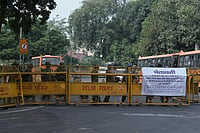
A contempt plea in the Supreme Court alleged the Centre and Delhi authorities did not comply with directions to ease metro and train restrictions.
The petition said 57 metro stations remained shut and several Delhi-bound trains were cancelled despite the court’s order.
It also claimed no traffic advisory was published before the Jantar Mantar protest against Chief Election Commissioner Gyanesh Kumar and the special intensive revision exercise.
A contempt plea was filed in the Supreme Court on Saturday, alleging that the Centre and Delhi authorities had not complied with its direction to relax sweeping limits on metro and train operations. The bench’s October 9 order had also asked that traffic advisories be issued before the Jantar Mantar protest.
Hindustan Times reported that Delhi saw restrictions on Saturday before the Cockroach Janta Party staged a protest against Chief Election Commissioner Gyanesh Kumar and the special intensive revision exercise. The report said the plea argued that, even after the court warned against inconvenience to the public, newspapers carried no traffic advisory and the shutdown of 57 metro stations and several Delhi-bound trains stayed in place. The petition was moved by advocate Shailendra Mani Tripathi.
Plea Allegation Details
The plea put the allegation this way. “Notwithstanding the solemn judicial mandate and the assurance recorded before the bench of the Chief Justice of India (CJI), the contemnors have consciously maintained a blanket shutdown across transit corridors, persisted with unwarranted train cancellations, and failed to issue or publicize transparent traffic and transit advisories.”


Submitted on Saturday morning, the contempt plea named Union home secretary Govind Mohan, Delhi Police Commissioner Anurag Kumar and Delhi Metro Rail Corporation chairperson D Thara as contemnors. In a report published by Hindustan Times, advocate Chand Qureshi filed the petition.
It further said, “This deliberate recalcitrance has severely crippled public life across the National Capital Territory, stranding essential travelers, and amounts to an intentional attempt to bypass and undermine the authority and majesty of this court.” The petition said no traffic advisory had been published in newspapers, that 57 metro stations remained shut and that several Delhi-bound trains terminating at New Delhi and Hazrat Nizamuddin stations were cancelled.
Earlier Court Hearing
The order had come a day earlier. A bench led by CJI Surya Kant, with justices Joymalya Bagchi and V Mohana, had passed it on Friday in a matter filed by CPI(M) general secretary MA Baby.
Senior advocates Kapil Sibal, Abhishek Manu Singhvi and Gopal Sankaranarayanan told the court the restrictions were so severe that ordinary people would be affected. They said roads were barricaded, major metro stations were shut and trains were cancelled, among other measures.
The hearing also noted the security backdrop. Police had denied permission for the protest to the CJP and stepped up vigilance and security measures to prevent any untoward incident.
Supreme Court Directions
The court said metro and rail services should not face a total bar. “We clarify that although there shall be no outright prohibition on the movement of metro trains, a prudent decision may be made to permit the operation of metro trains and other rail services in a suitable and regulated manner. Such a decision should be widely publicised to prevent further inconvenience.”
It also asked for a public advisory on road movement. “A traffic advisory shall also be published in respect of smooth movement of vehicles in newspapers and on online platforms to ensure that no hardship or inconvenience is caused to the public in the course of traveling within the city.”
The court directed the authorities to publicise the prevailing situation widely and sought a compliance report within four days.