



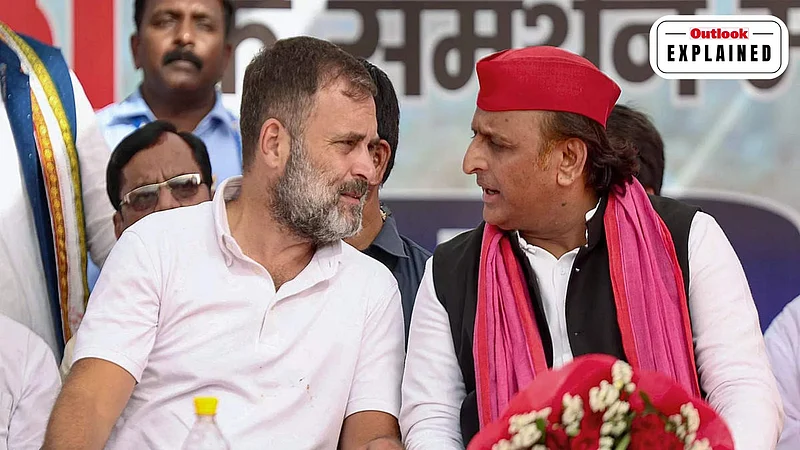
The Samajwadi Party has offered the Congress 26 seats for the 2027 Uttar Pradesh Assembly election, while the Congress is seeking more than 100.
SP general secretary Ram Gopal Yadav said the offer reflects past constituency-level results, including seats won or contested strongly by the Congress and 20 where the SP had a much higher vote count.
Akhilesh Yadav said the negotiations are ongoing and stressed that alliances are formed to win.
The Samajwadi Party’s offer of 26 seats has put Congress at the backseat as the two party attempt to form a "respectable" alliance for the 2027 Uttar Pradesh Assembly election. The Congress is expecting more than 100 seats, backing its demand on the recent Lok Sabha performance, however, the SP says its proposal reflects each party’s electoral record in the assembly polls in the state.
SP general secretary Ram Gopal Yadav announced the offer ahead of the alliance’s second round of talks on Tuesday. He said the proposal includes two seats won by the Congress, four where it finished second and 20 where the SP had secured between 60,000 and 70,000 votes in the previous election, while the Congress received about 2,000.
“We have offered two seats which the Congress won, four seats where it finished second, and 20 other seats where we (SP) had secured 60,000-70,000 votes, while the Congress had received only around 2,000 votes,” Yadav said. He added that the proposed constituencies would be discussed during the talks.



SP chief Akhilesh Yadav, meanwhile, said the discussions were still under way and that no final seat count had been settled.
“Regarding the ongoing discussions, our party's senior leaders, along with those entrusted by the party to handle these talks, are currently engaged in the process. What exactly is being discussed? How many seats are being agreed upon, and how many could the other party potentially win? These matters are under consideration, so it is difficult to say anything definitive right now. Alliances are formed with the sole objective of winning; the purpose of an alliance is victory,” he said.

SP Is Basing Its Offer On Constituency-Level Results
Ram Gopal Yadav’s explanation points to the SP’s central argument: the Congress’s statewide demand should be weighed against its performance in individual constituencies.
Congress leaders have framed the negotiations differently. MP Imran Masood said alliance talks should be guided by cooperation rather than competing demands.
“There is a difference between ‘demanding’ seats and ‘cooperating’. You don’t have to demand anything in an alliance. Within an alliance, it’s a matter of cooperation. We’ll sit down inside and talk about it,” he said.
AICC in-charge for Uttar Pradesh Rajendra Pal Gautam said the Congress would seek an arrangement acceptable to both parties. “We will try to sort things out and reach an amicable, respectable settlement that will be our endeavour,” he said.

Assembly Results Give SP Greater Leverage
The parties’ Assembly record helps explain why the SP is pressing for a smaller Congress share. In 2022, when they contested separately, the SP won 111 of the 347 seats on which it fielded candidates. The Congress won just two of the 399 seats it contested, and its vote share fell to 2.33 per cent.
The 2017 alliance offers another cautionary precedent. The SP and Congress campaigned together after Akhilesh Yadav agreed to an alliance following a bitter family dispute. Their “UP ko ye saath pasand hai” campaign presented Akhilesh and Rahul Gandhi as “UP ke ladke”. The alliance won 54 seats: 47 for the SP and seven for the Congress. The BJP came to power with a sweeping victory.
The parties split before the 2022 election. The Congress, led by Priyanka Gandhi Vadra, ran its own campaign under the slogan “Ladki hoon, ladh sakti hoon”, but won only two seats.

2024 Offers A Stronger Case For An Alliance
The Congress’s case for a larger share rests in part on the parties’ joint performance in the 2024 Lok Sabha election. Under their INDIA bloc arrangement, the SP contested 62 of Uttar Pradesh’s 80 seats and won 37. The Congress contested 17 and won six. Together, they secured 43 seats, while the BJP’s tally fell to 33 from 62 in 2019.
That result gives the Congress grounds to argue that its support can strengthen an alliance. The 2024 contest was fought for parliamentary seats, while the 2027 election will involve 403 Assembly constituencies. The SP is using the parties’ weaker Assembly record, especially the Congress’s 2022 result, to justify its current offer.
The negotiations are also taking place as the SP seeks to return to power after losing the 2017 and 2022 Assembly elections. Its leaders have signalled confidence that a deal is possible, but the 26-seat proposal leaves a wide gap to bridge.
Reacting to the talks, Uttar Pradesh minister Dayashankar Singh described the SP and Congress as “opposite poles” and said they were joining hands for their own interests. The BJP has also said it will contest to defeat the two parties whether they fight together or separately.
For now, the key question is whether the Congress will accept a seat-sharing formula rooted in the SP’s constituency-level calculations—or whether both sides can negotiate a broader arrangement based on their joint 2024 performance.








