



Mumbai airport has stopped accepting certain cargo on Aeroflot and Volga-Dnepr, with their Indian representative citing US sanctions.
Trucks were reportedly turned back, leaving shippers facing delays and demurrage costs.
The curbs came weeks after Adani Airport Holdings' $1 billion equity raise, but no causal link is established.
A truck carrying air cargo normally has a simple destination: the airport warehouse, where the shipment is checked, cleared and eventually placed aboard an aircraft. At Mumbai airport, however, trucks carrying cargo booked on two Russian airlines have recently been reaching a different end point — the road back.
Adani Group-run Mumbai International Airport Ltd (MIAL) has stopped accepting certain Russia-linked cargo booked on Aeroflot and Volga-Dnepr, according to the airlines’ Indian cargo representative, Delmos Aviation.
Airport officials told Delmos that the restrictions were linked to US sanctions administered by the Office of Foreign Assets Control (OFAC), the agency said in communications seeking government intervention. Adani Airports has not publicly responded to the allegations.
The dispute is not simply about Russian airlines. It is about what happens when sanctions compliance reaches the warehouse floor — and whether cargo should be refused because of the airline carrying it, even when the shipper, consignee and physical logistics company may not themselves be sanctioned.

Why Are Aeroflot And Volga-Dnepr Cargoes Being Stopped?
The immediate trigger, according to Delmos Aviation, is sanctions compliance. The company represents both Aeroflot Russian Airlines and Volga-Dnepr in India. Its head, Naveen Rao, said airport officials had linked the restrictions to US OFAC sanctions imposed on Russia.

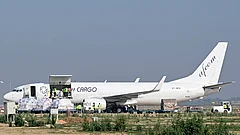
That distinction matters because US sanctions can create compliance risks for companies and financial institutions far beyond transactions physically taking place in the US. OFAC maintains extensive Russia-related sanctions, and Volga-Dnepr Airlines itself has been designated under the US Russia sanctions programme.

But Delmos is questioning how broadly those restrictions are being applied at Mumbai.
The agent says the cargo in question can involve an Indian logistics company physically moving the shipment, while the shipper and consignee are not sanctioned entities. It has also asked why Russia-related cargo can apparently move through Mumbai on other international carriers, including Emirates, Turkish Airlines and Ethiopian Airlines, while shipments booked on Aeroflot and Volga-Dnepr are being stopped.
There is another wrinkle. Delmos said a Volga-Dnepr charter operation at Navi Mumbai Airport had its slot arrangements confirmed initially but subsequently revoked. Rao has asked the Ministry of Civil Aviation to intervene and clarify the basis on which the restrictions are being imposed.
So far, the dispute is less about a declared government ban on Russian cargo than about how an airport operator is interpreting its sanctions-compliance obligations.

What Happens To Cargo At Mumbai Airport?
Air cargo rarely travels directly from a factory door to an aircraft. It moves through a chain of paperwork, trucking, customs checks, warehouse acceptance and airline handling.
At Mumbai, cargo booked for export is brought to the airport after the shipment and booking details have been checked. The cargo custodian accepts and stores the shipment before it is moved into the relevant airline warehouse and eventually placed on the aircraft. Customs-controlled goods also have to pass through the appropriate examination and clearance processes.
That chain depends on one deceptively simple step: the airport accepting the cargo in the first place.
If that step stops, the rest of the journey freezes.
Delmos said the process for Aeroflot and Volga-Dnepr shipments had effectively been halted for about two weeks. Trucks carrying cargo to the airport were being forced to return to their points of origin, according to reporting citing the airline agent.
By October 5, around 2.5 tonnes of cargo were sitting in the airport warehouse, while another 12.5 tonnes were awaiting carting so that Delmos could assemble a commercially viable 15-tonne truckload. The cargo had already been waiting for about a week, according to Rao, with demurrage charges accumulating, according to Economic Times.
And that is where a sanctions dispute becomes a business problem.
Mumbai airport's own published tariff structure provides for a limited free period before storage and demurrage charges begin. For imports, the free period is generally 48 hours after segregation, while demurrage rises with the length of the delay. Terminal storage and processing charges also apply.
For a shipper, therefore, a cargo refusal can mean more than a missed flight. It can mean a truck returning empty, warehouse space being occupied, cargo being rerouted, additional handling and storage charges, and potentially higher freight costs if another carrier or airport has to be found.
The longer the cargo remains in limbo, the more expensive the limbo becomes.

Why The Timing Of Adani's $1 Billion Fundraise Matters
The timing has added another layer to an already sensitive dispute.
On September 9, Adani Airport Holdings announced that it had entered into agreements to raise about $1 billion in primary equity from a consortium comprising Alpha Wave Global, Premji Invest, Temasek and BlackRock-managed funds. The transaction valued the airport platform at about $18 billion before the investment. Upon completion of the three tranches, the investors are expected to hold about 5.54% of AAHL, while Adani Enterprises remains the controlling shareholder.
The Russian-cargo restrictions were reported to have been in place for roughly two weeks by October 5. That places them within weeks of the fundraise announcement — close enough for the timing to attract scrutiny, but not enough to establish that one caused the other.
People aware of the development told The Economic Times that the decision followed the $1 billion investment, while Delmos has explicitly sought clarity over the sanctions rationale. But there is no public evidence establishing that the fundraise itself prompted the cargo restrictions, and Adani Airports has not responded to queries on the matter.
That leaves the central question hanging between two very different worlds: international sanctions and Indian aviation logistics.
India continues to maintain trade relations with Russia, while Indian businesses operating in globally connected sectors must also navigate the compliance risks created by Western sanctions. The airport sits precisely at that intersection.
For now, the cargo is the clearest measure of the dispute. Some of it is sitting inside the warehouse. Some is waiting outside. And some trucks, having arrived at the airport with a shipment that was supposed to fly, are turning around and going home.
The question is not merely who can carry Russian cargo out of Mumbai. It is which rules the cargo is expected to obey before it is allowed to leave.















