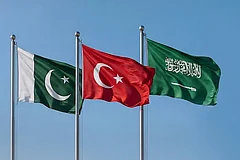
Pakistan and China operationalised their Boundary Joint Commission at an inaugural meeting in Islamabad on September 16.
The commission will cover border management, joint surveys, trade flows and people-to-people connectivity between the two countries.
India rejected the commission, saying Pakistan cannot enter arrangements concerning Indian territory under its occupation.
India on September 16, rejected the so-called Pakistan-China Boundary Joint Commission, saying it has no legal basis and that Pakistan has no right to enter into arrangements concerning Indian territory.
Responding to media queries, the Ministry of External Affairs (MEA) said India’s position was “clear and consistent” and that there is no boundary between Pakistan and China.
On September 16, Pakistan’s Foreign Ministry announced the operationalisation of the Pakistan-China Boundary Joint Commission following its inaugural meeting with Chinese officials.
“In a significant milestone for Pakistan-China relations,” the ministry said on X, the commission would facilitate greater cooperation in border management, joint border surveys, trade flows and people-to-people connectivity.
India rejected the move, saying Pakistan has no locus standi to enter into arrangements concerning Indian territory under its “illegal and forcible occupation”

What Is The Boundary Commission?
According to Pakistan's Dawn, the commission has its origins in the 2013 Agreement on the Boundary Management System signed during the visit of then Chinese Premier Li Keqiang to Islamabad.

Article 45 of the agreement provided for a joint commission to oversee implementation of border management arrangements.
The commission is intended to coordinate matters relating to the Pakistan-China border, including movement through the Khunjerab crossing and trade and connectivity linked to the China-Pakistan Economic Corridor (CPEC).
CPEC connects Kashgar in China with Pakistan's Gwadar port on the Arabian Sea. It is part of China's Belt and Road Initiative (BRI). India has consistently objected to CPEC because it passes through Pakistan-occupied Kashmir (PoK).

The 1963 Agreement
India's objections to the latest commission are rooted in the China-Pakistan Boundary Agreement of 1963.
MEA said India has never recognised the agreement and has consistently maintained that it is “illegal and invalid”. The agreement was signed as Pakistan's relations with China were deepening.
Under it, Pakistan ceded the Shaksgam Valley, also known as the Trans-Karakoram Tract, to China. The region is part of the Hunza-Gilgit area occupied by Pakistan and lies north of the Siachen glacier. India claims the territory as part of Jammu and Kashmir.
The issue resurfaced in January this year when India rejected Chinese infrastructure-building plans in the Shaksgam Valley.

Aksai Chin And Nehru's Objections
The wider territorial dispute also involves Aksai Chin. India has always considered the region part of Jammu and Kashmir. In the 1950s, China built a highway connecting Tibet with Xinjiang through the region. China has since claimed Aksai Chin as part of Hotan county in Xinjiang.
The 1963 agreement itself stated that after a settlement of the Kashmir dispute between India and Pakistan, the “sovereign authority concerned” would reopen negotiations with China and work towards a formal boundary treaty.
According to the Nehru Archives quoted by Indian Express, then Prime Minister Jawaharlal Nehru criticised the agreement in Parliament on March 5, 1963. He said India believed the agreement had been timed to influence the ongoing discussions on Kashmir and other related matters.
Nehru also said China was interfering in India-Pakistan relations and that India had lodged a protest with Beijing.
India's Position
India has continued to reject subsequent developments related to the China-Pakistan boundary arrangement.
In a 2022 Lok Sabha reply, then Minister of State for External Affairs V Muraleedharan said China was in illegal occupation of approximately 38,000 square kilometres of Indian territory in Ladakh, Indian Express reported.
He also said Pakistan had, under the 1963 agreement, illegally ceded 5,180 square kilometres of Indian territory in the Shaksgam Valley to China.