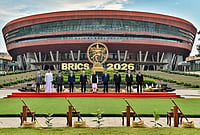
Prime Minister Narendra Modi and Chinese President Xi Jinping expressed differing positions on linking the boundary dispute to broader bilateral ties during the BRICS Summit in New Delhi.
New Delhi maintained that peace and tranquillity along the border remain an indispensable foundation for the normal development of overall relations.
Beijing proposed parallel, mutually reinforcing progress, suggesting that bilateral cooperation should advance alongside efforts to resolve the unresolved boundary question.
India and China have again set out different positions on how the border dispute fits into wider ties after Prime Minister Narendra Modi met Chinese President Xi Jinping on Saturday on the sidelines of the BRICS Summit in New Delhi.
Their official readouts show that New Delhi continues to treat peace on the border as the basis for broader ties, while Beijing argues both tracks should move together. The split matters because Xi was in India for the first time in seven years after the 2020 Galwan Valley clash, which killed 20 Indian soldiers and four Chinese Army personnel.
Since 2020, India has held that the border question and the wider relationship cannot be separated. China’s latest wording, by contrast, leaves room for bilateral ties to make headway while the boundary question remains unresolved.
China's Parallel Approach
Beijing framed both tracks together. In its statement after the meeting, China said both sides should push the relationship and the boundary question forward together. The Chinese readout used the phrase "parallel, mutually reinforcing progress" to describe that approach.



“The two sides should stay committed to advancing bilateral relations and resolving the boundary question, seek parallel, mutually reinforcing progress, and maintain peace and tranquility in the border areas,” the Chinese statement said.
That formulation leaves space for broader engagement while the boundary dispute remains open.
India's Border Position
India’s readout put the border first.
In the Indian statement, Modi said peace and tranquillity in the border areas remained "an essential basis for the continued development of bilateral relations". He also called for both countries to keep to existing agreements and understandings on border-related issues.
The statement added that the two leaders backed a "fair, reasonable, and mutually acceptable" settlement of the boundary question, while taking into account the wider bilateral relationship and the long-term interests of people in both countries.
That has been New Delhi’s position since the Galwan clash. India says the border must stay calm and existing agreements must be observed before the wider relationship can move normally.
No New Mechanism
No new channel emerged.
In their meeting on September 12, 2026, Modi and Xi did not announce or schedule any fresh institutional dialogue mechanism in New Delhi. Instead, the readouts pointed back to existing arrangements and earlier talks.
According to the MEA statement, the two leaders reaffirmed adherence to existing border agreements and understandings, and noted the 25th Round of Special Representative talks on August 25, 2026, as well as senior military commander-level flag meetings on September 6–7, 2026.