



Brent and WTI crude prices fell more than 8% as markets assessed the possibility of a US-Iran diplomatic agreement.
Global oil supplies have recovered, while weaker demand and increased Latin American exports have contributed to a market surplus.
Gulf oil exports remain below pre-war levels, and low global inventories could keep prices volatile.
The Democratic Party’s sweeping victory in the US midterm elections has dealt President Donald Trump a major political setback, increasing pressure on his administration over the US-Israeli war with Iran, now in its ninth month. With Democrats set to take control of both the House of Representatives and the Senate in January 2027, Trump faces the prospect of a Congress more willing to scrutinise his military decisions, question the cost of the conflict and challenge his administration’s approach towards Tehran.
The results, described as a ‘blue tsunami’ after Democrats made significant gains in traditionally Republican strongholds, also reflect growing voter dissatisfaction with the war, rising fuel prices and the cost of living. While the election does not immediately change Trump's powers as commander-in-chief, it raises the political cost of continuing military operations without a clear resolution.
What Does The ‘Blue Tsunami’ Mean For Trump’s Iran War?
The term ‘blue tsunami’ describes the scale of the Democratic Party's gains, with blue being its political colour. Democrats won control of both chambers of Congress, flipping Republican-held seats across the country.
The result is significant because the Iran war has become a political liability for Trump. The conflict, which began in February, has contributed to rising fuel prices and economic uncertainty. Democratic candidates repeatedly blamed the administration's military campaign for increasing the cost of living.


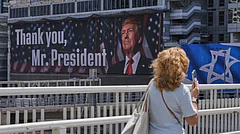
Trump himself acknowledged the war's role in the Republican defeat. Speaking to Fox News, he said, “I think a part of it was Iran.” He separately told The Wall Street Journal, “Iran was a piece of it.” However, he defended his decision to attack Iran, saying, “I did the right thing” and “I would have done it again”, Reuters reported.
Under the War Powers Resolution, the president is generally required to terminate the use of US forces in hostilities within 60 days of submitting, or being required to submit, a report to Congress under Section 4(a)(1), whichever comes first.
The period may be extended by up to 30 days only if the president certifies in writing that unavoidable military necessity concerning the safety of US forces requires their continued deployment to facilitate their prompt withdrawal. This is not a general extension to continue combat operations.
The application of the law to the Iran war has already been disputed. After the original 60-day deadline expired on May 1, the Trump administration argued that the April ceasefire had terminated hostilities. It later notified Congress that fighting had resumed on July 7, treating the notification as opening a new 60-day window, an interpretation challenged by lawmakers.
Democrats could use their incoming congressional majorities to investigate the administration's legal justification for military action, hold hearings and seek restrictions on military operations or defence spending. The 60-day period does not restart simply because a new Congress takes office.
Could The Election Push Trump Towards A Deal With Iran?
Two sources close to Gulf government circles told Reuters that Trump's midterm setback had increased his incentive to seek a negotiated end to the war. With Democrats set to control Congress and potentially constrain his military options, the sources said, another full-scale assault on Iran now appeared less likely.
However, Iran is not assuming that the election will automatically change Washington's policy. Supreme Leader Mojtaba Khamenei has said those expecting the results to alter the US approach are “deeply mistaken”, CNN reported. Tehran is preparing for further conflict even as it continues diplomatic efforts.
The possibility of escalation remains real. “The danger is that a president weakened at the ballot box may seek redemption on the battlefield,” Ali Vaez of the International Crisis Group told CNN, warning that Trump faces a choice between pursuing a face-saving agreement and intensifying military action.
Trump, however, has alternated between threatening further strikes and suggesting that he could end the conflict, Reuters reported.
Diplomatic efforts have continued through Qatar. CNN reported that talks, which had stalled over the summer, picked up in the week before the election as Iranian officials approached Qatari mediators.
A Reuters report said Iran and the US remained far apart on an agreement, with Qatar facilitating the exchange of proposals. Tehran's September seven-step proposal called for the US to end its naval blockade of Iranian ports, Iran to reopen the Strait of Hormuz, Washington to ease restrictions on Iranian oil sales and cancel new sanctions, followed by talks on other issues. Iran has since said the plan could be implemented within two days.
A separate draft circulated by Qatar in late October proposed a seven-day sequence of confidence-building steps, which an Iranian official described as unacceptable. The diplomatic exchanges have yet to produce an agreement.
The diplomatic efforts have continued alongside military action. Reuters reported that the US carried out limited strikes on Iran's Qeshm Island on November 2, targeting surface-to-air missile systems that a US official said were being used against American assets. A US official described the operation as defensive and said it did not signal a return to major combat operations.
Qatari Foreign Ministry spokesperson Majed al-Ansari said both Washington and Tehran were reviewing proposals put forward by mediators. “There are intensive joint regional efforts underway to avoid escalation,” he said, adding that Qatar remained hopeful an agreement could pave the way for further negotiations.
How Are Oil Markets Reacting?
Brent crude futures were trading at around $93.70–$93.80 a barrel on Thursday, down about 0.8 per cent. US West Texas Intermediate (WTI) crude was trading at around $86.80–$87.00 a barrel. Both benchmarks had fallen more than 8 per cent in the previous session, reaching their lowest levels since late August, Reuters reported.
Oil prices fell as markets weighed the possibility of reduced military escalation and a diplomatic agreement. Crude shipments through the Strait of Hormuz have also recovered to near pre-war levels, although shipping costs remain higher, Reuters reported.
JPMorgan estimated that the global oil market moved back into a surplus of 1.1 million barrels per day (bpd) in September. The surplus widened to 1.4 million bpd in October. Middle Eastern oil exports also recovered, rising to around 20.7 million bpd from 9.8 million bpd in March.
However, higher supplies are only part of the picture. Oil demand has fallen by an estimated 3.3 million bpd since the conflict began, according to JPMorgan. Latin American crude supplies have also increased by around 1.5 million bpd compared with the same period last year, adding to the global surplus.
Despite the recovery in exports, Gulf shipments have yet to return fully to pre-war levels. Reuters, citing Vortexa data, reported that exports of crude oil, condensate and refined products, excluding liquefied petroleum gas, averaged 17.1 million bpd in October. This was around three-quarters of pre-war levels.
Crude and condensate exports had recovered to 86 per cent of pre-war levels, while refined-product shipments remained just above half. These figures are preliminary and could be revised upwards. Some tankers have switched off their tracking signals as a safety measure amid risks around the Strait of Hormuz. The figures cover exports from a wider Gulf region and are not limited to shipments through the strait.
There are also signs of continued demand in the US. The Energy Information Administration said on Wednesday that US inventories of crude oil, gasoline and distillates all fell in the previous week. Demand, measured by the volume of petroleum products supplied, reached its highest level in a year.
However, lower oil prices may not last. Commercial oil inventories in major consuming countries are close to their lowest levels in 15 years. Uncertainty over diplomatic efforts and continuing geopolitical risks could keep oil markets volatile, Reuters reported.
What Happens Next?
The Democratic victory has raised the domestic political cost of continuing the war, but it does not compel Trump to end the conflict or rule out further military action. Democrats will take control of Congress in January, giving them greater scope to scrutinise the administration and challenge its military decisions. For now, the outcome will depend on whether Qatar's mediation can bridge the differences between Washington and Tehran or whether the two sides return to military confrontation.















