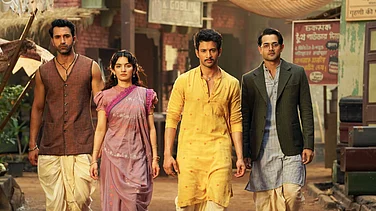
Ramayana Part 1 creates an expansive mythological world with impressive visual effects and production design.
Yash’s Ravana commands attention, while Ranbir Kapoor’s Ram lacks the character’s expected composure.
The film underdevelops Sita and overlooks the emotional and philosophical significance of Bharat.
There are only a few stories in Indian culture that carry the weight of the Ramayana. Its characters have been interpreted across generations, languages and artistic traditions, with each retelling finding its own way of approaching the epic. Bringing such a story to the big screen is an enormous undertaking, particularly when the ambition is to create a mythological world that can speak to audiences across the globe.
Nitesh Tiwari’s Ramayana: Rise of A Legend certainly has that ambition. Its scale is evident in the production design, visual effects and the sheer effort invested in bringing its world to life. Yet, somewhere between the spectacle and the storytelling, the film loses sight of what makes the epic endure. It gives us a world worth looking at, but does not always give us characters whose inner lives we can connect with.
The film follows Ravana’s (Yash) rise alongside Ram’s (Ranbir Kapoor) journey, beginning with his marriage to Sita (Sai Pallavi) and subsequent exile for 14 years after Kaikeyi (Lara Dutta) invokes a promise made by King Dasharatha (Arun Govil). Accompanied by Sita and Lakshman (Ravi Dubey), Ram’s exile sets the stage for the events that will bring him into conflict with Ravana.


The film's greatest achievement is its visual world. The VFX is immersive, the scale is considerable and the environments have a sense of grandeur that Indian mythological cinema has often struggled to achieve convincingly. Namit Malhotra's efforts to bring this ambitious world to the screen have largely paid off. The visual effects are not merely decorative additions to the narrative; they are central to the film's ambition, lending weight to its landscapes, architecture and action sequences. There are moments when the sheer scale makes the theatrical experience worthwhile. Nitesh Tiwari demonstrates a clear understanding of the visual demands of a story this vast, but his direction is less assured when it comes to holding the narrative together.
The screenplay struggles to give its many characters and parallel threads enough emotional depth, making the storytelling feel uneven despite the grandeur on screen. The music works well in several stretches and adds to the film's mythological atmosphere, while Yash's characterisation as Ravana gives the narrative a compelling centre. Ultimately, the technical ambition has translated successfully into a striking visual experience, but the writing does not always match the scale of the world being created.
However, scale is not the same as substance. The opening stretches of the film rely heavily on violence to establish the brutality of its world. While the conflict and bloodshed are part of the larger narrative, the excessive violence can become distracting. The film is so occupied with demonstrating the magnitude of its universe that it occasionally forgets to give its characters enough room to breathe.
The decision to use relatively accessible, spoken Hindi is understandable, especially for a story intended to reach a wide audience. Yet the dialogue does not always sound natural. At times, it lacks the rhythm, weight and emotional resonance that a story of this stature demands. The language need not be archaic to feel rooted in the world of the Ramayana, but it should carry a sense of occasion.


If one performance consistently holds the screen, it is Yash as Ravana. The film makes an effort to present him as more than a conventional antagonist. He is a scholar, a devotee of Lord Shiva, a capable ruler and a formidable warrior. His intelligence and devotion coexist with an extraordinary capacity for cruelty, making him a character driven by several competing impulses. The film's device of presenting his ten heads as different voices or aspects of his inner self is an interesting way of approaching this conflict.
His relationship with his mother also offers an emotional context for understanding the man he becomes. These moments help establish that Ravana's journey is not simply about the pursuit of power. Yash brings the necessary authority and intensity to the role, moving between the character's scholarship, devotion, ambition and ruthlessness without losing his commanding presence. His performance gives the film some of its most engaging moments.

Ranbir Kapoor's Ram, on the other hand, remains less convincing. Ram is traditionally understood as Maryada Purushottam: a figure whose strength lies as much in his restraint, composure and sense of duty as in his physical abilities. This does not mean he must be presented as someone without doubts or vulnerabilities. In fact, allowing him to question himself could make the character more human. The problem is that the film does not always make those internal conflicts sufficiently clear. Ranbir's portrayal often feels anxious and uncertain, with Ram appearing to seek reassurance or validation from those around him. His dialogue delivery, too, does not consistently convey the authority and calm one expects from the character.
There is a difference between portraying a human Ram and presenting a Ram who seems unsure of his own place in the world. The film needed to establish that distinction more carefully.

Sai Pallavi brings a welcome sense of agency to Sita. She is not presented merely as a passive figure accompanying Ram into exile. The film allows her to display courage and physical strength, including moments that establish her as someone capable of defending herself. This is an important dimension of the character, and Sai Pallavi brings sincerity to the role.
But Sita's strength should not be measured only through her ability to fight. Her intellectual and emotional companionship with Ram is just as important to their relationship. The two are meant to share a bond built on affection, understanding and a deep engagement with each other's choices. The film gives this relationship surprisingly little room to develop. Their exchanges are brief, and songs often take the place of conversations that could have revealed more about their connection. As a result, their chemistry does not acquire the emotional depth the story needs.

The treatment of the Lakshman Rekha also deserved greater thought. It is a familiar element in popular retellings, but its implications are worth examining, particularly in a film that otherwise attempts to present Sita as an independent and capable character. The film could have used this moment to explore the tension between protection, agency and choice rather than treating it as another established feature of the narrative.
Ravi Dubey brings an entertaining energy to Lakshman. His performance adds warmth and a lighter touch to the film, although the character could have benefited from a more substantial emotional journey of his own. Lara Dutta's Kaikeyi has the potential to be a significant presence, but her transformation feels abrupt. The film does not spend enough time establishing the motivations and emotional circumstances behind her decision. Arun Govil is well suited to Dasharatha, while Rakul Preet Singh's Surpanakha and Vivek Oberoi's Vidyutjihva add interest to the larger world.

Bharat's (Adinath Kothare) limited presence is another shortcoming. His relationship with Ram is one of the epic's most important emotional and philosophical threads. His response to Ram's exile and his refusal to occupy the throne in his brother's absence speak to the values of duty, love and rightful responsibility. Shatrughan, too, receives little acknowledgement. By giving these relationships so little space, the film overlooks an important part of the story that unfolds beyond Ram's years in exile.
Ultimately, the Ramayana is not remembered simply because it contains gods, demons, wars and extraordinary feats. It has endured because it examines human behaviour, moral responsibility, relationships, desire, ego and the difficult choices people make when their duties pull them in different directions. Its spiritual and philosophical dimensions are inseparable from its spectacle. A film of this scale has the opportunity to introduce those ideas to a new generation and to audiences beyond India. That ambition deserves to be taken seriously.

Ramayana Part 1 has the technical resources and visual imagination to create a formidable cinematic world. Yash's Ravana is a major strength, and the film's production scale is impressive. But the spiritual bond between Ram and Sita, the emotional weight of family relationships and the philosophical conflicts at the heart of the epic remain underexplored. A story this deeply embedded in our cultural imagination deserves more than grandeur. It needs emotional conviction, too.
For all its visual ambition, Ramayana Part 1 has yet to find that balance.