



Turkey has rejected Malaysia’s proposal to relocate 10,000 Rohingya refugees through a skills-training programme.
More than 1.2 million Rohingya refugees remain in Bangladesh, while Malaysia hosts over 133,000 registered Rohingya refugees and asylum-seekers.
The rejection highlights the challenges of third-country resettlement and international responsibility-sharing amid the continuing Rohingya crisis.
Malaysia’s proposal to relocate 10,000 Rohingya refugees to Turkey has exposed the limits of international support for a community that remains displaced nearly a decade after fleeing a military crackdown in Myanmar. Deputy Prime Minister Ahmad Zahid Hamidi announced a plan to relocate the refugees to Turkey through a structured skills-training programme. Ankara, however, called the announcement “unfounded”, and Prime Minister Anwar Ibrahim subsequently clarified that Turkey was not prepared to consider the proposal.
How The 10,000-Rohingya Proposal Fell Apart
On November 20, Deputy Prime Minister Ahmad Zahid Hamidi announced that Malaysia planned to relocate 10,000 Rohingya refugees to Turkey through a Technical and Vocational Education and Training (TVET) programme lasting between three and six months. He said the initiative followed his recent visit to Turkey and was intended to address Malaysia’s refugee situation in a more organised, effective and humane manner.
However, Turkey’s presidency department responsible for countering disinformation called the announcement “unfounded” and urged the public not to believe false information. Zahid’s Facebook post was subsequently removed.
On November 21, Zahid’s press secretary, Shuhaimi Mohamed, said Malaysia remained committed to pursuing the proposal, but that it required further clarification and coordination with the relevant parties. The proposal’s Cabinet approval was also disputed. On November 22, Agriculture and Food Security Minister Mohamad Sabu said it had not yet been discussed at a Cabinet meeting, contradicting Zahid’s announcement.
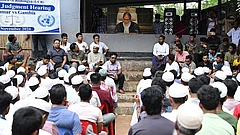


On November 24, Anwar told Parliament that Turkey had officially informed Malaysia two days earlier that it was not ready to accept the refugees. “Türkiye is among the countries hosting the largest number of refugees in the world, therefore, when they indicate they are not yet prepared, we respect that decision,” Bernama quoted him as saying.
He added that he would bring the matter to the Cabinet.
The proposed arrangement was described by Malaysia as a resettlement initiative, but the publicly available details focused on a short-term training programme. They did not clarify what long-term immigration or protection status the refugees would receive in Turkey.
From Myanmar To Malaysia: The Rohingya Refugee Crisis
The Rohingya are a predominantly Muslim ethnic minority from Myanmar’s Rakhine State. Decades of discrimination, restrictions on movement and the arbitrary application of Myanmar’s 1982 Citizenship Law have left most of the community stateless.
In August 2017, a military crackdown in Rakhine forced more than 750,000 Rohingya to flee to neighbouring Bangladesh. On November 19, 2026, the ICJ found that Myanmar had committed genocide against the Rohingya during the 2017 clearance operations, violating its obligations under the Genocide Convention. The Court also found that Myanmar had failed to prevent and punish genocide and had violated its 2020 order to preserve evidence related to the case. It ordered measures including safe, voluntary and dignified return for displaced Rohingya and the reunification of families.
More than 1.2 million Rohingya refugees remain in Bangladesh, most of them in camps in Cox’s Bazar. A report published in November 2026 by UNHCR and the University of Oxford found that 88 per cent of assessed refugee households reported deteriorating shelter conditions and limited ability to repair them. The humanitarian response also faced substantial funding shortfalls, with 59 per cent of requirements unfunded in 2025.
Malaysia hosts a substantial Rohingya population. According to figures cited by the Home Ministry from UNHCR, 133,400 Rohingya refugees and asylum-seekers were registered in the country as of September 30, 2026. The wider refugee and asylum-seeker population stood at 227,414, according to Home Ministry figures, including people from other Myanmar ethnic groups and other countries.
Malaysia is not a signatory to the 1951 Refugee Convention or its 1967 Protocol and has no comprehensive domestic asylum framework. Refugees have generally been treated as undocumented migrants under immigration law, leaving them vulnerable to detention and deportation, while facing barriers to formal employment, public education and healthcare. Malaysia is now shifting refugee registration to a government-led system under its Refugee Registration Document (DPP) programme. UNHCR halted new registration and documentation activities on November 18 following the government’s decision to take over the process, although it said other services, including urgent protection assistance and resettlement processing, would continue. The DPP programme does not confer permanent residence or citizenship.
Why Turkey Declined And Malaysia Is Running Out Of Options
Anwar cited Turkey’s existing refugee population as the reason for Ankara’s reluctance. He said the Turkish government had told him it was hosting more than four million refugees from Arab countries and neighbouring states.
The International Organization for Migration’s third-quarter 2026 report recorded more than 3.6 million foreign nationals in Turkey, including 2,206,483 Syrians under temporary protection. UNHCR separately recorded 145,155 refugees and asylum-seekers in the country in 2026.
But a host country cannot unilaterally resettle refugees elsewhere. Third-country resettlement requires the receiving state’s agreement and a legal status that provides international protection. UNHCR also plays a role in identifying and referring refugees for resettlement.
Malaysia is also pursuing repatriation through engagement with Myanmar’s military-backed government. Anwar said Myanmar had assured Malaysia that returnees would not be harmed and that discussions were intended to secure safe and dignified returns in line with the ICJ judgment.
Reuters reported that rights groups had warned that repatriation amid Myanmar’s ongoing civil war could endanger refugees and legitimise the military-backed government. Anwar said 10,476 Myanmar nationals had been repatriated following discussions with Myanmar, with the costs borne by the Myanmar government. However, a separate Home Ministry report put the number of Myanmar nationals repatriated in the first ten months of 2026 at 12,176. The two figures are not reconciled in the published accounts, and the ministry clarified that its tally was based on nationality rather than ethnicity. On October 6, Anwar had told Parliament that no Rohingya had been identified among those repatriated up to that point. He did not clarify on November 24 whether that position had changed.
OIC, Turkey-Malaysia Ties And The Question Of Responsibility-Sharing
Malaysia has also sought support through the Organisation of Islamic Cooperation (OIC). In a September 2026 statement, its Foreign Ministry called on OIC members and the international community to share the burden of supporting Rohingya refugees and host communities. It urged the restoration of Rohingya rights and citizenship in Myanmar and called for safe, voluntary, dignified and sustainable returns.
Anwar said Malaysia would continue looking for third countries willing to accept refugees, including OIC member states. However, neither this position nor the OIC’s broader calls for burden-sharing amount to a confirmed resettlement commitment by its members.
The disagreement comes against the backdrop of a broader strategic partnership between Turkey and Malaysia. The two countries established diplomatic relations in 1964, upgraded them to a Strategic Partnership in 2014 and a Comprehensive Strategic Partnership in 2022. Their first High-Level Strategic Council meeting was held in Ankara in January 2026. Both are also members of the OIC and the D-8 grouping.
There has been no indication in the public statements that Turkey’s refusal has triggered a wider diplomatic rupture. Until conditions in Myanmar permit that return, Rohingya refugees will continue to depend on protection in host countries and on other states agreeing to share the responsibility.








