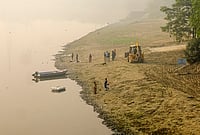
Thirty-nine farmers from Sindh have filed a lawsuit against German companies RWE and Heidelberg Materials
They are seeking more than €1 million in partial compensation for losses caused by Pakistan's 2022 floods
The case builds on a 2025 German court ruling in the RWE litigation, which left open the possibility of climate-related liability
For farmers in Pakistan’s Sindh province, the consequences of the 2022 floods did not end when the waters receded. Crops were destroyed, agricultural land was submerged and livelihoods were pushed into debt. Nearly four years later, 39 of them are pursuing an unusual legal route: asking a German court to make two of the country’s largest industrial companies contribute towards their losses.
The lawsuit, filed on December 22, 2025, at the Heidelberg Regional Court, names German energy company RWE and cement manufacturer Heidelberg Materials. The farmers are seeking approximately €1 million in partial compensation, arguing that the companies’ historical greenhouse gas emissions contributed to climate change, intensified extreme rainfall and caused identifiable damage to their farms.
The case raises a difficult question in climate litigation: can companies be held financially responsible for climate-related damage in another country based on their share of global emissions? The scientific link between human-induced warming and extreme rainfall is increasingly established, but translating that connection into civil liability requires a separate legal and evidentiary test.


What Are The Pakistani Farmers Seeking?
The 39 claimants come from three districts of Sindh: Jacobabad, Dadu and Larkana. According to the organisations supporting the case, they lost two growing seasons of rice and wheat after the 2022 floods damaged their land and crops. Their claim is for partial compensation for their individual losses, not the entire cost of the disaster across Pakistan.
The scale of the wider destruction provides context. The World Bank-led Post-Disaster Needs Assessment estimated that the floods caused $14.9 billion in physical damage and $15.2 billion in economic losses. Reconstruction and recovery needs were assessed at $16.3 billion. Sindh accounted for close to 70% of the combined damage and losses, while agriculture and livestock suffered an estimated $3.7 billion in damage.
For individual farmers, the losses extended beyond a single harvest. In an interview published by Dawn on November 10, claimant Abdul Khalique Laghari from Dadu estimated that he had lost $14,000 in assets, including his house, crops across 40 acres and livestock. He said his family was still struggling with debt.
The claimants initially notified both companies in October 2025 and invited them to engage in dialogue and mediation. After the companies declined to accept responsibility, the farmers proceeded with the lawsuit. No court has yet established that either company is liable or awarded compensation.

How Are Corporate Emissions Being Linked To The 2022 Floods?
The legal argument rests on a chain of causation involving four distinct elements: industrial emissions, global warming, intensified rainfall and the damage suffered by individual farmers.
Pakistan experienced exceptionally heavy monsoon rainfall between June and August 2022. The country received more than three times its usual rainfall in August, while Sindh and Balochistan recorded their wettest Augusts. Flooding affected approximately one-third of Pakistan, killing around 1,700 people and affecting more than 30 million.
A World Weather Attribution study published in September 2022 examined whether human-induced climate change had influenced the rainfall. It found that, based on observed trends, the five-day extreme rainfall across Sindh and Balochistan was around 75% more intense than it would have been without the observed 1.2°C of warming. The 60-day rainfall across the Indus basin was estimated to be around 50% more intense.
There are important qualifications. The researchers said high natural variability in the region and limitations in climate models made it difficult to quantify the overall contribution of human-induced climate change precisely. They also identified inadequate infrastructure, outdated river management, poverty and the vulnerability of settlements and agricultural land as factors that magnified the disaster.
The farmers' case seeks to connect this broader climate evidence to the emissions of the two companies. Their lawyers use the Carbon Majors database, which traces historical greenhouse gas emissions associated with fossil-fuel production and cement manufacturing.
According to calculations presented by the claimants, RWE accounted for at least 0.68% of global industrial emissions since 1965, while Heidelberg Materials accounted for at least 0.12%. These are figures advanced by the claimants using the Carbon Majors methodology, not judicial findings of corporate responsibility.
Even if the court accepts the wider scientific link between warming and extreme rainfall, the farmers must still establish how the flooding affected their particular land, crops and livelihoods, and how the companies' emissions can be legally connected to those losses.
What Is The Legal Argument Against RWE And Heidelberg Materials?
The farmers are relying on two provisions of Germany's Civil Code, the Bürgerliches Gesetzbuch (BGB).
Section 823 provides a basis for compensation when a person intentionally or negligently and unlawfully injures another person's life, body, health, freedom, property or another protected right. The claimants argue that major emitters knew about the harmful consequences of greenhouse gas emissions but failed to take adequate steps to reduce or prevent foreseeable damage. Their lawyers frame this as a breach of a legal duty of care.
Section 906 deals with interference with property through emissions from another property. Its provisions cover substances and effects such as gases, vapours, smoke and heat. Under certain circumstances, where a property owner must tolerate a substantial interference, monetary compensation may be available.
Applying these provisions to global greenhouse gas emissions is the novel part of the lawsuit. Section 906 traditionally concerns interference between properties, whereas the farmers are seeking to connect cumulative emissions from industrial activity in Germany to climate-related damage in Pakistan.
The claimants argue that a company need not be the sole cause of a climate-related loss to bear a proportionate share of responsibility. However, the precise legal basis and allocation of liability remain disputed.
There is also a difference in how the claim is characterised. The farmers describe their demand as partial, proportional compensation. Heidelberg Materials' April 2026 bond prospectus, however, describes the claim as one involving joint and several liability across 180 major emitters, under which the two defendants could be held liable for the entire damage attributed to those companies. The court will have to examine the legal basis and scope of the claim rather than treating either description as an established interpretation.

Why Can A German Court Hear A Case About Damage In Pakistan?
The case is possible because the two defendants are headquartered in Germany. Under Article 4 of the EU's Brussels I Recast Regulation, companies domiciled in an EU member state can generally be sued in that state's courts.
A separate question concerns which country's law applies. The EU's Rome II Regulation generally uses the law of the country where environmental damage occurs. But Article 7 provides an option for a claimant to rely on the law of the country where the event giving rise to the damage occurred.
That provision is relevant to the farmers' attempt to invoke German civil law, since the companies are headquartered in Germany and the alleged emissions arise from their industrial activities. It does not automatically settle which law governs every aspect of the case. The court must determine how the jurisdiction and choice-of-law provisions apply to the specific claims.
The distinction is important: the fact that German courts can hear a case against German companies does not, by itself, establish that the companies are liable for damage in Pakistan.
What Did The Earlier RWE Case Establish?
The farmers' lawsuit builds on a 2025 decision involving Peruvian farmer Saúl Luciano Lliuya and RWE.
Lliuya had argued that emissions from RWE's operations contributed to global warming, accelerating the melting of glaciers near his home in Huaraz, Peru, and increasing the risk of flooding from a nearby glacial lake. He sought a contribution from the company towards protective measures for his property.
On May 28, 2025, the Higher Regional Court of Hamm dismissed his claim. However, it held that a claim against a major emitter for cumulative, long-distance and long-term climate consequences was not automatically excluded under Section 1004 of the German Civil Code. It also said that the distance between the source of emissions and the affected property did not, by itself, prevent a legal claim.
The decisive obstacle was evidence of a concrete and sufficiently imminent threat to Lliuya's property. The court-appointed experts assessed the probability of the property being affected by the specific glacial-lake flood risk at around 1% over 30 years. The court consequently rejected the claim.
The ruling did not award damages against RWE or establish that the company was liable for the alleged harm. Nor did it decide the Pakistani farmers' claims under Sections 823 and 906. Its significance is narrower: it left open the possibility of examining whether a major emitter could face legal responsibility for climate-related effects abroad.

Is This Part Of A Wider Wave Of Corporate Climate Litigation?
The Pakistan case forms part of a growing set of lawsuits seeking to make companies answer for the consequences of their emissions. But these cases pursue different remedies and have reached different procedural stages.
In Switzerland, four residents of Indonesia's Pari Island brought a climate claim against cement manufacturer Holcim, seeking compensation, support for flood protection and stronger emissions reductions. The Cantonal Court of Zug declared the claim admissible in December 2025. Holcim said it would appeal, and legal aid for the appeal proceedings was granted in March 2026. This was a procedural decision, not a finding that the company was liable.
In the United Kingdom, survivors of Typhoon Odette, which struck the Philippines in 2021, have pursued a claim against Shell over alleged links between historical emissions and the storm's likelihood and severity. Shell disputes the scientific and legal basis for attributing a specific extreme-weather event to an individual company.
Another prominent case, brought by Dutch environmental organisation Milieudefensie against Shell, sought a court order requiring the company to reduce its emissions. In November 2024, the Hague Court of Appeal declined to impose the requested 45% reduction target, making it distinct from lawsuits seeking compensation for damage already suffered.
The range of cases shows that climate litigation is moving beyond demands for governments to adopt stronger climate policies. But admissibility, recognition of a legal duty and an actual award of damages are separate stages. None should be treated as proof that companies have been ordered to compensate communities for their share of historical emissions.
Can The Polluter Pays Principle Deliver Compensation?
The principle that those responsible for environmental harm should bear its costs is increasingly invoked in climate litigation. Its application to global emissions, however, faces difficult questions: how should responsibility be divided among thousands of emitters, how should historical contributions be calculated, and how can a court determine the share of a particular company's emissions in a specific disaster?
The Pakistan farmers must establish more than a general relationship between industrial emissions and climate change. They need evidence linking the companies' historical contributions to the intensified rainfall, the rainfall to the flooding of their land, and the flooding to the losses for which they are seeking compensation. They must also persuade the court that German civil law provides a remedy for those losses.
The defendants reject that argument. RWE has called the claim unfounded, arguing that it would undermine legal certainty to impose civil liability retrospectively for emissions that were permitted and regulated by the State. Heidelberg Materials has also said its operations complied with German law and that companies should not be judged retrospectively against different standards.
The case is likely to take years. Its immediate significance is therefore not that compensation has been secured, but that a group of farmers from a climate-vulnerable region is asking a German court to examine whether historical corporate emissions can create a legal obligation towards people affected far beyond the companies' home country. Whether that argument succeeds will depend on the evidence and the court's interpretation of German civil law.