US envoys Steve Witkoff and Jared Kushner held high-level meetings with Russian President Vladimir Putin in Moscow and Ukrainian President Volodymyr Zelenskyy in Kyiv.
Washington is advocating for a return to the trilateral negotiation format involving the US, Russia, and Ukraine, alongside potential European partner participation.
Russian President Vladimir Putin expressed full trust in US mediation, while Ukrainian officials noted that the American delegation presented new and more effective proposals.
The Trump administration has revived its diplomatic push to end Russia’s war in Ukraine, sending US envoys Steve Witkoff and Jared Kushner from Moscow to Kyiv in a fresh effort to reopen negotiations. No breakthrough was announced after their meetings with Russian President Vladimir Putin and Ukrainian President Volodymyr Zelenskyy, but Washington is now pressing for a return to trilateral talks involving the US, Russia and Ukraine.
In Kyiv on Sunday, September 6, Kushner said the US would keep trying diplomatically but could not promise a deal. It was the first official visit to Ukraine for Witkoff and Kushner. The renewed effort comes even as fighting continues across Ukraine and the main disputes that blocked earlier talks remain unresolved.
The diplomacy has moved quickly. Witkoff and Kushner met Putin in Moscow on Saturday and then travelled to Kyiv for talks with Zelenskyy on Sunday. Witkoff later said he was “confident that there’ll be a good resolution here”, while Zelenskyy said “several new ideas” came up during “good discussions” with the Americans.



Trilateral Talks Return
Washington wants the earlier trilateral format back. After meeting Ukrainian officials on Sunday, Kushner said, “One thing Steve (Witkoff) and I really thought would be productive is to go back to the trilateral format, which we were able to do about six months ago.”
He said that setup allowed direct contact between the two sides. “Everyone was speaking, you know, in Russian to each other and really discussing these issues in a very actually friendly manner, all in Russian,” Kushner said of the earlier negotiations.
The US has already floated the idea with both sides. Kushner said “hopefully we’ll have progress on that very soon”. Zelenskyy backed the idea but left room for a wider format, saying, “We must do everything possible to ensure that trilateral meetings take place – or trilateral meetings plus our European partners. We’ll see what Russia agrees to.”
Moscow And Kyiv
The shuttle diplomacy began in Moscow. Witkoff and Kushner held a three-hour meeting with Putin at the Kremlin on Saturday. Putin told them he had “full trust” in Washington’s mediation efforts between Moscow and Kyiv, and Witkoff described the encounter as a “good, concrete conversation”.
He argued that open channels with both capitals were essential. “If you don’t have relationships with both sides, and you have poor communication, then you probably have very, very little chance of getting to a peaceful resolution,” Witkoff said.
Moscow gave the talks a guarded but positive reading. Kremlin aide Yuri Ushakov called them “useful” and said the Americans had “prepared seriously for this trip”. The Kremlin said the Americans had “put forward a number of ideas on possible routes to a settlement”, without elaborating. A White House official told CNN the two sides “discussed substantive plans for next steps, which will be announced in the coming weeks.”
Witkoff said both sides would need to compromise, adding: “We think we have the ingredients to get to that place … and we look forward to continuing this as long as it takes.” Kushner said: “Hopefully this trip has come out with some new ways to advance forward. I think we’ve learned a lot from the trip.” Witkoff said he was hopeful a new round of US-mediated Ukraine-Russia talks would be announced “in short order”.
Kyiv followed immediately. Talks there on Sunday ran through three rounds. The first two involved American and Ukrainian officials, while the third included representatives from the United Kingdom, France and Germany, according to Kyrylo Budanov, head of the Office of the Ukrainian Presidency. It was the first visit to Kyiv for Witkoff and Kushner.
Washington brought fresh settlement ideas to Kyiv. Speaking to Agence France-Presse, a senior Ukrainian presidential official described the American negotiators' latest plans to halt fighting as “more effective”. “It’s not the same as it was before. This one now is more effective,” the official said after conferring with Zelenskyy. “They’re still talking. This is actually the most important part. There are three of them now.” Both envoys departed Kyiv early on Monday, Ukraine’s rail operator confirmed.
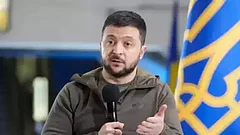
Zelensky said Ukraine, Europe and the US would meet again “in the near future”. “We want to prevent loss of life, we want this war to end fairly for all of us, and we want it to end in such a way that Russia’s aggression against Ukraine is never repeated,” he said. He also said Ukraine was holding more talks with British, German and French representatives, and earlier in the day said: “We are expecting one session of our talks, and then another session will be held with the European NSAs (national security advisors).”
On X, Zelenskyy wrote, “We hope that we will be able to reach arrangements with our American partners in this domain, and we hope for the support of European partners. If the war continues into the winter, we are counting heavily on the winter package, which I discussed in detail today with Steve, Jared, and our European partners. We are counting on support for air defense and the energy sector, as well as substantial volumes of American LNG and the ability to use them.” He also wrote, “I want to recognize the role of Steve and Jared in restarting the negotiation process today. It is important that the American team met with the head of Russia, and today with me, and that we discussed all the possibilities. We had a trilateral meeting with the participation of the Europeans, as well as a meeting of national security advisors, and I think we will do everything possible to restore these negotiations.”
Sticking Points Remain
The hard issues remain. Earlier US-mediated trilateral talks, held about six months ago, failed to narrow differences over territory and security guarantees for Ukraine.
Air defence is one of Kyiv’s most immediate concerns. Zelenskyy said shortages of interceptors had left Ukraine exposed to ballistic missile attacks, calling this its “weak spot”.
He also pointed to hopes of more support on Patriot systems. “The US side will increase production volumes of Patriot anti-ballistic missiles next year,” Zelenskyy said. He added, “We’re counting on such systems to defend our country, so we’ll increase the volume next year – I’m confident of that.”
Kyiv wants help before temperatures drop. Speaking at a press briefing, Zelenskyy said discussions focused on Patriot units and a "winter package" covering protective shields and power grid infrastructure. Ukraine is pursuing "serious volumes" of US assistance alongside European backing, he added, warning that combat would likely persist through the colder months.
Zelenskyy also said Russia had intensified strikes on Ukrainian cities before Russia’s State Duma election later this month, calling the attacks deliberate “terror” against civilians. Ukraine was working with 67 domestic companies developing systems to shoot down Russia’s jet-powered drones at scale, he said. The sides agreed to hold a follow-up meeting involving Ukraine, the US and Europe, with a location still to be set.
Putin has repeatedly said Moscow intends to seize the rest of eastern Ukraine, while Zelenskyy insists Russia should not be rewarded for its aggression.
That leaves the main question unanswered. Another round of trilateral diplomacy may restart contact, but it is still unclear whether it can move the sides past the same disputes that stalled the last effort.
Truce And Attacks
A narrow truce accompanied the visits. Russia and Ukraine agreed to pause airstrikes on each other’s capitals while the US envoys were in transit, a 72-hour arrangement that began at midnight on Friday into Saturday.
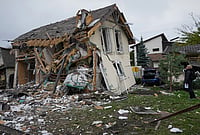
The pause was limited. It covered Kyiv and Moscow, but not the rest of Ukraine. Russia continued bombardment elsewhere overnight into Sunday.
The scale of those attacks remained high. Ukraine’s Air Force said Russian forces launched 108 Shahed-type drones and strikes were recorded at 11 locations. At least three people were killed in the latest attacks.
The wider toll was higher still. Ukrainian authorities said 10 civilians had been killed and 65 injured over the previous 24 hours, underlining how far the diplomacy remains from a broader ceasefire.