Bangladesh’s $335.78 million Chinese loan will fund the expansion and modernisation of Mongla Port.
A proposed Chinese-backed economic zone near Mongla adds another layer to India and China’s competing interests in Bangladesh.
China’s role in the Teesta River project raises questions about water-sharing, regional connectivity and India’s strategic concerns.
Bangladesh’s $335.78 million loan from China to modernise Mongla Port comes as Beijing expands its infrastructure presence in the country and Dhaka recalibrates its relationships with New Delhi. The loan formalises Chinese financing for a port expansion project approved in February 2025 and contracted to CCECC in March that year. The project is intended to expand container-handling capacity and upgrade cargo facilities.
Separately, Bangladesh has signed an initial agreement with a Chinese state-owned company to develop a proposed economic zone on land previously earmarked for an Indian-backed project near the port.
India has an agreement allowing goods to move through Mongla and Chattogram ports, while a separate proposal for India Ports Global Limited (IPGL) to operate a terminal at Mongla became contentious in 2024. Bangladesh’s government denied that an Indian company had been appointed to run the port.
China’s involvement also extends to the proposed Teesta River restoration project, which has implications for water management and India’s strategic concerns over the project’s proximity to the Siliguri Corridor.

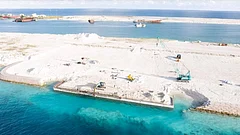

What China’s $335.78 million loan will fund
Bangladesh signed the formal loan agreement with China’s Export-Import Bank on October 10, 2026, securing RMB 2.404 billion, equivalent to Tk 3,592.90 crore or $335.78 million, for the Mongla Port expansion and modernisation project. The financing carries an interest rate of 2%, with repayment over 20 years, including a five-year grace period. Bangladesh had approved the project in February 2025 and signed a commercial contract with China Civil Engineering Construction Corporation (CCECC) the following month. The October agreement formalises the Chinese financing for that project.
The project is being implemented by the Mongla Port Authority under Bangladesh’s Ministry of Shipping. The October 2026 loan announcement says the works will include container-handling facilities, modern machinery, a container yard, a container delivery yard and a cargo-handling yard.
Located in southwestern Bangladesh on the Pussur River, Mongla is the country’s second-largest seaport after Chattogram. Its access to the Bay of Bengal makes it important to Bangladesh’s trade network, while its location offers potential advantages for cargo moving between Bangladesh and India’s eastern and northeastern regions.
For China, the loan adds to a wider economic relationship with Bangladesh that includes trade, infrastructure investment and defence cooperation. In February 2026, Reuters reported that Beijing was expanding its investment and diplomatic outreach as relations between Dhaka and New Delhi deteriorated after Sheikh Hasina’s ouster.
India’s port access and the IPGL question
India’s interest in Mongla is linked to cargo connectivity with its northeastern states. Under a 2018 agreement and its subsequent standard operating procedure, India can use Chattogram and Mongla ports to transport goods to and from its territory through Bangladesh. The arrangement facilitates cargo movement but does not give India ownership of either port or automatically grant India Ports Global Limited (IPGL) the right to operate a terminal.
IPGL’s proposed role was a separate issue. Indian media reports in July 2024, citing an unnamed Indian official, said the state-owned company would operate a Mongla terminal. Bangladesh’s then state minister for shipping, Khalid Mahmud Chowdhury, disputed those reports, telling New Age on July 29 that no private operator had been appointed and that the Mongla Port Authority continued to operate the terminals.
In June 2026, Bangladesh’s Economic Zones Authority signed a memorandum of understanding with China Civil Engineering Construction Corporation for a 110-acre economic zone beside Mongla Port. The land had previously been earmarked for an Indian economic zone under a 2015 bilateral initiative, but Bangladesh delisted the project in 2025 after the Indian-nominated developer failed to begin work within the stipulated period, The Business Standard reported. The MoU is an initial agreement; the Chinese company must prepare a master plan before further agreements can be considered.
The developments expand China’s economic role around Mongla and leave New Delhi facing the challenge of maintaining its connectivity interests as Chinese-backed projects advance.
The Teesta project and strained Dhaka–Delhi ties
China’s involvement in Bangladesh’s Teesta River Comprehensive Management and Restoration Project adds another dimension to the relationship. After Bangladesh sought Chinese support in May 2026, the two countries agreed to pursue cooperation on the project in June. China Exim Bank expressed interest in financing it, but no financing agreement has been finalised. A fresh feasibility study is planned for completion by March 2028, making construction unlikely before 2029, The Business Standard reported.
China said its cooperation with Bangladesh was not directed against a third country. The Teesta flows through India before entering Bangladesh, and the two countries have not resolved their longstanding dispute over water-sharing. The proposed project’s proximity to India’s strategically sensitive Siliguri Corridor has also drawn attention in New Delhi.
Bangladesh has presented the project as a development priority, while China has expressed willingness to support its infrastructure plans. The Indian Express reported that India offered technical and conservation assistance for the Teesta basin in 2024. The three countries have different priorities: Bangladesh emphasises water management and livelihoods, China seeks deeper development cooperation, and India is concerned about water-sharing and the strategic implications of Chinese involvement near its border.
The wider diplomatic context has changed since Hasina fled to India in August 2024. Dhaka’s demand for Hasina’s extradition remains a major point of friction, although Prime Minister Tarique Rahman has also sought to improve relations with New Delhi. Bangladesh continues to pursue Chinese financing for infrastructure while maintaining its economic and connectivity ties with India.
Mongla’s expansion does not mean China has acquired control of the port, nor does the loan cancel India’s existing cargo-access arrangement with Bangladesh. It does, however, show how financing, cargo routes and investment around Mongla are becoming part of a wider regional contest. The question is whether Bangladesh can expand its infrastructure with Chinese support while maintaining its existing arrangements with India—and how New Delhi will protect its connectivity interests as Beijing deepens its economic role in the country.