






Shehbaz Sharif says water cannot be used for political leverage as he raises the Indus Waters Treaty dispute at the SCO Summit.
India rejects the Hague tribunal’s ruling on the 1960 treaty, calling the Court of Arbitration illegally constituted and denying its jurisdiction.
Narendra Modi urges SCO members to target terror financing, recruitment, radicalisation and safe havens while warning against double standards.
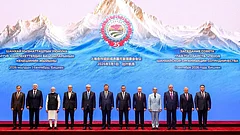
Pakistan Prime Minister Shehbaz Sharif on Tuesday used the Shanghai Cooperation Organisation (SCO) summit to reiterate Pakistan’s position on the Indus Waters Treaty, saying shared water resources must not be turned into a tool of political pressure. His remarks came a day after India rejected a Hague-based Court of Arbitration ruling that the 1960 treaty remains legally binding.
Addressing the SCO Council of Heads of State, Sharif described water as the region’s “lifeblood” and said it sustains millions of lives, supports agriculture and is crucial to the future of generations to come. According to India Today, his remarks came as India and Pakistan remain at odds over the treaty and the authority of the arbitration mechanism established under it.
Sharif Calls For Water Pacts To Be Honoured
Sharif said water could not be used as an instrument of coercion or political leverage, stressing that shared water resources were central to the region’s future.
“Water will not be allowed to be used as a weapon,” Sharif said, arguing that shared water resources must not be turned into an instrument of coercion or political leverage.


He also said agreements governing shared waters were binding international commitments and should not be set aside according to political circumstances.
“The treaties governing our shared waters are solemn binding international commitments. They are not matters of political conveniences to be cast aside at your will. They must be honoured unconditionally in both letter and spirit,” he said.
India Today reported that Sharif also placed the water dispute within the broader context of regional peace. He said South Asia could not realise its full potential without lasting peace and stressed the importance of diplomacy and regional cooperation in managing shared water resources.
His comments came a day after India dismissed the ruling by the Hague-based Court of Arbitration on the Indus Waters Treaty.
India Disputes Tribunal's Jurisdiction
The Court of Arbitration has ruled that the 1960 Indus Waters Treaty remains legally binding and that the dispute-resolution mechanism created under the agreement can continue to examine disagreements between India and Pakistan.
India has rejected the ruling, maintaining that it neither recognises the Court of Arbitration nor participated in its proceedings and therefore does not accept its jurisdiction.
New Delhi has described the tribunal as an “illegally constituted” body, arguing that it was created in violation of the provisions of the Indus Waters Treaty.
India has also maintained that the court has “no jurisdiction whatsoever” over its sovereign decisions. It has said the tribunal’s present or future pronouncements will have no bearing on India’s actions concerning hydroelectric projects.
New Delhi has further made clear that its decision to keep the Indus Waters Treaty in abeyance remains in force, despite the tribunal’s position that the pact continues to operate.
The dispute has intensified since India decided to suspend the operation of the treaty following the April 2025 Pahalgam terror attack, in which 26 people were killed.
Modi Focuses On Terrorism At SCO
Sharif’s remarks followed Prime Minister Narendra Modi’s address to the SCO summit, where India placed terrorism at the centre of its message.
Modi called on SCO member states to act against the entire ecosystem supporting terrorism, including terror financing, recruitment, radicalisation and safe havens.
"Terrorism continues to pose a serious challenge to humanity as a whole. In the fight against terrorism, we cannot remain confined to an action-reaction approach," he said.
He also warned against “double standards” in the fight against terrorism and said countries that provide shelter or support to terrorists must face a strong international response.
"We must dismantle the entire ecosystem of terrorist financing, recruitment, radicalisation, and safe havens. We must speak with one voice and make it clear that there can be no place for double standards on this serious issue," PM Modi said.
"We must send a strong message to countries that use terrorism as an instrument of policy and provide safe haven and support to terrorists that terrorism can never be a strategic asset for anyone," he added.
According to India Today, Modi also described the SCO as a confluence of great civilisations, cultures and ideas and outlined three key pillars for India’s vision for the grouping: security, connectivity and opportunity.















