



Prime Minister Mark Carney revealed Canada assessed potential US military attack risks.
Severe economic tariffs and failed negotiations have caused historic diplomatic strain.
Canada is now reducing its technological and defense reliance on Washington.
For nearly a century, Canada and the United States were held up as the model of a close alliance: a shared border, shared defence, deeply intertwined economies. That picture now looks very different. Under Donald Trump's second term, the relationship between Washington and Ottawa has slid into one of its worst phases in recent memory, with tariffs, collapsed trade talks and sharp rhetoric replacing the old warmth.
Now, Canadian Prime Minister Mark Carney has made a striking admission. In an interview with The New York Times, he said Canada had assessed the possibility of a US military attack, though he was quick to play it down, calling it "just risk management".
He described such a scenario as an "extreme tail risk". Even so, the fact that the question is being asked at all, and answered out loud, shows how far the two neighbours have drifted.

The US President Donald Trump in 2025 also clarified that it was "highly unlikely" for the US to ever use force against Canada.


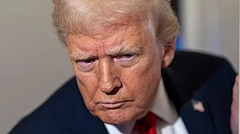
He maintained that, in order to achieve the economic and political goals, he will continue to exert pressure through economic tariffs. However, relations between both nations are in the worst phase of the recent past.
Deteriorating Relations Between Canada And the US
The relationship between the two countries has headed south ever since Donald Trump returned to White House in 2025 for his second term as president. Shortly after taking office, Trump imposed a 25 percent tariff on goods imported from Canada on February 4, 2025.
Trump argued that the tariffs were imposed due to the flow of fentanyl, a highly addictive and lethal drug, from Canada to the U.S. He warned that the tariff would not be lifted unless Canada controls the flow.

In February 2025, Trump wrote on his social media, “Canada should become our Cherished 51st State. Much lower taxes, and far better military protection for the people of Canada — AND NO TARIFFS!”
There was ongoing trade talk between both nations, which ultimately collapsed in August. Since then, both countries have imposed new, equal tariffs on each other- the US put 50 percent taxes on $20bn of Canadian goods, and Canada matched the same for the US goods.
Canada’s Response To Trump's Aggressiveness
Canada has responded politically as well as with economic tariffs to the remarks and tariffs of Trump’s administration. In his famous speech at the World Economic Forum, Davos, Carney warned that the global system order that was being led by the US is enduring “a rupture.”

He went ahead and said, “The old order is not coming back. We should not mourn it.” Carney added, “Nostalgia is not a strategy.”
Canada is also trying to reduce its dependency on the US. Al Jazeera reported that the Canadian authorities are reviewing its planned purchase of American F-35 fighter jets. Earlier, Carney had indicated that Canada also intends to reduce its reliance on SpaceX’s Starlink satellite internet service.
Why Plan for the Unthinkable?
Even though a war between the US and Canada is almost not possible in the near future, the remarks from the Canadian PM serve two purposes. Firstly, it reassures the citizens that the government is proactive, as after the US kidnapping of Nicolás Maduro in Venezuela, a Leger poll suggested that over 30% of Canadians believed that a US invasion was likely, BBC reported.
In the geopolitical world, his remarks act as a subtle deterrent and a diplomatic signal to Washington that Canada’s sovereignty is non-negotiable. Carney, in his speech at Davos, made it clear that if middle powers like Canada are not on “the table”, they will soon be on the “menu”.
History of US Attempts To Invade Canadian Territory
Even though the US and Canada emerged as strong strategic allies after the Second World War, historically the case was opposite. In the core of Canadian Identity sits its resistance to US expansionism in the 18th and 19th Centuries.
Canada was established as a nation as a collection of the British North American colonies. Even before Canada was officially formed, the US armies attempted to invade British North American colonies, taking control of Montreal in 1775 and nearly conquering Quebec City.
In the War of 1812, President Thomas Jefferson famously declared that conquering Canada would be a "mere matter of marching". US troops invaded the then Upper Canada and Lower Canada. The invasion was unsuccessful. The white house was burned by the British Army in the same war.
Even though the unease between the two nations is likely to continue for the near future, the doors of diplomacy are still open. In the interview given to the NYT, Carney said that he is open to a trade deal with Trump. He further said that they have spoken “frequently” since trade talks collapsed. It would be interesting to see how Trump responds after the upcoming midterm elections in the US are over.















