The Burning Giants premiered in Venice Film Festival 2026.
Phuttiphong Aroonpheng's latest drama is an Orizzonti selection.
The film is an allegorical riff on how a country silently wipes out its own in the guise of development.
Phuttiphong Aroonpheng is among the most aesthetically committed, politically cogent filmmakers working today. The Thai filmmaker who broke out with Manta Ray (2018) is back at Venice Film Festival, competing in Orizzonti with The Burning Giants. A mysterious virus cloaks a population in fear and uncertainty. There have been forceful evacuation, disappearances and uprooting of a community from their homes. When the film opens, we are placed right in its peculiar setting. Smoke envelops. The forest is manned by officers who have cordoned off entire sections.

Movement is heavily curtailed. The community that had its home in the forest’s depths has been driven out. One of the establishment’s units has captured a person from the ethnic community. Yak (Awat Ratanapintha) has been detained by the rangers. He’s chased and has scars all over his body. It’s contested whether the smoke carries the disease that has sparked this mass erasure. The actual reason precipitating the exodus gradually reveals murkier dimensions, nastier truths. Nothing is as it looks. The unit wonders if he too is infected. The higher ranges of the forests are off-limits for the community that once inhabited it. They are now scattered in other parts of Thailand, disparate and trying to rebuild their lives in unfamiliar spaces.


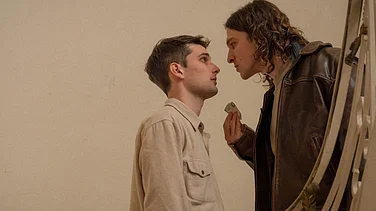
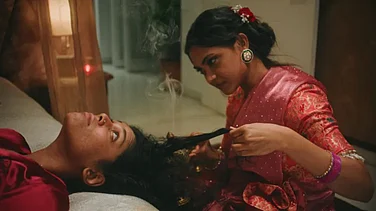
One of the officers, Lak (Pakapol Srirongmuang), is in a tentative relationship with Aepoh (Phunthida Phairuangkij). Her sister, Aeva (Waywiree Ittianunkul), still misses home and aches for her husband who’s left behind in the village. Lak clearly has strong feelings for Aepoh, but she keeps him hanging. She isn’t sure yet if she should turn the relationship anymore intense, a further step ahead. Aeva, who is anguished and pines for her husband, gently admonishes her sister to make up her mind. Daniel Hui’s editing suffuses these portions with a humming degree of involvement. There’s the brush of young lovers edging towards certainty juxtaposed with a wife’s yearning for her lost partner. Aeva raises her child alone with an unbending, practical resilience. But she also wants to reunite with her husband, determined to go to any length.
The film is on dodgier ground when it kneads around the government-backed squads and their dealings. A chief who might or not be infected is a concern that goes nowhere. But Aroonpheng is smart enough to know when to pull the plug and trundle away the needle. This intuition benefits the film greatly as it takes a stunning plunge into what’s concealed.

Recent and mythic past swirl in a mystifying, alluring concoction. The real thrust of the film comes in a latter detour, an audacious interruption that expands on our understanding of the volatile present. A great film proves itself when it can make its grand, unexpected pivot feel fluent and a natural bend. Just when the emotional complications of the trio begin to grip with feverish force, Aroonpheng scrubs those out, jolting away into a secret buried deep in the forest’s entrails. The region’s history of violence and oppression gets metaphorically entwined with the legend of the crown prince Rama who defeated the demon-king Ravana and laid Lanka to ruin. Rama is often celebrated as the hero. But The Burning Giants is more interested in the ogres, the marginalised left in the wake of the heightened carnage.

The Burning Giants isn’t afraid of ambition or bold swerves. It’s powered by faith in its intimate understanding of the forests, the atmosphere, the hierarchies sharpening between the tribals and the officers. The villagers are put under a mist of limited information. Power operates through fear, intimidation and shearing off access and privilege. Those left low on the rung have nothing by which to prise their way towards clarity. Accountability and justice become a tough sell. The strange, surreal final act breaks free from narrative constraints and order, dovetailing into a stage performance in the middle of a cave. A stage enactment of the Ramakien taps the liberation of the ‘ogres’. One of them, liberated, re-enters the everyday world, startled and disoriented by the changes wrought by time. Aeva and her long-lost husband, thus, gain centrality as the film’s engine. While one tries returning home, the other has to now encounter the world in its overwhelming new wash.

The Burning Giants finds haunting desolation in this figure of an ogre who has escaped (Thanatwut Rodpai). The actor anchors this final stretch without a line of dialogue but just potent body language that fills the frame with poignance and swelling dramatic effect. To watch someone catch up with a world that’s changed vastly, trying to merge in, makes for a deeply moving experience. This incredibly raw, affecting coda dredges up the humanity beneath the violence and displacement. New beginnings are possible, with some courage and willingness.