Uttam Kumar lived, died, and then lived again in an afterlife that has continued for almost half a century since his death.
When we talk about the man’s enduring popularity, we need to examine the collective psyche of the people who never quite let him disappear.
As long as his smile continues to seduce and intrigue us, the enigma of Kumar will remain alive—not in the answers we find, but in the questions we continue to ask.
A myth who never played a mythological role.
A talisman who hardly ever played a hypermasculine role.
A definition who rarely found a place in any academic discussion.
Uttam Kumar, an icon in the Bengali film industry and one of the three most enduring names in Bengali popular culture, will mark his birth centenary on September 3 this year. He lived, died, and then lived again in an afterlife that has continued for almost half a century since his death. Bengalis refused to forget him. Rather, they clung to his enduring legacy to such an extent that memory alone cannot define this phenomenon. It is memory intertwined with an uncanny affection that perhaps only Bengalis can experience—maya, moho, sneho (enchantment, infatuation, affection). Memories clouded by all three, which together could create an unforgettable, formidable legend like Kumar.


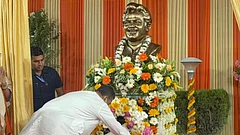

When we talk about the man’s enduring popularity, we need to examine the collective psyche of the people who never quite let him disappear. Many stars have achieved popularity, some undoubtedly far greater than Kumar did during his heyday. Yet, his demise created a unique void. The generations that followed either moved too far from Kumar’s ilk to occupy that space or, in their attempt to become more accessible to rural audiences, moved away from the sensibilities of the urban middle class. Others tried to reconstruct variations of his persona through their own middle-path, Kolkata-centric narratives. Some of these actors may even have been better actors than Kumar, but no one could replace him.
Or perhaps it was the audience that simply refused to let Kumar’s smile fade. Bengalis in the 2020s continue to smile back at Kumar almost the same way their parents and grandparents did in the 1960s.
Does Kumar’s enduring popularity suggest that audiences continue to return to him because his screen persona fulfils psychological and cultural needs that remain unresolved in Bengali society? Does Bengal continue to recognise an idealised version of itself in Kumar? What are those idealised yet lost, deeply relatable yet unresolved elements, that he came to epitomise? Those elements Bengalis continue to love, preserve and frame in order to hold on to their own cultural quintessence?
When we call Kumar an idealised Bengali icon, we must also recognise the particular Bengali he came to represent: urban, educated, middle-class, professionally respectable and emotionally restrained—the quintessential modern man emerging from a newly independent, Partition-stricken nation. And this is where Kolkata itself enters the picture. The Kolkata of Kumar’s era was moving away from the grandeur of its Victorian and neo-classical past and towards the sleek modernity of Art Deco. Kumar, in some ways, belonged to that same transition: urban without being alienated, sophisticated without being elitist, modern yet, unmistakably Bengali.

He was a lover, but unlike many of his counterparts in Hindi films of the time, he was not a deewana; his expression of love was restrained. Rather than chasing his beloved to the ends of the world, he would remain quietly committed to her—waiting to reunite with her (Saptapadi) or to revisit that lost relationship at a later stage in their lives (Jatugriha). He would redefine success by rejecting his wealthy father’s ambitions and declaring, “Money is not the most important thing in life” (Deya Neya). He would also embody the benevolent patriarch through a form of soft masculinity—not by asserting his presence as the conventional saviour of a damsel in distress, but by making space for his heroine: enabling her, revealing his own vulnerability and often stepping back to let her occupy the foreground, all while wearing that lethal smile (Shilpi, Sagarika, Shaap Mochon, Harano Sur, etc).
He also portrayed jealous or complicated husbands in a few successful films such as Indrani, Bilambito Loy and Shankha Bela. Even there, he eventually returned to the relationship, willing to work through its fractures—a form of vulnerability and surrender that was central to his masculine persona. Perhaps it was this very quality that made him the ideal modern man for the Bengali middle class. And consequently, one of its most desired masculine ideals.

As for the construction of this star—a figure who carried multiple meanings. He was mythologised through his untimely death, and was then continually reproduced through an organic, collective process of memorialisation: on television, in magazines, through gossip and memorabilia, and above all, through the irretrievable absence of the man himself. The decline in the quality of mainstream Bengali cinema through the 1980s and beyond coincided so closely with Kumar’s death in 1980 that the void left by his absence seemed to intensify the impulse to remember him. For decades, this remembrance was centred less on his birthday than on his death anniversary, July 24. Indeed, until recently, when the Trinamool Congress government attempted to bring his popularity within the ambit of an official state celebration by foregrounding his birthday, Kumar remained one of those rare icons who were more intensely commemorated on the day of their death than on the day of their birth.
Transmitted from one generation to another, Kumar gradually ceased to be merely a star and became a cultural inheritance. A millennial audience, two or even three generations removed from the era in which he was a contemporary star, could still grow up on his films through the month-long retrospectives once programmed by Doordarshan and later by private television channels. This continued even in an era dominated by the overwhelming presence of a new generation of stars, most notably Shah Rukh Khan. Kumar, in other words, was not simply being remembered; he was being handed down.
But the first quarter of this millennium has passed, and being Bengali feels different now. A nostalgia-prone community seems increasingly susceptible to forsaking its memories, forgetting its past and convoluting its history. In this era of exploding digital images, forgetfulness naturally overpowers, aided by a diminishing attention span; remembrance can be an important way of resistance. Not nostalgia, but rather the preservation of memory and the restoration of the past are sensible antidotes. And yet, if we keep wandering through that past, wondering why that smile, rendered in perfect shades of black and white, without the overambition of colour, continues to stay with us so organically and effortlessly, perhaps the enigma itself is worth preserving.
Kumar continues to linger—not merely as a memory of a vanished era, but as a reminder of what the Bengali middle class chooses to remember when everything around us urges us to forget. And as long as that smile continues to seduce and intrigue us, the enigma of Kumar will remain alive—not in the answers we find, but in the questions we continue to ask.
(Debarati Gupta is a filmmaker, writer & guest lecturer at the University of Calcutta)