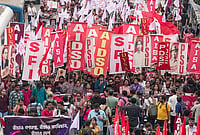
Police detained protesters, student leaders and journalists at several locations across central Delhi during demonstrations demanding CEC Gyanesh Kumar’s resignation.
The detentions came amid heavy security deployment, restrictions on movement and Metro station closures, with thousands reportedly detained during the protests.
The Supreme Court directed authorities to prevent illegal detentions of peaceful, unarmed protesters and restore normal public services.
Police detained protesters and journalists at several locations across central Delhi on Sunday as demonstrations demanding the resignation of Chief Election Commissioner Gyanesh Kumar continued, despite a Supreme Court order against illegal detentions. The police action continued across the New Delhi district through the day, as Hindustan Times reported.
The protesters are demanding Kumar’s resignation over alleged irregularities in the Special Intensive Revision (SIR) of electoral rolls.
During a special hearing on Sunday, a bench of Justices Joymalya Bagchi and V Mohana held that peaceful and unarmed protesters cannot be detained except in accordance with the “procedure established by law”.
The Supreme Court’s intervention came after petitions alleged mass detentions and restrictions on movement, internet connectivity and transport. Despite the court’s directions, police detained people at multiple locations on Sunday, extending the crackdown that had spread across the Capital since Friday.


Journalists, Protesters Detained Across Delhi
Detentions were reported at several locations, including outside the Press Club of India on Raisina Road, Connaught Place and RK Ashram Marg. Those detained included journalists working for a national daily and digital news platforms, as well as camera persons.
More than 70 people were detained outside the Press Club of India alone, according to the report. At Connaught Place, one bus carrying detainees had two journalists and at least two protesters who were bruised and bleeding. Around 100 protesters were packed into two buses and taken away from the area.
In one incident, police pulled a man out of a burger joint on suspicion that he was a protester. In a video of the incident, the man told police that he was merely standing at the spot and refused to accompany them. Police later released him.
Political activists were also detained. All India Students' Association (AISA) president Neha Bora and CPI(M) leader John Brittas were picked up at Connaught Place. Brittas was injured after security personnel allegedly dragged him.
On Raisina Road, National Students' Union of India (NSUI) members staged a protest after the Cockroach Janata Party (CJP) concluded its press conference.

Heavy Security Deployment, Transport Restrictions
Saturday saw an extensive security deployment across the Capital as authorities moved to prevent a planned protest. Around 41,000 security personnel were deployed across Delhi, according to the figures cited in the report. The operation led to the detention of about 7,000 people and left several parts of the city unusually quiet.
Several senior political figures, including four former chief ministers and CJP leaders, were among those detained. Police also detained students, lawyers and politicians and prevented them from reaching Jantar Mantar, the proposed protest site.
Small demonstrations nevertheless broke out at various locations on Saturday, although police moved to disperse them. The CJP subsequently called for a second day of protests on Sunday.
Restrictions had been in place since Friday. Thousands of police personnel were deployed, internet services were suspended near Jantar Mantar, several trains to Delhi were cancelled and 45 Metro stations were shut, reportedly marking the largest such closure this year.
Police began detaining people heading towards the protest site at around 1 am on Saturday, after authorities denied permission for the demonstration.
Road traffic was also affected. Police installed spike strips on major roads, erected thousands of yellow barricades and used loudspeakers to broadcast recorded warnings against unlawful gatherings.

SC Directs Authorities To Restore Normal Services
The Supreme Court held a special hearing on Sunday after petitions alleged mass detentions, restrictions on movement, internet suspension and non-compliance with its October 9 order concerning transport restrictions ahead of the protest against Kumar.
The bench said peaceful and unarmed protesters could not be detained except in accordance with the “procedure established by law”. It also held that police could not keep such protesters in custody beyond areas covered by a prohibitory order under Section 163 of the Bharatiya Nagarik Suraksha Sanhita (BNSS).
The court also directed that Delhi Metro and railway services operate normally, internet connectivity remain undisturbed and the free movement of people be restored.
It further directed authorities to withdraw a notice imposing prohibitory restrictions around the Supreme Court and other court complexes, emphasising the need to protect unhindered access to justice.