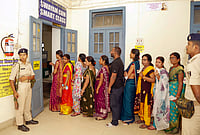
Raihan Vadra says he was asked to remove 70 photographs just hours before his exhibition was due to open at Bikaner House.
He says art institutions have a responsibility to reflect society, regardless of who is in power.
Vadra rejects speculation about a political career, saying he intends to continue pursuing his work as an artist.
Photographer Raihan Vadra was asked by Bikaner House, run by the Rajasthan government, to remove all but one of his photographs documenting protests in the capital against Chief Election Commissioner Gyanesh Kumar and the July 2026 protests.
Vadra, son of Congress MP Priyanka Gandhi Vadra, said he was asked to take down 70 of the 105 photographs displayed across two floors of Bikaner House, just three-and-a-half hours before the exhibition was due to open on Wednesday evening.
Of the 105 photographs, 71 documented the protests, during which demonstrators, journalists and content creators have faced mass detentions. The remaining 34 were wildlife photographs and cityscapes.
In this interview, 26-year-old Vadra discusses the removal of his photographs, his exchanges with the venue’s administration and the importance of freedom of expression. He also speaks about his approach to art, his family’s role in assessing his work and the value of honest criticism.
Edited excerpts:
What were the photographs that were taken down and why you think they were removed?
The photographs were mainly abstract images and portraits, along with some street photography taken at the protests in July and October. I had focused on portraiture, abstract images and the poetry and symmetry I could see in the large crowds moving together. This entire floor of the exhibition was themed around movement.
After reading Bikaner House’s policy, I had removed most images of political leaders and political sloganeering. The photographs were not making any particular political point because I wanted to avoid exactly what has happened.
I was contacted 24 hours before the show opened and told that some of the images might be objectionable or against the policy. I asked them to put their concerns in writing and let me know. They said they would get back to me.
The next day, around noon or 1 pm, five or six hours before the exhibition opened, I was told that the images would have to be removed. I again asked them to explain their reasoning in writing and said I was happy to discuss it. I had tried to follow their policy, and if they felt any images were overtly political, I was willing to replace them with other photographs. I had kept extra prints specifically for that purpose.
I explained that I needed their reasoning in writing because an oral conversation could only go so far. They continued to refuse. At around 3 pm, the chief resident commissioner came and told me that all the images had to be taken down because the context and timing were not appropriate, given what was happening outside.
At 3.20 pm, I received a written notice stating that I had to remove all the images by 4 pm. Otherwise, the building would be sealed and the exhibition cancelled by 5 pm.
We then turned all the frames around so that only their backs were visible. They came to inspect them and said that was not acceptable either. We had to remove the photographs, so we took them down and piled them in a corner. They then said that was not acceptable and instructed us to put them in storage, which we did.
There were also two large photographs of the Indian flag. We had taken down several photographs of the flag but left these two up. I asked how they could possibly violate the policy. If they wanted me to remove a photograph of the Indian flag, I said, they would have to give me their reasoning in writing. They did not.
We left one photograph up. The other was removed by them while I had gone home to change. They then put all the images in their storage. They have the key, and we currently have no access to the artworks. They have locked the room and taken the key away.


The protests demanding CEC Gyanendra Kumar and Opposition parties are now demanding the removal of the Chief Election Commissioner. Do you think the political context influenced what happened?
I don't know. I am still trying to digest what has happened. It has only just happened, and I have been speaking about it for days without really having the time to process it myself.
As an artist, I did not want to get involved in this entire issue. That was never my intention. I simply wanted to show my work. If three people had come, seen the work as I intended it to be seen, and gone home, I would have been much happier than I am now, with all this attention.
I don't know whether it was politics, but I feel that an artist's freedom of expression has been suppressed.
As a public institution, it should not have a policy that prohibits political content. I believe all art is political. Institutions such as Bikaner House have a responsibility towards the artists and galleries that exhibit there. Their responsibility is to those people, rather than to those in power, regardless of who is in power.
My artwork was not making a statement against anybody. But even if it had been, it should have been allowed to be displayed. If the Congress were in power in Rajasthan tomorrow and an exhibition criticising the Congress government were to be held, it should be allowed to be shown. There is no reason for any artwork to be taken down.
The BJP has also commented that this incident has given you a break. There have been other allegations against you, including claims that there was a ghost photographer. How do you deal with these accusations?
These claims come with the background I come from. First of all, there was no ghost photographer. I looked like a ghost myself, wearing a mask, cap and glasses while running around taking pictures, but there was no ghost photographer.
As for the claim that I am being launched into politics, I am not launching into anything. Yesterday, I must have given about 20 interviews throughout the day, and in all of them I said that I am not joining politics. I am an artist, and I will remain an artist. I don't know where they have got the idea that this is a political launch or that I am trying to do something else.
I took the photographs. This is my work, and I am going to continue doing it.
Over the past six years, I have consciously tried to build a path for myself. That is difficult, given the family I come from. It is easy for people to make assumptions, even when they are not explicitly accusing you of anything. They may simply think that this is exactly what you are going to do. I have consciously tried to distance myself from those assumptions and carve out my own path in my field. I do not plan to join politics. I intend to continue as an artist.

Since you have mentioned it, is joining politics something you would never consider?
I don't know what the future holds. But I am quite clear that, right now, this is the path I have chosen for myself.
What have your shows been about?
My first three shows explored philosophical themes such as comparison, choice and control. I tried to build experiences that made visitors feel controlled or required them to make choices at different points as they moved through the exhibition. My first show was during the pandemic in 2021, here at Bikaner House. All my shows have been here.
My first exhibition was about control. We had just come through the pandemic, when we were constantly being told whether to wear masks, whether to meet three or four people, or whether to meet anyone at all. We had spent the previous two years living under guidelines, and my exhibition explored that experience of control through photography.
The second show was about choice. At each point in the exhibition, visitors had to make a choice about what they would see next. The third was about comparison and how we are conditioned to make comparisons constantly as we go through life.
For this exhibition, I took a three-year break between shows because I had been working on other projects. I organise Delhi Art Weekend and Bengaluru Art Weekend. Delhi Art Weekend takes place in September, and Bengaluru Art Weekend takes place in April.
I have also been busy curating other people's work and developing projects. There is only so much solo work one can do. I had held three exhibitions in three years, so I needed a break to develop my own body of work.
When I sat down to work on this exhibition, I was clear that I wanted it to be photography-first.
The earlier exhibitions weren't?
In the earlier exhibitions, the photographs fitted into a larger storyline. This time, I decided that the photographs would come first, and I would build something around them. I kept jumping from one idea to another. That is why I called the exhibition No Ideas Final. I couldn't settle on exactly what I wanted to do.

When this issue happened, did your mother get involved?
My mother really helps me curate my work. She is quite objective and brutal when she needs to be, but she also appreciates the work when it deserves appreciation. She was here helping us set up, but she did not get involved in any of the conversations with the administration. She felt that, since I had booked the space, it was my issue to deal with. I felt the same way. It was between me and the administration.
Everyone in my family is very supportive, but they are fair in their judgement. They will not say something is very good if it is not. They understand that putting your work out in public comes with certain responsibilities. They are all in public life, so they know that when you put yourself out there, you have to be true to what you are doing, and your work has to meet a certain standard, especially when it comes to art.
Do you think this incident has given you a platform to speak about the role of art institutions and freedom of expression?
I said this yesterday as well, but it got drowned out: I hold no ill will towards the people who work here.
I think the main sticking point is that there was a grey area between their definition of political content and mine. That is where the problem lies. I felt some photographs could have remained on display. When they insisted that we take them down, even after we had turned the frames around, I felt I had to speak out.
I had to speak out not just for myself, but also so that people know they can speak out, and should do so, when something like this happens to them.
Exactly. I have a unique opportunity because this incident has attracted so much attention. I want to use that attention to say that institutions such as Bikaner House, Travancore House, Iris and even private institutions and art fairs have a responsibility to showcase what is happening in society.
Art is always a reflection of society, and society, in turn, is reflected in the art that emerges from it. These institutions have a responsibility to show what is happening. You cannot display only beautiful paintings and pretend that everything is fine when things are happening outside.
Whatever political movements are directed against, there should never be any curbs on freedom of expression.