Union Home Minister Amit Shah asserted at the National Security Strategy conference in New Delhi that India is not a 'dharamshala' and only citizens have the right to reside in the country.
Shah introduced a new four-pronged border security framework shared with land-border states to make India free of illegal infiltrators in a short period.
The Home Minister emphasised that strengthening internal security is vital for India to emerge at the forefront globally amid rising extremism and digital disinformation.
Union Home Minister Amit Shah addressed the valedictory session of the Intelligence Bureau's (IB) National Security Strategy (NSS) conference on Tuesday, August 25, 2026. He warned that illegal border crossers endanger the nation's economic stability, demographic makeup and overall safety.
"This country is not a dharamshala (charitable rest house); only citizens of the country have the right to live here," Shah said.
Four-Pronged Border Strategy
The government targets illegal border crossings, with Shah outlining a new framework to eliminate this issue swiftly.
"Over the past eight months, after visiting all states sharing land borders, we have shared a document outlining a four-pronged approach to border security with the states. Our goal is to make the country free of infiltrators in a very short period," Shah said.
The Home Minister framed India's security policy against current worldwide volatility, vulnerabilities in energy and resource supplies, broken supply chains, increasing extremism and the weaponisation of digital disinformation. "If India is to emerge at the forefront in every field, its internal security will have to be further strengthened," Shah said.


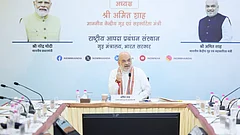

The two-day conference involved central agencies and state police chiefs. Participants discussed infiltration, real-time intelligence-sharing against terror groups and dismantling their logistics and funding networks.
Precedents on Dharamshala
Shah made similar remarks in the Lok Sabha on March 27, 2026. During a debate on the Immigration and Foreigners Bill, 2025, he argued that Parliament had the right to bar those who posed a threat to national security and that sensitive locations and army establishments along the borders could not be left open to all. He added that India was "not a dharamshala where anyone can come and stay for any purpose", noting that legal entrants were welcome to contribute to India's prosperity, but illegal entrants would be dealt with strictly.
The judiciary has echoed similar sentiments. On May 19, 2026, a Supreme Court bench of Justices Dipankar Datta and K Vinod Chandran refused to interfere with the custody of a Tamil citizen from Sri Lanka. The individual faced deportation after a seven-year sentence under the Unlawful Activities (Prevention) Act.
The bench remarked on the country's population burden. "Is India to host refugees from all over the world? We are struggling with 140 crore. This is not a dharamshala that we can entertain foreign nationals from all over," the court stated.
Tackling Security Challenges
Authorities have eliminated major security hotspots. Shah said that challenges related to narcotics, Naxalism and northeast insurgency have been resolved. He credited state police, CAPFs and central agencies for this success.
Shah criticised previous governments for failing to anticipate these challenges before they escalated into massive issues, saying that had they done so, "the country would not have had to suffer their consequences for decades". He directed state police forces to implement the Narcotics Control Vision document 2026-2029 on the ground immediately. This strategy relies on the "three Ds—Detect, Disrupt and Destroy" framework to achieve a drug-free India.
He also instructed security officers to analyse crime trends over the next 15 to 20 years. This forward-looking approach will help preemptively formulate preventive strategies.