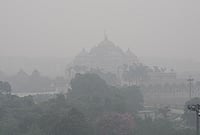
Gurugram recorded an AQI of 320 on November 12, placing the city in the 'very poor' category.
Luxury housing societies are installing anti-smog guns, rooftop sprinklers and treated wastewater systems to control dust.
Gurugram authorities have deployed water tankers and prohibited coal and wood-fired tandoors at eateries.
With Gurugram's air quality deteriorating, residents of luxury housing societies are investing in private pollution-control measures, including anti-smog guns, rooftop sprinklers and systems that use treated wastewater to suppress dust. Many have also installed air purifiers inside their homes as pollution levels continue to rise.
According to official data, Gurugram recorded an Air Quality Index (AQI) of 320 on Thursday, placing it in the 'very poor' category. The city's air quality has deteriorated over the past week, prompting residential societies, developers and civic authorities to step up efforts to control pollution.
Under the Central Pollution Control Board's classification, an AQI between zero and 50 is 'good', 51 and 100 'satisfactory', 101 and 200 'moderate', 201 and 300 'poor', and 301 and 400 'very poor'. Readings between 401 and 500 fall in the 'severe' category.
At Central Park Resorts in Sector 48, residents have been using auto-rickshaws and e-rickshaws to spray a fine mist of water. Anti-smog guns have also been installed on building rooftops.
"It is disheartening that residents, even after spending crores of rupees to buy luxury apartments, are unable to access basic amenities like clean air. Why should a city that contributes substantial revenue to the government have to struggle?" said Shailja Bhatia, a Central Park Resorts resident.


According to PTI, several builders are also incorporating sprinkler networks into new residential projects to prepare for future pollution-related challenges and minimise the impact of deteriorating air quality.
Housing Societies Turn To Treated Wastewater And Sprinklers
At Rising Homes in Sector 92, the Resident Welfare Association (RWA) invested Rs 2.5 lakh four years ago to connect the society's Sewage Treatment Plant (STP) to a sprinkler network. The system uses treated wastewater to spray water across the residential premises.
Since Diwali, the RWA has extended the spraying duration by two hours, PTI reported.
"We believe that environmental protection cannot remain limited to discussions, advisories or assigning responsibility to others. It requires investment, infrastructure and consistent action.
"At Rising Homes, we took the initiative to develop our own dust-control mechanisms and utilise treated wastewater for environmental management. However, it is important to understand that air pollution cannot be controlled by individual societies alone," said Praveen Malik, Resident Welfare Association president of Rising Homes.
Other residential complexes in Gurugram have also introduced pollution-control measures. At Vipul Greens on Sohna Road, anti-smog guns, rooftop sprinklers and dust-suppression units have been installed around trees. Since Diwali, the sprinklers have been operating throughout the day.
In DLF City, Phases 1 and 4, the management has allocated a dedicated budget for pollution-control measures during the winter season. Mechanised sweepers have been deployed to clear dust and silt from roads. The management is also undertaking water sprinkling, monitoring dust-control measures at construction sites and checking instances of open waste burning.
Residents Share Images Of Polluted Air Purifier Filters
The impact of deteriorating air quality inside homes has also drawn attention on social media. An X user recently shared two photographs of an air purifier filter in Gurugram, showing a thick layer of dark dust and grime accumulated on its surface. One photograph showed a small section that had been cleaned, highlighting the contrast with the rest of the clogged filter.
"This is my air purifier filter in Gurugram. The land of Rs 200 crore apartments, huge towers.... Welcome to the city where we pay a premium for polluted air. Efficiency, but make it toxic," the user wrote.
Gurugram Administration Steps Up Pollution-Control Measures
Beyond residential complexes, Gurugram's administration and civic bodies have deployed water tankers to spray water along major roads to control pollution and reduce the impact of road dust.
In a separate measure, District Magistrate and Gurugram Deputy Commissioner Uttam Singh issued an order on Wednesday prohibiting the use of coal and wood as fuel in tandoors at hotels, restaurants and open-air eateries across the district. The restriction is aimed at controlling air pollution.