After nearly 17 years in London, Tarique Rahman is now Bangladesh’s prime minister and could make his first India visit for BRICS.
His possible New Delhi trip comes as Sheikh Hasina, his mother Khaleda Zia’s longtime rival, remains in India.
Tarique’s rise marks a new chapter in the political rivalry that once defined Bangladesh through the “Battle of the Begums”.
India has invited Tarique Rahman, whose country currently chairs BIMSTEC, to the outreach session, but Dhaka has not confirmed whether he will attend. On September 8, Indian foreign ministry spokesperson Randhir Jaiswal said there was “no update” on Rahman’s participation, while Bangladesh Foreign Minister Khalilur Rahman also declined to confirm his attendance. The uncertainty comes as relations between India and Bangladesh remain strained, particularly over Hasina’s presence in India and Dhaka’s demand for her extradition.
For Rahman, a possible first visit to India as prime minister would also bring the son of Khaleda Zia to the country where her old political rival has remained since fleeing Bangladesh in 2024. For decades, Khaleda and Hasina were the two dominant figures in Bangladeshi politics. Their rivalry grew out of the political legacies of their fathers and husbands, survived elections, military intervention, imprisonment and exile, and became known as the “Battle of the Begums”. Now Khaleda is dead, Hasina is out of power and Rahman, after nearly 17 years in London, has inherited his mother’s political mantle.
Two families, two political legacies
Bangladesh’s political story cannot be separated from the violence that marked its birth and early years. Sheikh Mujibur Rahman, who led the country’s independence struggle against Pakistan in 1971, became Bangladesh’s founding leader. In August 1975, he was assassinated in a military coup along with most of his family. His daughters Sheikh Hasina and Sheikh Rehana survived because they were in Europe at the time.
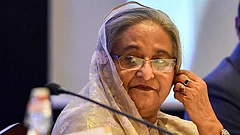



Hasina returned to Bangladesh in 1981 after years abroad and became leader of the Awami League, the party founded by her father. The assassination of Mujibur Rahman and most of her family became central to her political identity and her determination to preserve his legacy. Reuters has described the 1975 killings as a defining force in Hasina’s political life.
Khaleda Zia entered politics after another family tragedy. Her husband, Ziaur Rahman, a former army officer who became president and a major political figure, was assassinated in 1981. Khaleda, who had largely stayed away from politics, took over the Bangladesh Nationalist Party (BNP) in 1984, the party her husband had founded.
The two women initially found common ground. They joined forces in the movement that toppled military ruler Hossain Mohammad Ershad in 1990 and helped restore parliamentary democracy. Their partnership soon collapsed into the rivalry that would dominate Bangladesh’s politics for decades. Reuters has described how the two women, later dubbed the “battling Begums”, went on to dominate Bangladesh’s political life for decades.
From alternating governments to political warfare
Khaleda won the 1991 election and became Bangladesh’s first female prime minister. Her government oversaw the restoration of the parliamentary system, under which executive power was centred on the prime minister. She returned to office after another election victory in 2001, leading a BNP-led four-party alliance that included Jamaat-e-Islami and remained in power until 2006.
Between those two Khaleda governments came Hasina’s first term as prime minister. The Awami League won the 1996 election, putting Hasina in office until 2001. Khaleda then returned to power, remaining prime minister until the political crisis of 2006. Bangladesh’s Parliament records the succession clearly: Khaleda from 1991 to 1996, Hasina from 1996 to 2001 and Khaleda again from 2001 to 2006.
The rivalry became increasingly personal and institutional. One of its darkest episodes came in August 2004, when grenades were thrown at an Awami League rally in Dhaka where Hasina was speaking. Twenty-four people were killed and hundreds were injured. Tarique Rahman was among those convicted in the case in 2018, receiving a life sentence, but Bangladesh’s High Court overturned the convictions in December 2024 and acquitted him and the other defendants. Elections were followed by strikes, boycotts and allegations of political violence. The two parties accused each other of corruption and authoritarianism, while supporters on both sides treated the other political camp as an existential threat.
Hasina returned to power after the 2008 election and remained prime minister for more than 15 years. Her governments presided over a period of strong economic growth and major infrastructure expansion, even as critics increasingly accused her administration of repression, arrests of opposition figures, restrictions on dissent and a narrowing of political competition. The BNP boycotted the January 2024 election, leaving Hasina’s Awami League to contest an election without the country’s main opposition party amid criticism over restrictions on political opposition and electoral competition.
In August 2024, after weeks of student-led protests that developed into a wider movement against her government, Hasina resigned and fled to India. Hasina was later convicted and sentenced to death in absentia over the crackdown on the 2024 protests. She has denied the allegations and called the verdict politically motivated. She remains in India, while Dhaka has sought her extradition. Reuters reported that India was examining the extradition request. Her departure ended one of the longest periods of uninterrupted rule in Bangladesh’s history.
Khaleda’s illness and the son who waited in London
While Hasina consolidated power, Khaleda was increasingly pushed out of active politics. She was imprisoned in 2018 after corruption convictions, which she and the BNP said were politically motivated. She was later released from prison on humanitarian grounds and placed under house restrictions as her health deteriorated.
Her treatment became a political issue in its own right. Khaleda’s doctors wanted her to receive advanced treatment abroad, but the Hasina government did not allow her to leave Bangladesh under the terms attached to the suspension of her sentence. In June 2024, Law Minister Anisul Huq said there was no legal provision allowing her to go abroad under those conditions, according to The Daily Star.
After Hasina’s fall, Khaleda was freed from those restrictions. She travelled to London in January 2025 for medical treatment and returned to Bangladesh in May after about four months there. In December, plans were made to take her back to London for further treatment, but her condition deteriorated and doctors delayed the journey. She remained in Dhaka, where Reuters reported that she died on December 30, 2025, aged 80, after a prolonged illness.
Her son Tarique’s own political journey had already taken him away from Bangladesh. He left Bangladesh for London in 2008 after being detained during the military-backed caretaker government. Reuters reported that he left after his release, saying he needed medical treatment, and remained there for nearly 17 years before returning to Bangladesh on December 25, 2025.
Tarique’s Bangladesh — and the shadow of Hasina
Tarique’s return changed the political equation. After the BNP’s landslide victory in the February 2026 election, he was sworn in as prime minister on February 17, becoming the first male prime minister in 35 years. His government marked the BNP’s return to power after nearly two decades.
Since returning, Rahman has sought to present himself as a reformist politician, promising institutional changes and limits on the concentration of executive power. During the election campaign, Reuters reported that Rahman promised a two-term, 10-year limit for prime ministers, institutional reforms and a recalibration of Bangladesh’s foreign relationships so that the country would not become too dependent on any one power. The news agency also reported that he sought to project a less confrontational image, emphasising reconciliation, institutional reform and democratic governance.
That does not automatically make Tarique a more progressive politician. His rise, however, illustrates the persistence of dynastic politics in Bangladesh: he has inherited the leadership of the party founded by his father and led for decades by his mother. At the same time, the reformist image he has cultivated is significant after years in which Bangladesh’s politics became associated with the concentration of power, repression and political confrontation.
His possible visit to New Delhi therefore carries a symbolism that would have been difficult to imagine during the height of the Khaleda-Hasina rivalry. India has invited Rahman, in his capacity as the leader of the country currently chairing BIMSTEC, to the BRICS outreach session on September 12-13, but Dhaka has yet to confirm his attendance. On September 8, Indian foreign ministry spokesperson Randhir Jaiswal said he had “no update” on Bangladesh’s participation. The same day, Bangladesh Foreign Minister Khalilur Rahman declined to confirm whether Tarique would attend. Speaking at a press conference in New York after taking charge as president of the 81st session of the UN General Assembly, FM Rahman said, “I’m not here in a national capacity, so please forgive me.”
For years, Bangladesh’s political story revolved around two women who inherited the unfinished battles of their families. Khaleda’s husband was assassinated; Hasina’s father was assassinated. One inherited and led the BNP built by her husband; the other rebuilt the Awami League around her father’s legacy. They fought for power, fought over elections and eventually became symbols of two competing visions of Bangladesh.
Now Khaleda is gone, Hasina remains outside the country and Tarique Rahman is in power.
If Rahman does arrive in New Delhi for BRICS, the image will carry decades of political history: the son of Khaleda Zia travelling to India, where Sheikh Hasina has remained since fleeing Bangladesh in 2024. The “Battle of the Begums” ended as a political contest with Khaleda’s death and Hasina’s fall from power. But its political inheritance now rests with the generation that follows them.