Spain is working to move around 500 unaccompanied migrant girls from Ceuta to mainland resources
A surge in arrivals has overwhelmed Ceuta’s child-protection system and left many minors outside formal accommodation
The proposed transfers raise wider questions over child protection, legal safeguards and Spain’s migration system
Spain is working towards moving around 500 unaccompanied girls to specialised resources on the mainland as Ceuta continues to struggle with the number of children who arrived during the mass migration crisis at the end of July.
On Friday, Secretary of State for Youth and Children Rubén Pérez said such a transfer was feasible within a few weeks. He said around 1,400 minors were sleeping in Ceuta’s accommodation resources, while many others remained outside the formal protection system and had yet to be registered. The government was still working with Ceuta on the arrangements and had not yet sent a final proposal to the city.
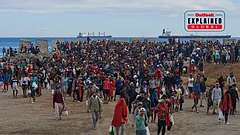
The urgency comes after a chaotic period for the Spanish enclave. More than 50,000 people entered Ceuta during the July 30 episode and that at least 57 people died during the crisis.
The pressure did not end when the immediate border crisis subsided. Children who entered without parents or legal guardians became the responsibility of Ceuta’s protection system, adding to a longstanding problem of limited capacity.
The situation was further complicated by three reported sexual-assault cases involving migrants who entered during the July episode. All three alleged victims were migrant women, two of them minors. Two alleged perpetrators were remanded in custody and another was ordered expelled to Morocco, according to judicial sources.


The proposed transfer, however, is not simply a response to those incidents. It reflects a deeper problem: Ceuta has become responsible for protecting large numbers of unaccompanied children while Spain’s system for distributing them among its regions remains politically and administratively difficult.
What Triggered The Crisis?
The immediate crisis began on July 30, when thousands of people attempted to enter Ceuta from Morocco around the Tarajal border area. One of the most serious such episode since the 2021 crisis.
Spanish Prime Minister Pedro Sánchez travelled to Ceuta on July 31 as the government deployed additional police, Guardia Civil and military personnel and worked with Morocco on returns and border management. Sánchez said the government would use all available state resources to restore security and normality.
More than 48,000 people had returned to Morocco by the following day, according to Spanish government figures. But the remaining population included children who could not simply be processed through the same immigration procedures as adults.
That shifted the problem from border control to child protection.

Why Are So Many Children In Ceuta?
Ceuta is unusual because it is Spanish territory on the North African coast, directly adjoining Morocco.
That makes it both a Spanish external border and an entry point into the European Union. The EU describes the Western Mediterranean route as including irregular arrivals to mainland Spain as well as crossings into Ceuta and Melilla.
For unaccompanied children, however, crossing the border creates a separate legal and administrative responsibility.
Spain’s autonomous communities and the cities of Ceuta and Melilla have responsibility for child protection and social services. Where an unaccompanied minor is determined to be in a situation of abandonment, the relevant public authority assumes responsibility for the child’s protection.
That means a sudden concentration of minors can overwhelm a territory even though responsibility for their care is decentralised.
UNICEF said that Spain’s Ministry of Youth and Children had confirmed more than 1,500 unaccompanied children in the protection system, while warning that the real number was likely higher because other children remained in streets, informal settlements or private accommodation.
The latest government figure is lower because it refers specifically to minors sleeping in Ceuta’s accommodation resources on Friday rather than everyone known to be in the wider protection system.
Why Move 500 Girls?
The government is working towards moving around 500 unaccompanied girls to specialised resources on the mainland. The proposal is still being developed rather than being a completed transfer programme.
Pérez said on Wednesday that the government considered moving around 500 girls to the peninsula within a few weeks was feasible, but that the details still had to be worked out with Ceuta.
The focus on girls reflects the particular risks highlighted by UNICEF. The organisation said several hundred girls were among the recent arrivals and that their age, gender, lack of family support and highly vulnerable circumstances exposed them to heightened risks of violence, abuse, exploitation and trafficking. It called for faster identification, registration and transfer into supervised child-protection resources.
The reported sexual assaults have added to concerns about the immediate safety of vulnerable girls, although they are not the sole reason for the proposed transfer.
The key issue is therefore not simply moving children out of Ceuta, but moving them into a system where they can be properly identified, protected and accommodated.

How Will Spain Distribute Them?
Redistribution of unaccompanied minors among Spain’s regions is not new.
The government said in February that 1,019 unaccompanied foreign minors from Ceuta, Melilla and the Canary Islands had already been relocated to other autonomous communities. Of those, 320 had been moved from Ceuta, while 128 additional Ceuta cases with completed files were still awaiting transfer at that time.
The legal framework was strengthened in 2025 through an emergency reform that created a specific mechanism for extraordinary migration contingencies involving unaccompanied minors.
Under the system, a formal extraordinary migration contingency can be declared when the relevant thresholds are met and the protection services of the affected territory are insufficient. Once the mechanism is activated, the state can determine where minors are to be relocated under objective criteria and through a formal transfer process.
The legislation requires the child and the receiving autonomous community to be heard before a transfer decision is made, with the Public Prosecutor’s Office informed and involved to safeguard the child’s interests.
The law was designed precisely because the burden of caring for unaccompanied children can fall disproportionately on frontline territories such as Ceuta, Melilla and the Canary Islands.
What Are The Legal Challenges?
The central legal principle is that migration status does not remove a child’s protection rights.
The 2025 legislation requires the state to act according to the best interests of the child. It also establishes procedures for identification, registration, transfer and the allocation of guardianship and custody after relocation.
That creates a distinction between relocating a child within Spain’s protection system and returning an adult migrant through immigration procedures.
UNICEF has stressed that decisions on reunification, return or relocation must be made individually and in accordance with the child’s best interests, taking into account protection needs and risks of trafficking, violence or exploitation.
This is particularly important when children are moved to another region. A transfer is not simply a change of address; responsibility for their care and protection also moves.

What About Family Reunification?
Family reunification is another possible route, but it cannot automatically determine what happens to every child.
UNICEF says family reunification should be explored in every case where it is possible, while decisions must be made individually and according to the child’s best interests. Authorities must also consider possible international-protection needs and risks of trafficking, violence and exploitation.
Any return would also require legal safeguards, including that the child is informed and heard, has access to legal assistance and can challenge the decision. UNICEF says a return should occur only where the child can be received in a safe and protective environment.
For children without a suitable family network, Spain’s child-protection system remains responsible for their care.
That is why the current debate cannot be reduced to “sending children to the mainland”. It involves determining where they can safely live, who assumes guardianship and whether family reunification or another long-term solution is appropriate.
Why Is Ceuta So Sensitive For Europe?
Ceuta is not simply a local migration-management problem.
Because it is Spanish territory, it forms part of the European Union’s external border. The EU’s Western-route framework includes crossings into Ceuta and Melilla alongside migration routes towards mainland Spain.
At the same time, entry into Ceuta does not automatically mean a migrant can remain in Spain or travel freely through the rest of the EU. Spain itself has stressed that irregular entry into Ceuta or Melilla does not confer an automatic right to stay or move onwards into Europe.
That makes Ceuta an unusually sensitive border.
It is simultaneously Spanish territory, an EU external frontier and one of the points where Europe’s migration relationship with North Africa is most directly tested.

Why Does Morocco Matter?
Ceuta’s migration crisis cannot be separated from its relationship with Morocco.
The city sits directly on the Moroccan border, and Spain has increasingly relied on cooperation with Rabat to reduce irregular migration, combat smuggling networks and manage returns.
During his August 11 visit to Ceuta, Foreign Minister José Manuel Albares stressed the importance of coordination among Spanish authorities involved in managing the border and migration. Spain has also continued to emphasise cooperation with Morocco on migration management.
The EU also identifies cooperation with Morocco as an important element of managing the Western Mediterranean route, including border management, irregular migration, protection and returns.
Sánchez said after the July crisis that Spain was working with Morocco on border management and the return of people who had entered irregularly.
That cooperation creates a difficult balance.
Spain wants Morocco to help control irregular crossings and accept returns, but it must also manage the consequences when large numbers of people reach Spanish territory. With unaccompanied children, the legal and humanitarian obligations become considerably more demanding.
What Does The Crisis Reveal?
The immediate issue is protecting children and relieving pressure on Ceuta. But the episode exposes a recurring problem in Europe’s migration system.
The EU has invested heavily in external border management and cooperation with countries such as Morocco. Its Western-route strategy combines border controls with efforts to combat irregular migration and smuggling, strengthen returns and address migration pressures.
When large numbers of unaccompanied children reach Europe, however, the issue changes from border management to responsibility.
Who protects them? Which region has the capacity to accommodate them? Can they be reunited with family? Can they safely return? And what happens when the territory where they arrive does not have enough resources to provide appropriate protection?
Ceuta is again forcing those questions into the open.
Madrid’s proposed response is to move its most vulnerable children towards specialised resources on the mainland. The government says it considers the transfer of around 500 girls feasible within weeks, but the proposal and arrangements are still being developed.
The deeper question is whether Europe can maintain a migration system that controls its external borders while also meeting its obligations to children who arrive without parents or guardians.
Ceuta remains one of the places where those two objectives collide most directly.