India has approved an ₹11,000-crore scheme to expand domestic manufacturing of infrastructure equipment
China's export controls on tunnel-boring machines expose India's dependence on specialised industrial imports
Washington's proposed tariffs of up to 25% add pressure on India's manufacturing and trade policies
A country building its own infrastructure should ideally control the machinery needed to construct it. For India, that ambition has become a strategic concern, with tunnel-boring machines, industrial components and specialised manufacturing technology increasingly caught up in geopolitical and trade disputes.
On Wednesday, the Union Cabinet approved an ₹11,000-crore incentive scheme to expand domestic manufacturing of construction and infrastructure equipment. The announcement came a week after China's new export-control regime covering tunnel-boring machines and related machinery took effect. On the same day as India's Cabinet decision, Washington announced proposed tariffs of up to 25% on Indian goods under a separate investigation into manufacturing capacity and industrial policy.
The developments expose the competing pressures facing India's manufacturing ambitions. Beijing has considerable leverage through its control over industrial inputs and technology, while Washington is questioning the subsidies and incentives New Delhi uses to build domestic capacity.
Why Is India Investing In Domestic Machinery Manufacturing?
India's construction and infrastructure equipment industry was valued at approximately ₹97,500 crore in FY2024–25, making it the world's third-largest market after China and the US. The government projects it will grow to ₹2,28,100 crore by FY2029–30, driven by infrastructure development across roads, railways, ports and housing.
Yet around 45% of the industry's requirements are met through imports, according to the government's Wednesday briefing. An estimate based on information supplied by the Indian Construction Equipment Manufacturers' Association puts equipment and component imports at approximately ₹34,500 crore in FY2024–25. Of this, ₹30,250 crore comprised components and aggregates used in domestic manufacturing, while fully built machines accounted for ₹4,250 crore.


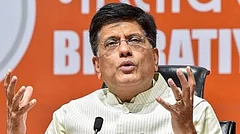
The dependence extends beyond finished machinery. Engines, transmissions, hydraulic systems and drive components remain important gaps in India's manufacturing ecosystem.
The new scheme offers incentives ranging from 13% to 8% of incremental sales over five years. It also provides up to ₹375 crore for a dedicated testing facility. The government expects the programme to attract ₹21,000 crore in investment and generate ₹22,500 crore in import substitution.
Tunnel-boring machines, excavators, cranes and other specialised equipment are among the targeted categories. The ambition is to develop the components, testing infrastructure and manufacturing expertise required to produce complex machinery within India.

How Does China Have Leverage Over India's Supply Chains?
China's October 19 export-control announcement, effective November 18, covers full-face tunnel-boring machines, key components such as cutterheads and main drive systems, and specified engineering machinery and associated technologies.
The rules introduce licensing requirements for exports to sensitive countries and regions with which China has disputes. Shipments to other destinations require registration and export certification, alongside undertakings restricting unauthorised onward transfers.
Beijing has not explicitly named India as a restricted destination. The announcement therefore does not amount to an India-specific blanket ban on Chinese machinery exports. Its broader significance lies in the additional regulatory controls China can exercise over specialised industrial equipment.
There is a precedent. The US-China Economic and Security Review Commission's 2026 report records that Chinese authorities delayed exports of tunnel-boring machines intended for the Mumbai-Ahmedabad bullet train project in 2025, alongside restrictions affecting specialised fertilisers. The Commission interpreted the measures as retaliation for India's post-Galwan restrictions on Chinese interests. Beijing lifted those restrictions in August 2025.
The Commission's wider assessment identifies other instances of Chinese supply-chain leverage. These include delays involving rare-earth permanent magnets and restrictions on the movement of specialised engineers and manufacturing equipment to Foxconn's Indian facilities in 2025.
According to the Commission, China accounted for 30.8% of India's industrial imports in 2025. Its share of imports under HS 8479, a broad customs category covering certain industrial machinery, was estimated at 45%. The latter figure does not specifically measure India's dependence on Chinese tunnel-boring machines.
The Commission argues that Beijing can use these industrial dependencies to complicate India's emergence as an alternative manufacturing hub. This is a US congressional assessment, rather than an admission by either the Indian or Chinese government.
Why Is Washington Challenging India's Manufacturing Policy?
The pressure from the US comes through a different channel. On Wednesday, the Office of the US Trade Representative (USTR) announced determinations in 14 investigations under Section 301 of the Trade Act of 1974, including one concerning India.
The USTR found that policies relating to structural excess capacity and manufacturing production in India were unreasonable and burdened American commerce. Its India-specific report examined programmes including Make in India, Production Linked Incentive (PLI) schemes and Atmanirbhar Bharat.
Washington argues that manufacturing incentives, export promotion, market-access barriers and other policies contribute to industrial overcapacity and distort international competition. The sectors highlighted include pharmaceuticals and medical devices, steel, solar products, and information and communications technology.
The proposed response includes additional tariffs of up to 25% on Indian goods, subject to exemptions and existing duties. The USTR has also proposed considering a 17% rate if India reaches a reciprocal trade agreement addressing its findings.
Although, these duties have not yet been imposed as USTR has invited submissions until January 5, 2027, and scheduled a public hearing for January 25.
New Delhi has disputed the findings in its response, the Commerce Ministry said India had argued during the investigation that it had no structural excess capacity in any sector. It also maintained that trade-related concerns should be addressed through the ongoing India-US Bilateral Trade Agreement negotiations.

China Is Also Challenging India's Incentives Through WTO
Beijing's concerns over India's domestic manufacturing policies extend beyond export controls. China has initiated World Trade Organisation proceedings challenging selected Indian incentives covering advanced-chemistry-cell batteries, automobiles, electric passenger cars and solar modules.
China alleges that these programmes favour domestic goods over imports and discriminate against Chinese products. Panels have been established in the disputes, but no ruling has been delivered in the proceedings cited in the source record.
The legal challenges add another dimension to India's effort to protect emerging industries. New Delhi is promoting domestic production through incentives and trade measures, while Beijing is contesting some of those policies through the multilateral trading system.
Moreover, these proceedings are separate from China's export controls and Washington's Section 301 investigation. They nevertheless illustrate how industrial policy has become an increasingly important arena of economic competition.
The Strategic Cost Of Industrial Dependence
India's challenge goes beyond producing more machines. Domestic manufacturing can expand while the factories themselves remain dependent on imported components, specialised machinery and foreign technical expertise.
The scale of the relationship with China illustrates the difficulty. India's imports from China reached approximately $96.61 billion during April–October 2026, according to revised Commerce Ministry estimates, compared with exports of $13.77 billion. The resulting bilateral merchandise deficit was approximately $82.85 billion.
The security dimension adds to the economic concerns. The US-China Commission has connected Beijing's industrial leverage with its military partnership with Pakistan. SIPRI's latest data show that China supplied 80% of Pakistan's major arms imports during 2021–25, while Pakistan's arms imports increased by 66% compared with the preceding five-year period.
India consequently faces several overlapping challenges: securing access to critical industrial inputs, expanding its domestic manufacturing base, protecting export markets and reducing strategic dependence on Chinese technology.
The ₹11,000-crore scheme is an attempt to address part of that vulnerability. Its eventual success will depend on whether India develops local capabilities in specialised components, engineering and technology rather than remaining reliant on imported inputs for domestically assembled machinery. In an increasingly contested trading environment, industrial self-reliance has become a question of both economic competitiveness and strategic autonomy.