



BJP and SAD reunite after six years, reviving their alliance ahead of Punjab Assembly elections 2027.
The Centre's renewed farmer outreach comes amid unresolved demands for a legal guarantee on MSP.
The alliance faces electoral challenges as both parties seek to rebuild support among Punjab's rural voters.
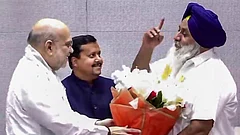
Bharatiya Janata Party’s (BJP) renewed outreach to Punjab’s farmers has gained political significance after its alliance with the Shiromani Akali Dal (SAD) was announced on Tuesday.
As the two former partners prepare to contest the 2027 Assembly elections together, the Centre’s recent engagement with farmers has raised questions about whether the political groundwork for the reunion has extended beyond seat-sharing and electoral arithmetic.
Over the past four months, Union Agriculture Minister Shivraj Singh Chouhan has visited Punjab four times, interacting with farmers in villages and praising the state’s contribution to food security and efforts to curb stubble burning. The visits have focused on crop diversification, soil health, farm mechanisation and agricultural income, reported Indian Express.
Yet, among sections of the farming community, the central question remains, what has the BJP-led government done to address farmers’ concerns, particularly their demand for a legal guarantee for Minimum Support Price (MSP)?
The question assumes greater significance after the SAD, which walked out of the alliance in 2020 over the three farm laws, returned to the BJP-led National Democratic Alliance (NDA). The laws were subsequently withdrawn, but the MSP demand remains unresolved.



Prime Minister Narendra Modi is also expected to visit Moga on December 8, his first visit to Punjab after the alliance announcement. The visit could provide an opportunity for the Centre to address some of the concerns that continue to shape the relationship between the BJP and the state’s farming community.

The Centre’s Outreach To Farmers
As Indian Express reported, Chouhan’s visits have followed a consistent pattern. On August 28, he interacted with farmers at a Kisan Chaupal in Umra Nangal village in Amritsar district, assuring them that the Centre would not compromise their interests in international trade agreements.
During his September 21 visit to Bathinda, he attended a Kisan Mela and a Kisan Samvad on crop residue management. On November 17, he visited Badarpur village in Mohali and Krishi Vigyan Kendra Samrala, discussing crop diversification, soil health and farm mechanisation. His November 24 visit to Booh Haveliyan village in Tarn Taran district included another Kisan Chaupal.
At these interactions, Chouhan reiterated the Centre’s commitment to MSP procurement and said it had procured the entire quantity of wheat and paddy offered. He also cited the approval of ₹254.20 crore for Punjab under the PM-RKVY for 2026-27, along with seven additional projects worth ₹98.44 crore.
The minister also defended Punjab’s farmers against accusations that they were solely responsible for air pollution in Delhi and its surrounding areas. He praised their efforts to reduce stubble burning and assured them that concerns over machinery and subsidies would be taken up with the Centre.
The outreach, described by the government as part of the ‘Khet Bachao Abhiyan’, is aimed at improving soil health, reducing cultivation costs, encouraging crop diversification and raising farm incomes.
Why The Alliance Matters Now
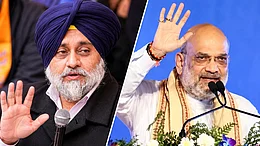
As Outlook India reported earlier, BJP-SAD reunion comes six years after their separation and 30 years after the two parties first came together in 1996. For the Akalis, the 2027 election is crucial to their political survival and relevance. It will also be their first joint electoral contest without former Punjab Chief Minister Parkash Singh Badal, who died in April 2023.
The alliance announcement followed weeks of speculation. Union Home Minister Amit Shah described the return of the NDA’s oldest ally as a matter of happiness, while BJP president Nitin Nabin called the partnership a “natural alliance”.
Shah also made the power-sharing arrangement clear, saying the SAD would be the “big brother” and that the Chief Minister would come from the regional party. SAD president Sukhbir Singh Badal described the reunion as an “emotional alliance”, stressing that the partnership was built around Punjab and the Sikh community.
However, the alliance faces a changed political landscape. Both parties have suffered electoral setbacks since 2020, and their workers will have to rebuild trust after six years of campaigning against each other.
The BJP’s vote share rose to 18.56% in the 2024 Lok Sabha election from 6.06% in the 2022 Assembly polls, though it failed to win a seat. The SAD’s vote share fell from 18.38% in 2022 to 13.48% in 2024.
In 2022, the BJP contested 73 seats and won two, while the SAD contested 97 seats in alliance with the Bahujan Samaj Party and secured three. The Aam Aadmi Party swept the Assembly election with 42% of the vote, before its share fell to 26.02% in the 2024 Lok Sabha polls.
For the BJP, the alliance offers a route beyond its traditional urban strongholds and towards a wider rural and Sikh electorate. For the SAD, it offers an opportunity to recover lost ground.
But the reunion’s success will depend on more than electoral calculations. The unresolved MSP question, farmers’ concerns and the ability of the two parties to campaign together will remain central to the alliance’s prospects in 2027.








