The author shares a moving story of a Muslim student fondly remembering his Kashmiri Pandit teacher, Narayan Joo.
For generations, classrooms across the Valley reflected the finest traditions of a shared society.
Narayan Joo selflessly invested in a tomorrow that did not belong to him.
I wish I had known Narayan Joo. I wish I could have sat beside him and chatted with him. It would have been a privilege. However, I am fortunate to have met one of his former students, Habib Khankashi, a Kashmiri Muslim, who spoke about his mathematics teacher, Narayan Joo, as if he had attended his class only yesterday.
Decades have passed since he sat in Joo’s classroom at Lowood Garden School near Heemal Hotel at Dalgate, Srinagar. Khankashi, who studied under Joo from Class 3 to Class 7 between 1981 and 1984 remembers him fondly. “We used to call him ‘Iron Piece,’” Khankashi says.
This nickname came from the pointed iron tip fixed to the end of his walking stick. It was enough to command discipline in a classroom full of mischievous boys. But in reality, Joo never actually struck anyone. Respect was inspired not by fear, but by integrity. His mathematics classes remain etched in the souls of his students. And beyond the classroom, his other works stand as a lasting testament for all to see.
Khankashi said that whenever Joo travelled to his hometown in Baramulla to visit his relatives, he returned carrying saplings of apple, pear, peach and apricot trees with him. He carefully wrapped their roots in wet mud so they would survive the journey. He would stop along the roadside, open his traditional Kashmiri folding knife, dig a small pit and plant each sapling before continuing his journey. People often wondered why he invested so much effort in trees whose fruit he might never live to see.
His answer was disarmingly simple. The journey, he would say, was long. Travellers often had little to eat. If he could not feed them himself, perhaps these trees would one day do so. Even if he never tasted their fruit, someone else would. Joo was unmarried and didn’t have any children. He had the deepest love and respect for all his fellow humans. “He was talented, gentle, kind- hearted and at the same time, dignified and no pushover. I loved him for these qualities,” his former student says.





The story moved me. Planting trees whose shade one may never sit beneath is perhaps the purest expression of public service. It is an investment in strangers. It is faith in the future. It is hope made visible.
Khankashi remembers another lesson with equal clarity. “If you work with nature, nature works with you. If you stand against nature, nature stands against you.”
Long before environmental stewardship became a global concern, Joo had already grasped a timeless truth: humanity flourishes only when it lives in harmony with nature, not in conquest of it.
His story reminds us of a Kashmir that is too often forgotten.
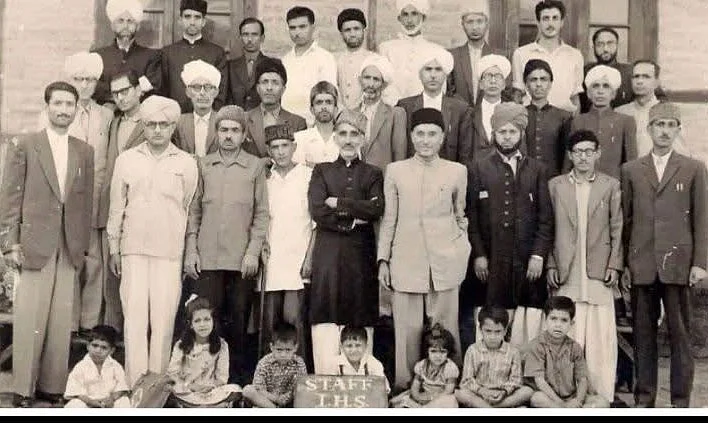
For generations, classrooms across the Valley reflected the finest traditions of a shared society. Many Kashmiri Pandit teachers taught predominantly Muslim students. Likewise, countless Muslim teachers shaped the lives of Kashmiri Pandit children with equal affection and commitment. These classrooms did not produce only examination results. They produced character. They nurtured trust, curiosity, discipline and mutual respect. The students later became doctors, engineers, teachers, civil servants, entrepreneurs and artisans. More importantly, they grew into adults who carried the values of those classrooms into their own homes, where they passed those stories to their children and grandchildren.
This inheritance continues quietly, often away from public attention.
For me, a Muslim student who continues to remember his Kashmiri Pandit teacher with affection decades later is a moving tale. I have heard a number of such stories preserved in Kashmiri Pandit homes about Muslim neighbours, teachers and friends whose kindness remains inseparable from their memories of Kashmir. These stories are part of the lived experience of generations.
These are important stories in our time. We all know when conversations shift from individuals to communities, the language often changes. Identity begins to overshadow humanity. The individual disappears behind the collective. The warmth of memory is replaced by the coldness of accusation.

None of this is to deny the immense suffering that Kashmir has endured. Pain cannot be wished away. Displacement cannot be ignored. Loss, fear, betrayal and grief have left deep wounds across communities. Those wounds deserve acknowledgement, empathy and justice. But pain, however legitimate, should never become a permanent prison from which future generations are expected to inherit only bitterness.
The ordinary Kashmiri is occupied with raising a family, educating their children, earning an honest livelihood and hoping for a future that is better than the past. There is another truth we often hesitate to acknowledge. I may disagree deeply with my friend Arif who may harbour genuine disappointments about me. But neither me nor Arif has the luxury of imagining a future without the other. Our destinies remain inseparable.
The Jhelum does not distinguish between those who stand upon its banks. The Chinars offer shade without asking a traveller’s faith. The mountains that surround us have watched generations come and go, reminding us that identities rooted in coexistence endure longer than identities built upon exclusion.

Joo understood this instinctively. He planted trees for people he would never know. He taught children without asking who they were. He invested in a tomorrow that did not belong to him. Many of those children today are grandparents themselves. They still narrate stories of “Iron Piece” to their own grandchildren, not only because he was a good mathematics teacher but also because he was a man in love with humanity and nature. His classroom’s lessons continue to travel from one generation to another.
If these words happen to reach anyone from Joo’s family, or anyone who knew him personally, they should know this: his students remember him. They remember his discipline, his compassion and his quiet belief that a meaningful life is measured not by what one consumes but by what one leaves behind for others.
Few teachers are granted such a legacy. Joo was one of them. Perhaps somewhere along those old roads, some of the trees he planted still stand, offering shade and fruit to strangers who know nothing of the man who placed them there.
(Mohit Bhan is spokesperson PDP & General Secretary [Organistaion] Youth PDP)