Tales Of A Club
- Founded in 1983 as Lajong Sports Social and Cultural Club to promote football in Shillong
- Started dominating local football eight years ago
- With local players, beat top national teams in 2006
- Qualified for I League this year
- Won two, lost two and drew three of their seven games. Currently ranked 9th among 14 teams.
- Registered over 2,000 members in two weeks for a modest fee
- Larsing Ming Saywan took over the operations from his father in 1999, has engineered its rise
***
On match day, they start trickling into the stadium more than three hours before the start of play. Young men, of course, and also older men, and teenagers and children. Most astonishing to see, though, are the many women, usually invisible in Indian sports—from little girls to old women. There are women holding babies, one or two with babies tied on their backs with colourful shawls. There are people outside the ground, unable to procure a ticket; there are people perched on trees or roofs of houses on the hills near the stadium, ready for the action.
All this isn’t for cricket. It’s for football. Though not unknown in the past, such feverish enthusiasm for the beautiful game has all but disappeared in the ‘mainland’. But it flourishes in this northeastern capital where, combined with reasons political and geographical, it’s producing astonishing scenes of football mania. A local team, Shillong Lajong Football Club, has qualified for Indian football’s elite I League for the first time. Besides foreign recruits, it has players from Meghalaya, Manipur, Mizoram, Arunachal Pradesh, Assam. A Nepali recruit has widened the fan base.



Red barons: Lajong players take the field to a tumultuous applause at home
Players from the Northeast have always been on the national scene; the current I League champion, Churchill Brothers, has six. Several people in Shillong remind me that the man who led the first Indian team at the 1948 London Olympics was Dr Talimeran Ao from Nagaland. Yet, strangely enough, no team from the Northeast had made it to the top level in Indian football.
Now, they have Shillong Lajong. The club itself was conceived to appeal to the local sentiment, to tap into their passion for football. Lajong means “our own” in Khasi. Its slogan: ‘One team, one passion, one colour’. The colour is red, and on match day, the incarnadine-splashed stands heave in anticipation. The unbridled passion has had a salutary effect—it’s unifying people from different tribes and ethnic backgrounds.
Near the football stadium, on the empty field, rest three young cricketers after nets; they are non-tribals, they carry the anxiety of the outsider. Born in Shillong to non-tribal parents, witness to the difficulties of mingling with the local populace from their childhood, they insist change is upon them. Two years ago, Amit Paul, a Shillong resident and a “non-tribal plainsman”, came close to winning the Indian Idol contest, uniting different ethnic groups. “He made a massive difference,” one of the boys says. “Earlier, if we as much as accidentally brushed against a Khasi lad, there could be serious fights. But Paul did what Gandhi would have found difficult to do.”
Khasi, Jaintia and Garo are the chief indigenous tribes in Meghalaya. It’s a matrilineal society, explaining why women here are more independent, and also their large numbers in the stadium. The plainsmen can’t buy land, and the local people have accused them of marrying tribal girls to acquire land in their wives’ names. There has been friction with the “outsiders”, at times erupting into riots, most recently in the 1990s.
The balm of football has soothed the festering sores of ethnic tension. Andrew Suting, born to a Bengali father and Khasi mother, says he had trouble in assimilating with schoolmates who were merciless in their taunts. “There were political reasons behind those problems, going right back to the time when the hill regions signed the instrument of accession after Independence,” Suting, who now works for Lajong, says. “Now it’s changed, because young people are freer of prejudice. This is reflected in shared pleasure from music and football, the two passions of the Northeast.”
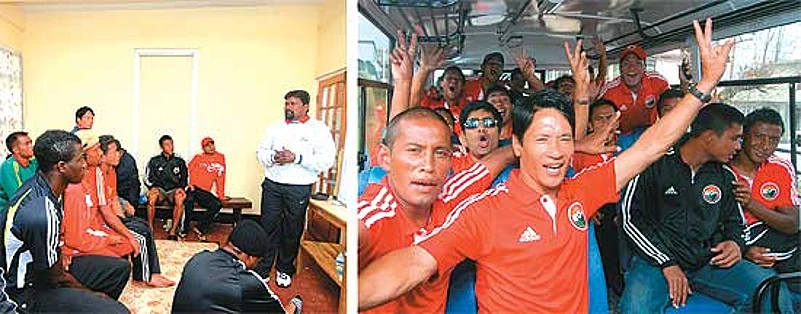
On their mark: Left, coach Stanley Rosario with players; right, scene in the team bus
It’s difficult to tell whether the changed context threw up the Paul and Lajong phenomena, or vice versa. But when different ethnic groups cast aside inherited prejudices and come together to cheer a football team, the buzz can be heard from afar. In the supercharged atmosphere of the stadium, the ‘outsider’ finds his fear of the indigenous unfounded; and the indigene in turn discovers his suspicion of the outsider’s cultural or political loyalty unsubstantial.
Take Amit Pradhan, 19. As he waits for his girlfriend to reach the ground, he says different communities are realising that they need not be adversaries. Now no one really cares if a tribal boy or girl is dating a non-tribal. His own girlfriend is Khasi. “Football seems to be doing what Paul did,” says Pradhan. “It’s bringing people from different communities closer.” The support for Paul convinced the ‘outsider’ that he’s more than an adopted son; the Lajong club shows the indigene that the outsider considers Shillong, or the Northeast, his home.
Lajong has given people a sense of proud achievement. David R. Syiemlieh, professor of history at Shillong’s North Eastern Hill University, says, “There’s a sense of thrill that Lajong has done so well. And it seems to be a unifying factor socially too.” Dr Syiemlieh says it may be stretching things too far if one tries to seek a region vs mainland theme underlying the Lajong phenomenon.
However, almost everyone Outlook talked with, from children to old women, expressed a sense of alienation from “mainland India”. It seems Lajong has become a channel for expression of regional sentiment. Neglected and confined to the margins, the Northeast can hope to insert itself into the Indian cultural consciousness through Lajong. “I’ve been called Chinese, chinky and all sorts of names in India. They’ve asked me if Shillong is Ceylon!” says Richard Nongrum, who studied in Bangalore. “People here have a sense of alienation and injustice. Most Indians are racist.”
Their answer to this perceived racism is to root for the team playing against the best from other parts of India. Fervour for Lajong has transcended Shillong; fans travel from neighbouring regions and even states to support the team. It grips even places in “mainland India” with high concentration of northeastern students. Shillong Lajong FC secretary Larsing Ming Saywan, whose father P.D. Saywan founded the club in 1983, says the perceived alienation isn’t without basis, and has made Lajong a vehicle for regional sentiment. He, however, insists, “It’s a changing scenario, changing demographic. The younger people are more progressive and less prejudiced.”
Their prejudice for football, however, is undeniable, and Lajong is reaping the benefits. The clamour for the Lajong team jersey in Shillong led to a scarcity. Even non-drinkers swarmed into bars that offered free tickets to matches. Nokia, Adidas, Kingfisher and McDowell have come in as sponsors. The stadiums are full, each spectator (other than sponsors and invitees) pays Rs 50 or Rs 100 for a ticket. If you come in early, you get the best seats. Those who possess spare tickets are likely to make some money. “When the match starts, when they hear the shouts inside, people outside would be willing to pay Rs 500 or even more for a Rs 50 ticket!” one man tells me. After the games, the streets close to the ground are clogged with the outgoing traffic.
The performance has been fairly good, too—Lajong have won two of their seven games, losing one to Mohun Bagan after dominating the match. The first objective, says Saywan, is to avoid relegation and retain players. “Our time will come, I’m certain.” But football and integration in the Northeast are ideas which already seem to have a breathing presence.