



Neha Bora questioned whether Section 163 would be enforced against police personnel protesting outside Delhi Police headquarters.
The gathering followed the transfer of ACP Manasvi Vashishta and Inspector Arun Kumar after a clash between police and lawyers at Shahdara police station.
Section 163 allows authorities to restrict activity in a specified area through a written order; its terms determine whether a gathering needs prior permission.
Neha Bora questioned whether Delhi Police take action against its own officers, accusing them of violating the Section 163 after they gathered outside the force's headquarters to protest against the transfers of ACP Manasvi Vashishta and Inspector Arun Kumar.
In a post on X, Bora said the headquarters fell within an area where Section 163 was in force and asked whether police would register a case against the protesters.
"The Delhi Police HQ in New Delhi falls in that area where Section 163 of the BNS is in effect. Will the Delhi Police register an FIR against the Delhi Police who are angry with the Delhi Police? The signs of your crumbling system are everywhere," she said.

Police Personnel Protest Against Transfers
The protest followed the transfer of ACP Manasvi Vashishta and Inspector Arun Kumar, the former station house officer of Shahdara police station. The transfers came after a lawyer was allegedly seriously injured in a scuffle at the police station on October 23. Delhi lawyers had launched a strike over the incident before calling it off after the transfers.

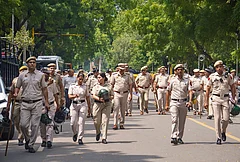


Around 100 police personnel gathered outside the headquarters, seeking the reinstatement of the two officers, according to PTI.

What Section 163 Says
Section 163 replaced Section 144 of the Code of Criminal Procedure. It allows a District Magistrate, Sub-Divisional Magistrate or another specially empowered Executive Magistrate to issue a written order in urgent cases involving a nuisance or apprehended danger. The order can direct an individual or the public in a specified area to stop an act or take a particular action to prevent risks to people, public safety or public tranquillity. In an emergency, it can be issued without advance notice.
Section 163 does not automatically prohibit every gathering of five or more people. The restrictions depend on the terms and geographic scope of the specific order. An order reported in force across New Delhi district prohibited assemblies of five or more, processions, demonstrations, picketing and dharnas without prior written permission.

Do Restrictions Apply To Police Personnel?
Section 163 allows an order to apply to “any person” or to the public in a specified area. It does not provide a general exemption for police personnel. If police officers gather in an area covered by an order, the restrictions depend on the order’s terms and whether the gathering had the required permission.
The law also allows orders to prevent obstruction or injury to people lawfully performing their duties. That provision does not, by itself, exempt police personnel taking part in a protest.
What Can Follow A Violation?
Section 223 of the Bharatiya Nyaya Sanhita sets out penalties for knowingly disobeying a lawful order issued by a public servant. Depending on the consequences, the punishment can be up to six months’ simple imprisonment, a fine of up to ₹2,500, or both. If the disobedience causes or risks danger to life, health or safety, or a riot or affray, the maximum rises to one year’s imprisonment, a fine of up to ₹5,000, or both.
A Section 163 order ordinarily remains in force for up to two months. The state government may extend it for up to six months, subject to the conditions in the law.















