Padmaavat co-writer Prakash Kapadia defended the film's climax, stating the jauhar sequence accurately reflected historical reality and rigorous research.
This comes after Swara Bhasker revisited her objections to the scene.
Bhasker specifically criticised a shot featuring a pregnant woman participating in jauhar, reaffirming her stance from her 2018 open letter to Sanjay Leela Bhansali.
Sanjay Leela Bhansali's 2018 film Padmaavat has ignited debate again. Actor Swara Bhasker termed the period drama's jauhar sequence “problematic”, prompting co-writer Prakash Kapadia to justify the depiction as the “reality of those times”. The film starred featured Deepika Padukone, Ranveer Singh and Shahid Kapoor in lead roles.
Jauhar, or the collective self-immolation of women in medieval India to avoid capture by an invading army, sits at the centre of the renewed debate. Bhasker raised the issue at a recent Delhi event while Kapadia responded in an interview with Hindustan Times.

Prakash Kapadia defends Jauhar scene
Kapadia said that they made the film according to their research and what is written in history books and very person interprets the film differently. “What we showed, including the jauhar scene, was the reality of those times; it cannot be changed now. The situation was that of ‘do or die’,” he said.


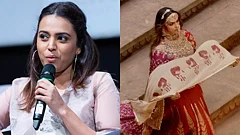
Defending the scene, he also said that the criticism sparked by Bhasker’s remarks was unnecessary. “It depends on the person’s mood; even if it’s a good film and you watch it with a bad state of mind, you will find it bekaar (worthless). It’s also about intention; whether you are going as a viewer, or watching it to find something controversial, or to find negativity…,” he added.
He further said that with Padmaavat, “people had raised objections even before watching the film and had protested on the streets. The same conversation is continuing years later, so what can I say? Let people say what they want to.”

About Swara Bhasker jauhar controversy
Bhasker said the scene troubled her because of the message she felt it sent to rape survivors.
Recently, she attended an event organised by the India International Centre in Delhi, where she revisited the backlash around the open letter she wrote to Bhansali after seeing Padmaavat. At the event, Bhasker said, “I’m watching this, these 800 women committing jauhar, and I was like, yaar, if I had been, God forbid, if I was a rape survivor, what is this film telling me? I would feel like a coward, that I didn’t kill myself to save my honour. Is that what you want to tell in a society like ours, where I feel like there’s anyway a rape epidemic? Is this what we want to tell our survivors, that you didn’t deserve to live? That if you actually had been honourable and brave women, you would have killed yourself. Are we saying that rape is the end of a woman’s life?”
She also objected to one close-up in the sequence and said "chiii". “There is a close-up of a pregnant woman’s belly. And she is going, so you’re saying that a foetus that might be female doesn’t deserve to be born, because she might be raped by a Muslim ruler? And then I came out and I was like this is terrible. And normally people think that I do these things out of rage. But I waited for five days. And I was like, let me check if I still feel like this. And then at the end of five days, I wrote this letter,” Bhasker said.