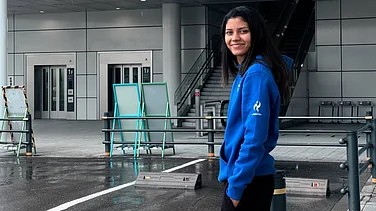
Teqball is one of the new sport introduced at Asian Games 2026 and Quimcy D'Souza is one of India's athletes participating in it
D'Souza has transitioned from state level football player to teqball only four year ago
In her first Asian Games, she made it to the women's singles semi-final, losing to Indonesia's Sumaya
Despite the faux pas at the Opening Ceremony, the Asian Games 2026 in Aichi-Nagoya are moving ahead full steam ahead. Fans across the continent are eager to watch their athletes compete at the highest level and bring home glory. For Indian supporters, one athlete to watch could be Quimcy D’Souza, who has the opportunity to win the country's first-ever medal in Teqball at the Games.
With six new sports added to the Asian Games programme this year, including Teqball, India has more medal opportunities than ever before.
While the sport is still relatively new in the country, football fans are already familiar with it, having watched global stars such as Ronaldinho showcase incredible skills on the curved Teqball table and capture the imagination of audiences worldwide.
D’Souza was one of those fans. Watching Ronaldinho perform tricks and flicks on the table left her fascinated by the sport. That curiosity eventually led her to try Teqball for herself, and from the very first session, she knew she had found something special.



D’Souza Felt a Personal Connection With the Game
Quimcy's journey into Teqball may have been unexpected, but her success in the sport is hardly surprising. Before discovering Teqball, she was already an accomplished athlete, representing Maharashtra in football and competing at the state level as a runner.
During her recovery from a serious ligament injury suffered on the football field, D’Souza came across Teqball on social media.
Intrigued by what she saw, she gave the sport a try and instantly fell in love with it. More importantly, she felt a unique connection with the game, almost as though it had found her at the perfect moment in her life.
"From day one, I fell in love with the sport. I've not mentioned it to anyone, but Teqball's logo, the 'Q', is what I feel is Quimcy, so I feel this sport is for me."
She began playing in Mumbai players who shared her passion. However, her ambitions soon grew beyond casual participation. Determined to improve and compete at the highest level, she moved to Bengaluru, where she balanced her sporting aspirations with her job as a sports engineer at Decathlon.

Her Bengaluru Move Was About More Than Just a Job
D’Souza firmly believed that others would fall in love with Teqball just as she had if they were allowed to experience it. Her move to Bengaluru was therefore about more than advancing her own career or training opportunities.
While continuing to refine her skills, she also worked to expand the sport's presence in India. Recognising the need for an organised platform for aspiring players, she founded the Teqball Club of Bengaluru, helping introduce the game to new audiences and providing young athletes with opportunities to train and compete.
Her contributions have had an impact both as a player and as a pioneer for the sport. She has already established herself as India's dominant Teqball player, winning seven national titles.
Her Background in Football Gave Her an Advantage, But the Game Needed More Than That From Her
Being a football player, Teqball came naturally to her. Given the sport prohibits the use of hands and arms much like football, she found it to her advantage, though she found it would take more than her skills on the field to master this new sport she has ventured into.
While her skills on the field helped her get a head start, Quimcy found that she needed a lot of patience to master it. Most athletes give up the sport before they can turn pro because they find it hard to be at it because of financial constraints.
Therefore, she knew she had to keep at it even when things might seem hard, and her pursuit would demand sacrifices from her.
“Slightly an advantage for footballers because you do not use your hands, so you automatically start using your legs. But for the last four years we have not been funded. We work full-time and save that money for tournaments.”
Her Persistence and Hard-Work Paid Off
Years of hard work, sacrifices, and self-funding ultimately led D’Souza to the biggest stage of her career. For the first time, she did not have to worry about arranging resources or finding ways to fund her participation, as the Indian Olympic Association and the federation took care of the expenses.
The experience was both rewarding and emotional for an athlete who had spent years building her career in a niche sport with limited support.
"For this time, when everything was sponsored by the IOA and the team, it is overwhelming to have everything ready for us."
Having discovered Teqball only four years ago, she could never have imagined that the sport would one day take her to the Asian Games and give her the chance to represent India on a continental stage.
Quimcy Competing at the Asian Games Represents Something Bigger Than Herself
When D’Souza first picked up a Teqball ball, her goal was simple: to compete at the highest level possible. Now that she has achieved that dream, she understands that her presence at the Asian Games is about more than personal success.
As one of India's leading Teqball athletes, she is carrying the hopes of countless young players who dream of following the same path.
For D’Souza, simply competing at the Games is a statement about how far Teqball has come in India and how much potential the sport still has to grow.
"I've dreamt about this day. Playing on such a big platform gives immense pleasure not just to me but to all the Indian players who are here and to the dreams we are carrying for Teqball players back in India. If you are here, it's a big thing. I just want India to know that I gave it my best and I want India to know what Teqball is."
She Gave Her All, But It Wasn't Her Day
Making her Asian Games debut, D’Souza came agonisingly close to reaching the women's singles final. Facing Indonesia's Sumaya in the semifinals, the Indian started brightly and even took the lead before her opponent mounted a comeback.
Drawing on her background in sepak takraw, Sumaya recovered strongly to claim a 2-1 victory, ending D’Souza's hopes of competing for gold.
Despite the defeat, D’Souza refused to dwell on the result. Instead, she chose to focus on the positives and accept that sport can sometimes be decided by the smallest of margins.
"I wouldn't say something went wrong today. Sometimes this game is about luck, sometimes it's about hard work. Sometimes your smashes land, sometimes they don't go the way you want them to. Not every ball is the same and not everything you do will work out similarly."
Rather than allowing disappointment to overshadow her achievement, D’Souza remains focused on the opportunities that still lie ahead. She will face Japan's Yuina Sakamoto in the bronze medal match, giving her another chance to make history for India.
The Maharashtra athlete is also still in contention for a medal in the mixed doubles event, where she has teamed up with Mohammad Anas Imran.
With two bronze medal matches on the horizon, D’Souza's Asian Games journey is far from over, and she still has the opportunity to cap off a remarkable story with a place on the podium.
(Using PTI Inputs)