Bench led by Chief Justice of India Surya Kant said the State, not the court, must तय the national sentiments linked to Vande Mataram
Court agreed to examine whether the 2026 amendment can trigger criminal prosecution for conscientious objectors
TM Krishna has challenged the constitutional validity of the amendment and Home Ministry directions on the six-stanza version
On Tuesday, the Supreme Court declined to decide whether Vande Mataram should be recognised as the National Song or whether its official version should contain two stanzas or six. It said elected governments must तय the choice of national symbols and the sentiments tied to them, but it will examine whether that recognition can lead to criminal consequences for a citizen who, for reasons of conscience or religion, does not sing it.
A bench of Chief Justice of India Surya Kant and justices Joymalya Bagchi and V Mohana said its scrutiny would focus on the penal effect of the 2026 amendment to the Prevention of Insults to National Honour Act. The amendment extended criminal protection under Section 3 to the “National Song” alongside the National Anthem.
Hindustan Times reported that the court made clear it would not decide either the status of Vande Mataram as the National Song or the question of how many stanzas should be officially sung. It will, however, examine whether that recognition can bring criminal consequences for those who choose not to sing it.



Penal Consequences Scrutinized
The bench narrowed the issue sharply. “Nobody who feels an infraction of Article 25, 26 rights would be subjected to penal consequences,” the bench stated.
It added: “for a conscientious objector, not to recite one or all the stanzas of the national song is not going to subject himself to criminal prosecution.” The court indicated that the principle laid down in Bijoe Emmanuel Vs State of Kerala (1986) would continue to govern the field.
That ruling matters here. In Bijoe Emmanuel, three Jehovah’s Witness schoolchildren refused to sing the National Anthem because of their religious beliefs, but stood respectfully when it was played. The Supreme Court then held that their refusal did not amount to disrespect and could not justify expulsion. The present bench indicated that the same distinction between respect for a national symbol and compelled participation could apply to the amended law covering Vande Mataram.
Krishna’s Challenge
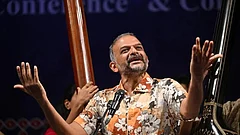
The petition was filed by Carnatic vocalist, author and Ramon Magsaysay Award recipient TM Krishna. He has challenged both the constitutional validity of the amendment and the Ministry of Home Affairs directions that prescribe the full six-stanza version of Vande Mataram for specified governmental, ceremonial and cultural occasions.
The amendment replaced Section 3 of the 1971 Act. The amended provision says anyone who intentionally prevents the singing of the National Anthem or National Song, or causes disturbance to an assembly engaged in such singing, can be punished with up to three years in prison, or fine, or both.
Krishna’s petition alleges violations of fundamental rights linked to equality, religious freedom, free speech and protection against discrimination. It argues that the six-stanza version contains portions that expressly invoke Hindu deities. The petition says the last four stanzas refer to Durga, Lakshmi and Saraswati, and argues that compulsory rendition would violate freedom of conscience and religion and have a disparate impact on non-Hindu citizens.
The challenge also attacks the legal basis of the Home Ministry’s directions. Krishna argues that the directions are executive instructions without an independent statutory basis and that an office memorandum cannot by itself create criminal liability or restrict fundamental rights. The petition says the State action also breaches the constitutional guarantee of secularism.
Court Draws Line
The bench separated two issues. “It is not the remit of the court to second-guess what are the national sentiments and aspirations associated with Vande Mataram. It is for the State,” the bench said.
It then drew the constitutional limit. “To the extent of penal consequences the Act provides, (that) can be gone into,” the bench said. It added, “in a democracy, State is best placed to give aspiration to the national song. But no conscientious objector can be subjected to penal consequences.”
The judges also refused to turn the case into a religious inquiry. “From the very beginning of this hearing, we have said we are examining no religion. We are confining only to the legal issue under the Constitution,” it said.
The bench noted that “by customs and usage, the National Song has always been mentioned and understood as Vande Mataram”. That came after senior advocate S Muralidhar, appearing for Krishna, argued that the amendment inserted the term “National Song” into a penal law without defining what it meant or which version of Vande Mataram it covered.
Muralidhar also argued that the Home Ministry’s directions prescribing all six stanzas could not become the basis for criminal prosecution. “So for the first time, after almost 80 years, they are trying to tell us it’s not two stanzas,” submitted Muralidhar. The bench did not accept that it should settle the content of national sentiment and observed, “Perhaps this stage is the best to articulate national aspirations”.
Hearing Ends
The hearing also saw a separate clash in court. Muralidhar and Solicitor General Tushar Mehta sparred after Mehta referred to “Naxalites” while defending Parliament’s legislative authority.
Muralidhar objected and sought withdrawal of the remark, saying it was not appropriate for a law officer to use such language during a live hearing. The exchange then widened into a discussion on constitutional institutions and extra-constitutional methods.
The bench stressed that constitutional courts remain institutions where even people accused of serious offences retain legal rights. It then directed that the petition be furnished to the solicitor general and gave the Centre two weeks to file its response. The matter will be taken up further after that.