



Baba Ramdev criticised Dhirendra Krishna Shastri in Jamshedpur, calling him a pakhandi (hypocrite).
The remarks came days after both shared a stage at the widely publicised Kunda Ram Katha in Uttar Pradesh.
The public exchange has drawn political attention, given their association with the BJP's wider religious and cultural network.
A public clash between yoga guru Baba Ramdev and Bageshwar Dham head Dhirendra Krishna Shastri has widened into a political controversy after a viral clip purportedly showed the latter comparing Lord Ram and Lord Krishna. The remarks drew criticism and demands for an apology, turning a religious dispute into a political flashpoint.
The clip, attributed to Shastri, showed him describing Lord Ram as seedhe and Lord Krishna as tedhe-medhe, an apparent reference to Krishna's tribhanga posture. The remarks were made during an earlier katha. Shastri later apologised, describing them as an “emotional outburst”, while reiterating that he was a devotee of Krishna.
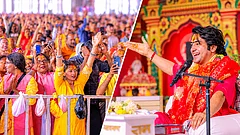
Ramdev publicly criticised Shastri despite having shared a stage with him days earlier at the much-publicised Kunda Ram Katha in Uttar Pradesh. Speaking in Jamshedpur, Ramdev called him a pakhandi (hypocrite). The exchange has since drawn political attention, as both figures are seen as part of the BJP's wider religious and cultural network.



What Did Ramdev Say?
Ramdev's initial response was sharp. Speaking in Jamshedpur, he criticised Shastri over the comparison between the two deities and questioned how such remarks could be made.
“Those who made comparisons between Gods and Goddesses — 'Ram mahan hain, Krishna toh tedhe-medhe hain' — later apologised and bowed before Banke Bihari. What did they say later? 'Krishna toh tedhe hi hain.' You have lost it. Pakhandi (hypocrite),” Ramdev said.
He followed this with a warning on religious conduct. “There is decorum, discipline and protocol for everything,” he said.
A day later, however, Ramdev softened his stand. At a press conference in Haridwar on November 24, he said he had spoken to Shastri on November 23 and described his criticism as an act of discipline rather than a rupture in their relationship.
“Bageshwar Baba is like a child in front of me. He is also like my younger brother and disciple. Therefore, the things that seemed inappropriate to me and caused me pain, I reprimanded him with my authority. He too accepted my scolding as love. This is also his greatness,” Ramdev said.
He also linked the issue to the wider image of Sanatan Dharma, saying, “Sanatan Dharma is divine. Sanatan Dharma is scientific. The values of Sanatan Dharma are very high.”

How Did Shastri Respond?
Shastri chose not to escalate the dispute. Speaking during a katha in Pathankot, he played down Ramdev's criticism and described it as affection from an elder.
“Ramdev ji is very simple. He is a great man. He is our own. There is great joy between both of us. If something was in his mind, he gave a blessing. This too is a blessing. A good blessing,” he said.
He further described their relationship as one built on respect and affection. “I am happy with both. He is a revered swami. He is a guru. He can say whatever he wants with love,” Shastri said.
In another statement, Shastri described Ramdev as a mahapurush and said he regarded him as a guardian. “We accept his criticism as well as his praise. We cannot have any feeling of disregard towards saints. We aim to unite Hindu society, not to divide it,” he said.
Political Overtones
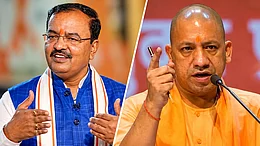
The row quickly drew political attention. The Kunda gathering itself had attracted considerable interest, with prominent Rajput leaders and political figures in attendance. Ramdev's presence alongside Shastri was also seen as a sign of the latter's growing reach among influential religious and political circles.
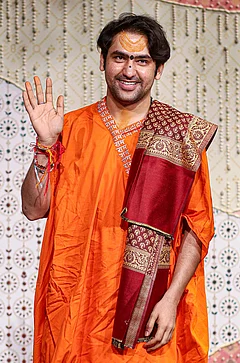
Opposition leaders criticised Shastri's remarks about Lord Krishna. Shastri, 30, is the head priest of Bageshwar Dham in Chhatarpur, Madhya Pradesh, and is popularly known as “Bageshwar Baba”. He has gained considerable popularity in India and abroad through his religious discourses, or kathas, claims of supernatural insight through what is popularly known as parcha writing, and his public speaking style.
Ramdev, a widely known yoga guru and considerably older than Shastri, has built his own mass following through yoga camps and the Patanjali business empire.
Their links with the BJP have added another layer to the controversy. Ramdev campaigned against corruption and the Congress-led UPA before the 2014 Lok Sabha elections and later backed the BJP and Prime Minister Narendra Modi. Modi has publicly referred to Shastri as his “brother”.
The Opposition also joined the debate. Samajwadi Party chief Akhilesh Yadav took a swipe at the exchange and used it to target the political establishment. He posted a tweet reading “Anulom-Vilom” on November 23.
His party had earlier opposed Shastri's katha in Uttar Pradesh over his reported remarks on Lord Krishna. The Yadav community, also referred to as Yaduvanshis, traces its lineage to Lord Krishna.
The timing has added to the political significance of the dispute. The BJP is seeking to make the proposed grand temple at Krishna Janmabhoomi in Mathura a prominent part of its political messaging ahead of the 2027 Uttar Pradesh Assembly elections.








