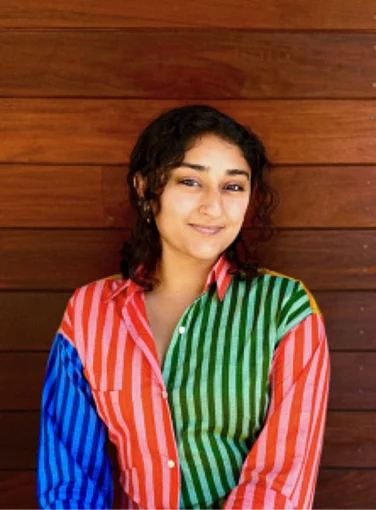
Vaishnavi Upadhyay is a Los Angeles-based film editor with expertise in both cinema and contemporary visual culture. Her films have travelled widely across the international festival circuit– including Oscar- and BAFTA-qualifying festivals– while her work across fashion, beauty, music, and commercial storytelling has continued to expand the vocabulary of her craft.
Q. What first drew you towards editing as a career?
Vaishnavi Upadhyay: Like many editors in our field, I did not always know that I wanted to be an editor. I come from an academic background, and I was first introduced to the craft through the magic of documentaries. It was there that I began to realise that meaning is not always inherent to an image, but can emerge from the relationship between images—and that an editor’s role is in shaping that relationship.
I’ve learned it’s far more open-ended than simply putting pieces of a film together. A puzzle suggests that there is one correct outcome, but editing holds endless possibilities. The same images can be assembled in entirely different ways to evoke entirely different meanings, emotions, and experiences in a viewer. That possibility is what I find so exhilarating about the craft.
Q. You pursued an MFA in Editing at the American Film Institute Conservatory. What did your time at AFI teach you about the craft?
Vaishnavi Upadhyay: The time I spent at the AFI was incredibly formative. It was a period in which I could completely immerse myself and spend long hours in the edit bay, experimenting, failing, discovering, and slowly learning to trust my instincts.


AFI taught me that filmmaking can never really exist in a vacuum. I was fortunate to learn alongside some remarkable veteran editors and filmmakers who challenged me and helped me find my own voice.
Being selected as the only editing fellow among eight graduates to represent AFI at the Telluride Film Festival’s FilmLAB in 2025 was another deeply meaningful part of that journey. To spend that time immersed in cinema, surrounded by filmmakers whose work I admired, and to be able to exchange ideas and talk about the films we love was an experience I’ll never forget.

Q. Your projects have appeared at several international film festivals. How does festival exposure influence an editor’s perspective?
Vaishnavi Upadhyay: An editor holds the responsibility of being the film’s first audience. As we spend the most time with the raw footage, we must gauge how a shot or performance makes us feel, and build the edit from there.
Having my films travel widely through the festival circuit has only deepened that belief. There is something incredibly special about sharing a labour of love with an audience– and Moti was particularly meaningful in that regard. The film travelled to more than 45 festivals internationally, and it was astonishing to sit in theatres across different parts of the world and watch audiences respond to moments we had carefully shaped in the edit. It was a beautiful reminder that, when an emotional truth is genuine, it can travel much farther than the film itself.
Q. What was your experience editing Moti?
Vaishnavi Upadhyay: Moti was originally conceived as a children’s play for Katkatha Repertory, an educational arts collective in New Delhi. Set during the pandemic, the film explores the absurdity and unpredictability of life, and this quality is what we wanted to preserve. It was an extremely grounding and fruitful experience. The film was in Bengali, a language I didn’t speak, so on the surface, the dialogue was something I couldn’t understand when I first started. But I became so attuned to the footage that, after working on it meticulously, I could eventually recite the dialogue by heart.
Moti required a great deal of patience, as the initial film had several loose threads that we were able to weave together in the edit. The film never truly had an ending, so the director and I experimented with different versions. What was especially exciting to me was the opportunity to build texture through sound and image. We even incorporated scans from the original play that director Yash Saraf had performed years before the film was made. I also had the opportunity to sound design the film, which gave me greater control over its absurd and fantastical elements.
Q. Does working across film, fashion, beauty and music influence your creative approach?
Vaishnavi Upadhyay: Absolutely. Working across formats keeps the creative process fresh. Each medium needs the editor to bring a new set of sensibilities to the process, but the toolbelt you’ve accumulated remains the same. So it’s not as different as it may seem, because both formats chase the same core: emotional resonance with audiences.
Earlier this year, I was juggling campaigns for big clients like Touchland, M.PH Beauty, AGOLDE, and Buck Mason while also being in post-production on an indie feature. Switching between projects kept me from reaching stagnation. I think exposure to different forms of storytelling makes an editor more adaptable and, hopefully, more thoughtful.
Q. What do you think audiences may not understand about the editor’s role?
Vaishnavi Upadhyay: There is often a misconception that editing is primarily technical and less so creative artistry. I think referring to it as an “invisible” art belittles the amount of creative labour and decision-making that goes into it.
Q. What are you hoping to explore as your career develops?
Vaishnavi Upadhyay: I want to continue working on creatively challenging stories and collaborate with filmmakers who have distinctive points of view. I’m currently working on both commercial and narrative projects, and have recently delivered a feature film and a documentary that is set to release later this year. I’m also enjoying festival runs for the films I worked on earlier this year, including Wellness and In Our Wake, which are set to premiere at the Tasveer Film Festival in October.